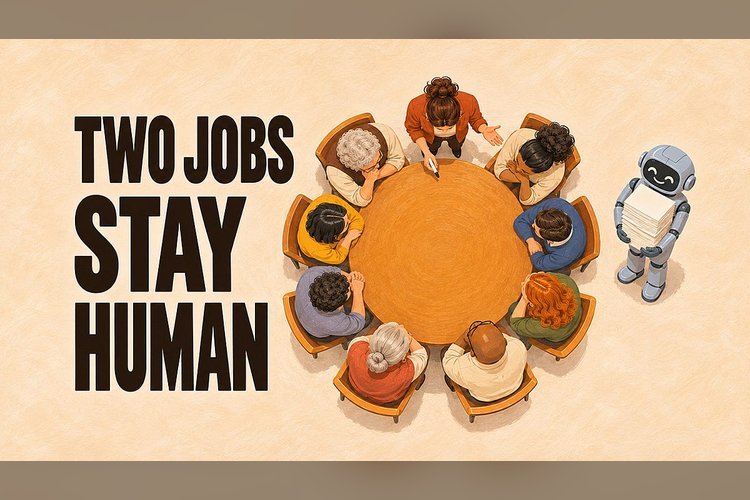
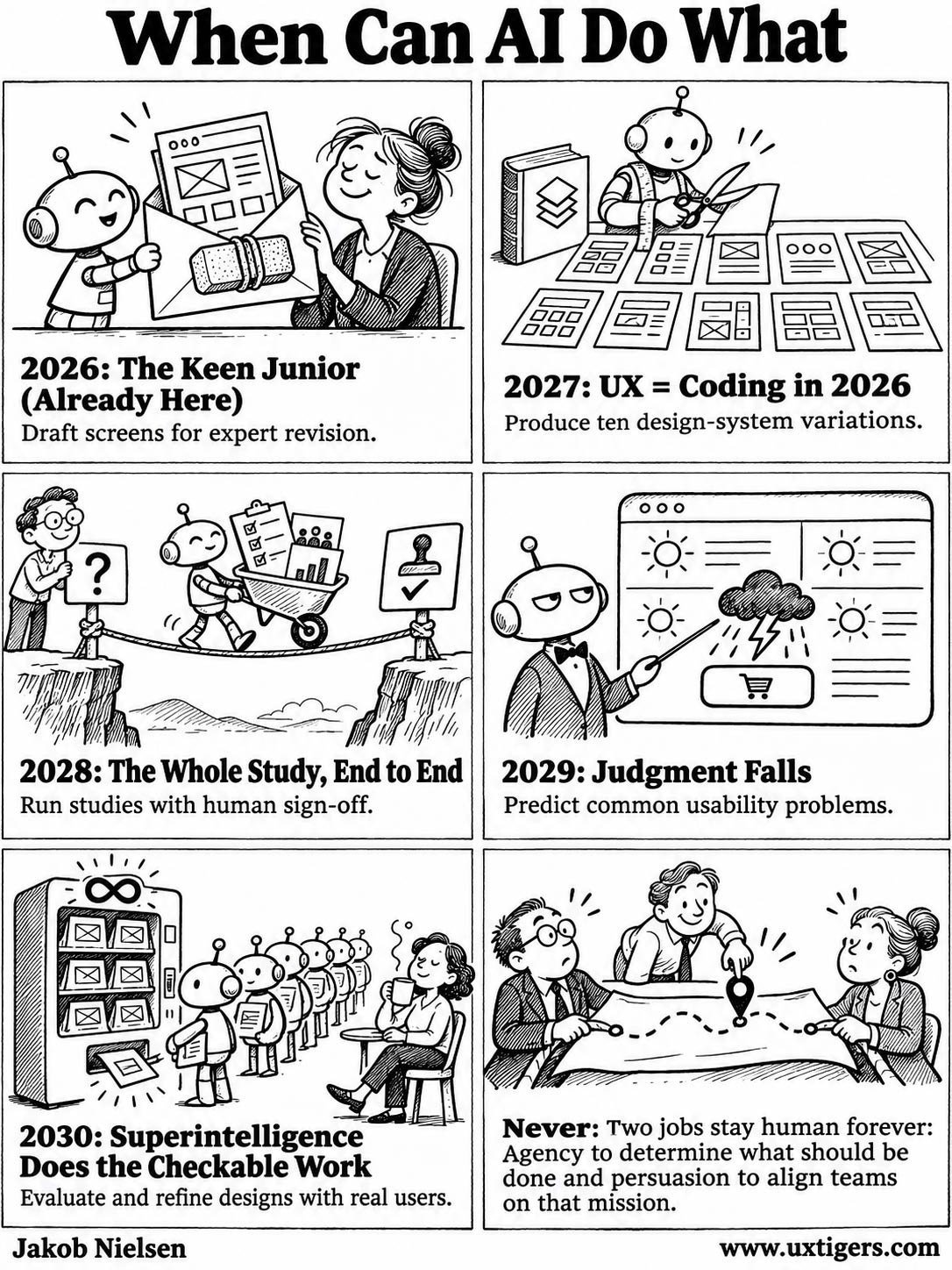
AI UX tasks fall into a clear order, and the order follows how cheaply a result can be checked. A new forecast, graded against 13 months of evidence, says hard-to-verify work improves as fast as easy work. It just starts later, and by 2030 AI is expected to beat humans at every UX task with a checkable result.
That would leave people two jobs: deciding what is worth doing and aligning the team around it.
How last year’s predictions scored
The forecast checks five predictions from October 2025 and counts four as right, though partly for the wrong reason.
- Interviews and survey analysis, fast: right. In a pre-registered study of 139 AI-moderated interviews against 24 run by professional moderators, AI matched humans on depth, covered more themes and cost about 20% as much per interview. Coding 903 open-ended answers, GPT-5.4 reached adjusted Rand scores of 0.61 for codes and 0.54 for themes against five human coders. AI moderators talk too much, though: participants got 34% of the talk time versus 64% with a human.
- Spotting usability problems, fast to medium: right. Two AI models each caught 3 of the 4 problems an expert found in one session, and one added 6 false alarms. One session is a tiny sample.
- Design synthesis: wrong. Design arrived first. Top models met 99% of the criteria in 160 briefs against 98% for human designers, a result from a vendor with products to sell. But the AI designs looked alike, scoring 0.58 for distinctiveness against 0.90 for humans.
- Heuristic evaluation, medium to slow: right. GPT-5.4’s agreement with experts on 12 web interfaces was a Cohen’s kappa of 0.19, which counts as slight.
- Simulated users, slow: right. Four language models used as synthetic respondents inflated differences between customer segments by a factor of 2 to 4 and none beat the best statistical baseline.
Baymard’s UX-Ray now checks 346 e-commerce heuristics and agrees with human auditors 95% of the time, but generative AI judges nothing there. Models only classify the UI pattern, and the verdicts rest on 8 years of human work mapping more than 8,000 components to research.
Why verification sets the schedule
Models improve fastest where an automatic grader can mark attempts. Code compiles or it doesn’t, and tests pass in seconds. UX has no compiler: a usability verdict takes 5 users and several days, and a strategy verdict can take a year.
METR’s Q4 2026 update puts the doubling time of AI’s task horizon at 3.6 months. For tasks that cost more to set up and score, the horizon is 2.9 times shorter, about 1.5 doublings behind, but it grows at the same speed. That is about 5 months. Each further doubling of verification cost adds 4.6 months, and the forecast assumes UX needs one more, so the lag is roughly a year. In short: UX equals coding plus one year.
At 3.6 months per doubling, four years bring 13 doublings, or roughly 10,000 times. Even at the slow end of METR’s range, 4.9 months, the factor is above 800.
The cost flip, and where AI stalls
For 40 years, building interfaces was expensive and evaluating them was cheap. AI reverses that. Generating 10 working designs takes minutes, while checking which one works for humans still takes days. The forecast expects teams to build several divergent candidates first and spend scarce user-testing time choosing among them.
A study of 19 OpenAI and Anthropic models, each making 15 proposals for causal political-science research, shows where verification runs out. GPT-4 beat a renowned political economist’s research designs 9% of the time. Almost every frontier model released since January 2026 beats them, and GPT-6.2 Astra wins 93% of matchups.
On picking important questions, AI hasn’t improved much since 2023. Only Claude Fable 5.1 clearly beats the benchmark, and no OpenAI model tops 50%. Graders agreed 80% of the time on design quality but only 57% on which question mattered more. If experts can’t agree on the target, a model can’t be trained to hit it.

What to plan for
The evidence is thin. It’s a patchwork of one-off studies, some run by vendors, and the benchmark called for in 2025 still doesn’t exist: one design held out of training, judged by at least 10 experts and tested with at least 20 users, then repeated each year. A university lab could build it for the price of a few AI subscriptions.
Until then, the practical bet is on checkable work moving first. Teams hiring or training now should expect design generation and interview analysis to be automated sooner than audits of unfamiliar workflows.
Source: jakobnielsenphd.substack.com