A computer scientist with three unsolved theory problems on the shelf for more than a decade has now seen all three settled, with AI involved each time. The cases show how AI solved open problems in very different ways, and they leave the researcher unsure what is lost when proofs come this fast.
An NP-hardness proof nobody could read
The first problem came out of automated mechanism design work with the researcher’s then PhD advisor, Tuomas Sandholm. A colleague, Ryan O’Donnell, sent over a long AI-generated NP-hardness proof. The researcher couldn’t follow it, yet AI systems judged it correct.
Knowing the answer and perhaps picking up some intuition from the machine proof, the researcher then wrote a much shorter proof by hand. Of the three, this was probably the easiest.
A voting result that held almost everywhere
The second wasn’t a crisply stated open problem. It was a result that was easy to prove in limited settings but seemed to hold far more broadly. It concerns voting theory: a Gibbard-Satterthwaite-style result showing that, in a specific sense, the Borda rule is as strategy-proof as a voting rule can get.
The question was how broad a setting to aim for. A paper led by Emin Berker, with Eden Hartman, Jiayuan Liu, Caspar Oesterheld and the researcher, shows the result holds in about as general a setting as anyone could have hoped. Earlier versions of the paper contained only human-written results. The final and strongest one leaned heavily on AI, and the paper includes an AI usage statement. Berker then worked to turn the proof into one people can actually digest and learn from.
An open call that drew a crowd
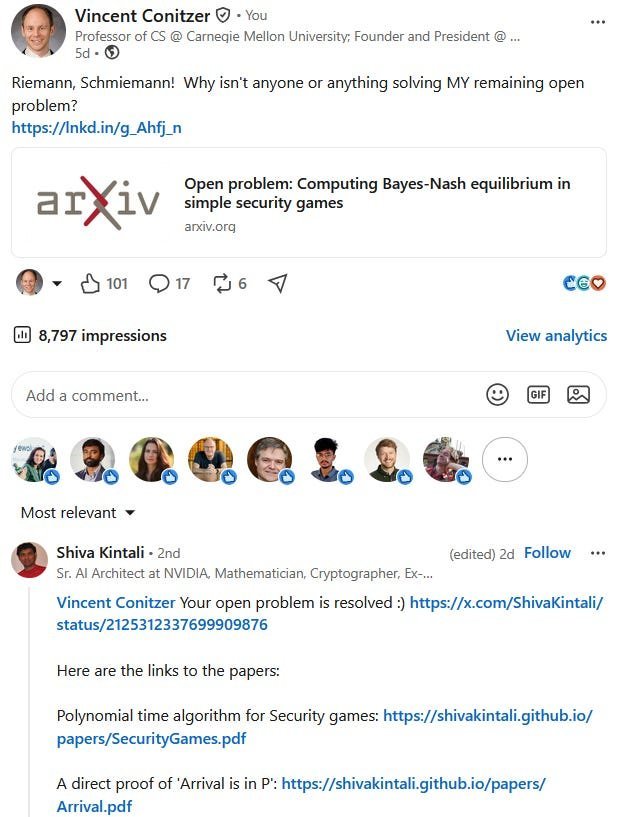
The third problem asks whether, in a certain setting, a game-theoretic equilibrium can be computed in polynomial time. It builds on earlier work with former students Dima Korzhyk and Yuqian Li and collaborator Ron Parr. For a while it held out. Models produced partial results, and a claimed solution from one person didn’t convince the leading AI systems.
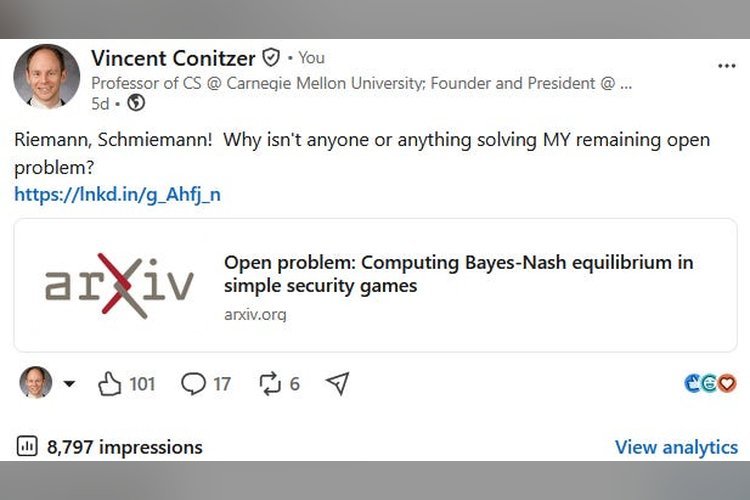
This was where AI solved open problems most publicly. After the excitement over the Riemann hypothesis, the researcher posted a self-mocking line asking why nobody was solving the remaining open problem. It worked. People pointed their own AI tools at it, and the answer came from Shiva Kintali, a senior AI architect at Nvidia with a Georgia Tech PhD in theoretical computer science: yes, it can be done in polynomial time. The researcher says they haven’t yet worked through the proof, though it passes AI checks.
Results then arrived from several directions at once:
- Vincent Lin, a recent Carnegie Mellon CS and math student now working as a software engineer at Amazon, showed that solving the problem in polynomial time would also settle a separate open question called ARRIVAL. His post was an AI-written book on the problem.
- Kintali posted a direct proof for ARRIVAL as well.
- Jeonseong Kim and Chenglin Fan posted another proof of it.
- Other people emailed AI-assisted findings that look only loosely related but possibly even more important. One 30-page draft came from a person who admitted they couldn’t vouch for it.
The usual order would have been to study the easier ARRIVAL problem first. Instead the harder one fell right away and ARRIVAL came with it.
What the researcher worries about
The experience had a friendly, ad hoc community feel. Still, the researcher notes that a problem like this could once have filled an entire PhD and produced deep human understanding. That route now looks closed. The proofs can be studied, but will people do it, or will the field rush on? Kintali, for instance, has 35 preprints this year after almost a decade without publishing.
Several questions follow. Will people still want to understand a result they didn’t find? Will understanding be shallower when nobody struggled through the proof? Could the machine proofs miss versions that come more naturally to humans? Peer review is strained too. Most venues still require human reviewers, submissions are climbing, and reviewers can end up spending longer on a paper than its authors did.
The researcher says these proofs are not yet beyond human understanding. The gap comes from speed and incentives. In a recent paper on recursive self-improvement, they lay out scenarios where results do end up beyond us.
Beyond math
The researcher expects the same pressures to spread outside math and theoretical computer science, adding that in software they already have. For anyone who reviews, publishes or depends on technical work, the near-term test is whether verification and understanding can keep pace with how quickly AI solved open problems like these.
Source: aifails.substack.com