One extra sentence changed what AI shopping agents recommended. In a test by Andreessen Horowitz and The Prompting Company, agents choosing between a Shark FlexStyle and a Dyson Airwrap picked the cheaper Shark in 91% of runs. When the prompt said the buyer would use the device daily, 88% of runs went to Dyson. Products and prices were identical.
Recommendations are now becoming real orders. This week, Walmart began letting shoppers start their Black Friday purchases through Meta’s Muse.
How Walmart and Meta split the job
A shopper tells Muse what they want and pays within the chat. Muse passes the request to Walmart, which selects the products. So the assistant you speak with and the retailer filling the cart can be different companies.
The shopper logs in to Walmart, sets a limit in a Walmart Agent Profile and pays with a card already on file. Walmart’s returns rules apply, and the retailer says the outside agent can’t see the customer’s wider history. Meta gets the start of the trip. Walmart keeps the account, the payment method, product matching and returns. Amazon takes the opposite stance and blocks outside shopping agents.
What the numbers show about AI shopping agents
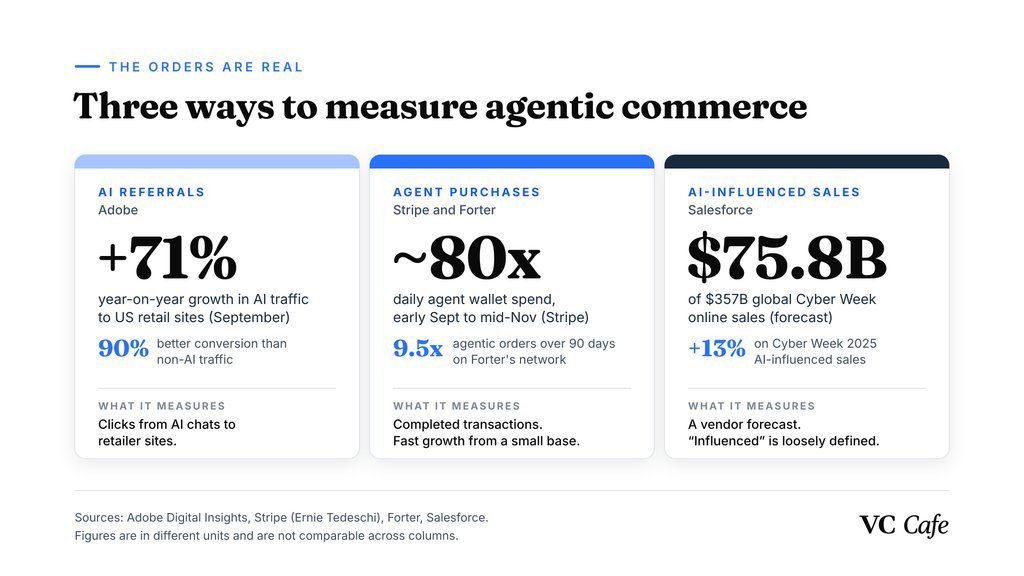
Three kinds of data measure different things:
- Referrals. Adobe reports US retail traffic from AI up 71% in September from a year earlier, converting 90% better than other visits, the widest gap it has recorded. Its holiday outlook is for AI traffic to climb 159% on Thanksgiving and 95% on Black Friday.
- Agent purchases. Stripe economist Ernie Tedeschi shared early figures for Link Agent Wallet, which pays for Muse, Instinct and Grok. By mid-November, daily spend had grown almost 80-fold since early September on a seven-day average, from a tiny base. Over half of first-time agent buyers bought again, typically in the same category.
- Influenced sales. Salesforce expects $75.8 billion of $357 billion in worldwide Cyber Week online sales to be influenced by AI and agents. “Influenced” is a loose term and the figure is a vendor forecast.
Fraud-prevention firm Forter says agentic orders on its network in the 90 days to November 24 ran at 9.5 times the first week, up from 7.8 times earlier. About 70% came from agents that browsed pages, completed forms and used the normal checkout.
No figure here gives agents’ share of all ecommerce. They point the same way, though: discovery has moved to AI and payment is following. Forter’s Galit Shani-Michel compares it with early mobile shopping, when people squeezed desktop sites onto phones before merchants built mobile versions.
How a brand makes the shortlist
The a16z study ran four personal agents through 1,270 prompts and 11,307 completed runs from October 22 to November 8. Muse, when it browsed in addition to searching a catalogue, opened only three product pages on average. A brand in fourth place may never be seen.
Habits differed by agent. Grok Bot placed items in carts at large retailers. Muse frequently argued from price. Instinct preferred to send shoppers to the brand and talk about stock and returns. Dots relied on reviews but sometimes stalled at checkout. Results can change after updates, so brands should rerun tests.
A practical first step is to collect the questions buyers ask before a £400 purchase, such as weight, lowest heat setting and returns, and put them to the agents. If “daily use” flips the winner, the support inbox may teach more about winning a recommendation than the keyword budget.
Where startups are betting on AI shopping agents
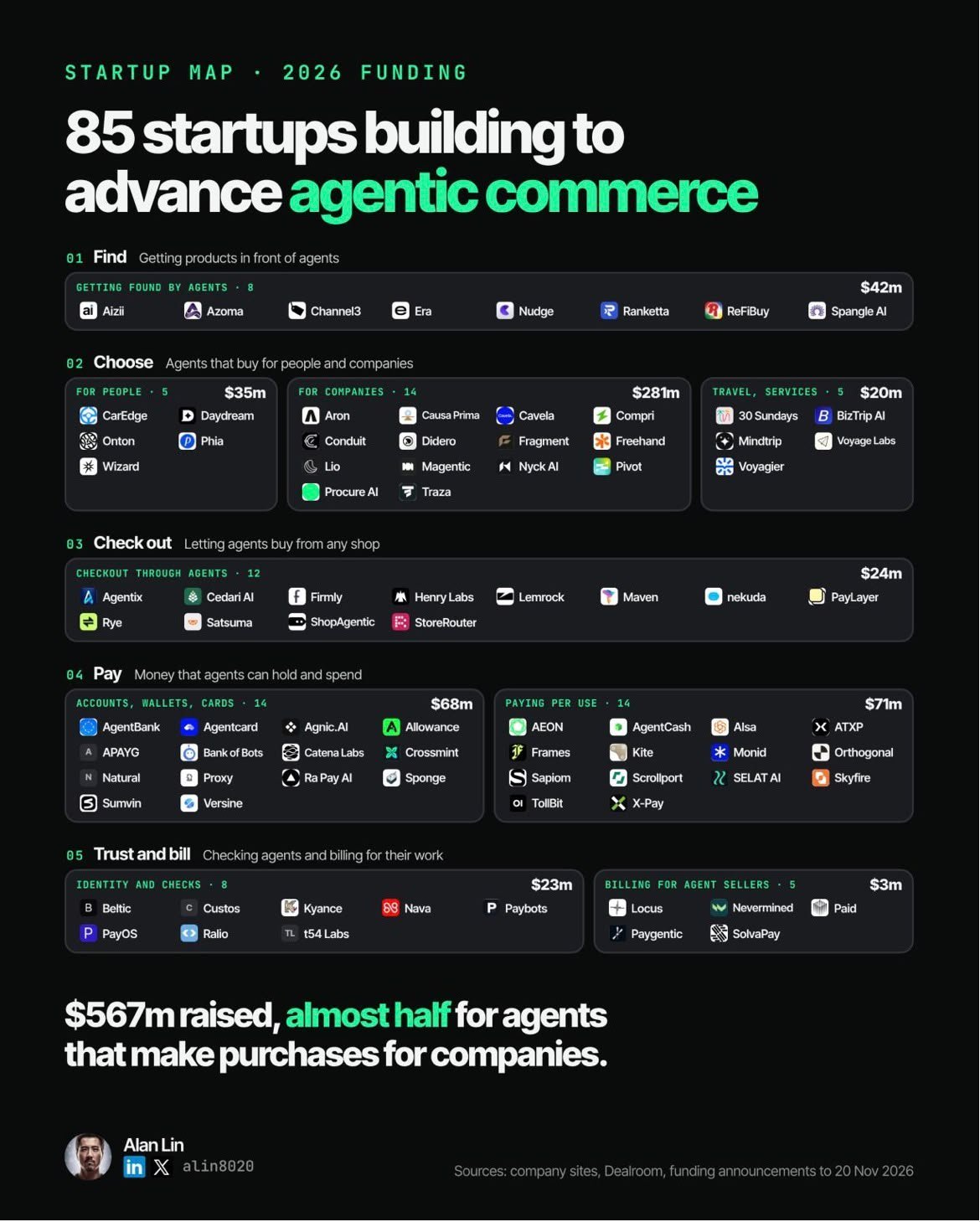
A market map counts 85 startups across discovery, purchasing, checkout, payments and trust. Of $567 million raised in 2026 through November 20, $281 million went to agents that buy for businesses, such as a procurement team reordering parts monthly.
Israeli founders are taking different angles. Brandlight tracks how brands appear in AI answers and raised a $30 million Series A led by Pelion. Limy, backed by Flybridge and a16z speedrun, ties recommendations to what agents find on a merchant’s site and to sales. Aigency builds a chat version of a store on the retailer’s own domain for shoppers arriving from assistants. Nekuda helps sites expose actions via WebMCP, a proposed browser standard, so agents call a function rather than guess which button to press. A product feed helps an agent find a medium blue jacket, while a working site action lets it choose that variant.
Concentration risk and the repeat order
Walmart’s Agent Gateway is an invitation-only beta and access “may be suspended at any time”. A startup sending 40% of its orders through one retailer could lose two-fifths of its business overnight, even with happy shoppers.
The test that matters comes after Cyber Monday. A customer whose agent chose a coffee machine needs filters a month later. Where does that order start, what does the agent remember with permission, and what happens when the usual retailer is unavailable or a spending limit changes? Repeat orders, not first checkouts, will show who earns loyalty.
Source: VC Cafe