
The AI selloff 2026 has erased roughly $8 trillion from S&P 500 market value since early October, and Nvidia alone has shed about $2.7 trillion. A fresh market analysis says the AI capital cycle hasn’t turned. Chips are still in short supply, so the danger now lies in how the buildout gets paid for, and in 2028, when new capacity arrives just as spending slows.
Three waves of selling
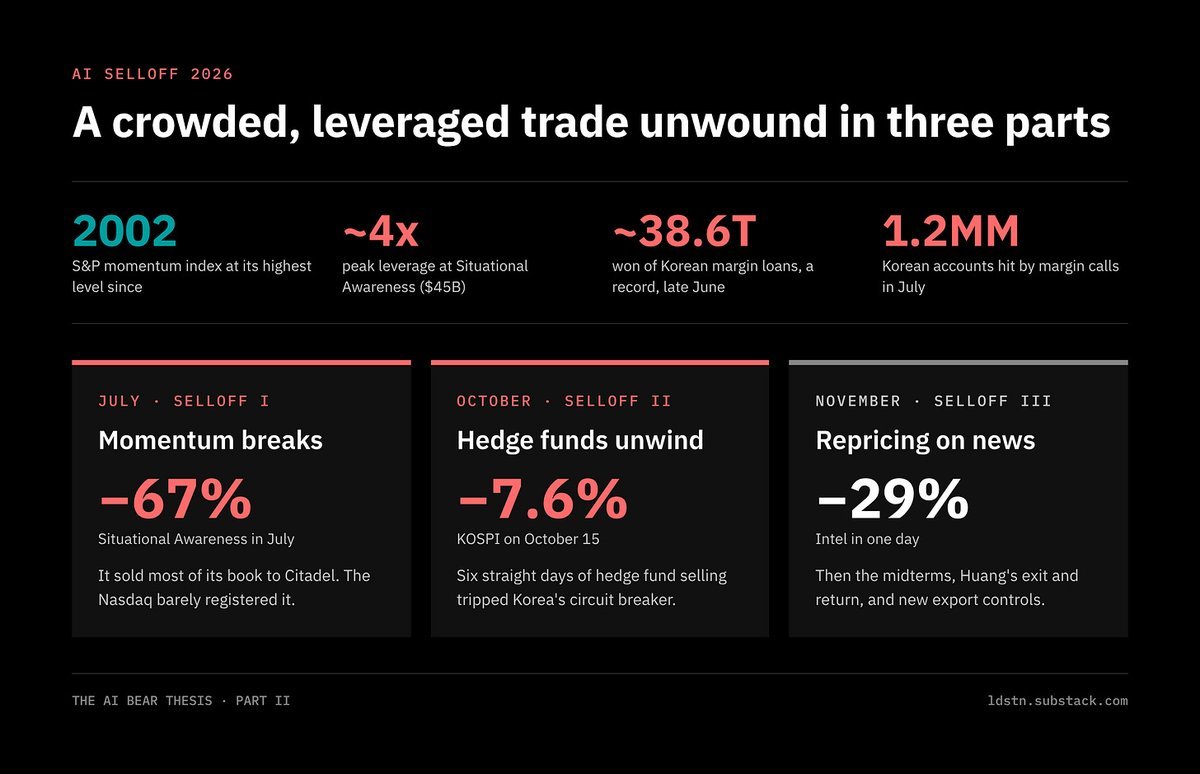
Trouble began in July, well before the broad indexes weakened. Two mechanical forces were at work. First, too many investors held the same bets: the S&P momentum index had climbed for almost three years to its highest reading since its data begins in 2002. Second, many of those bets were funded with borrowed money. The AI-focused hedge fund Situational Awareness held $45 billion at its peak, with exposure of up to about four times its capital. In South Korea, margin loans reached a record of about 38.6 trillion won in late June. After the KOSPI dropped 27% from its June peak by mid-July, an estimated 1.2 million accounts, or one in 30 working-age Koreans, faced margin calls.
The second wave arrived in October. Hedge funds sold AI shares for six sessions in a row. On October 15 the KOSPI fell 7.6% and hit a circuit breaker. A week later, on October 22, Goldman’s basket of hedge fund favorites lost 4.2%, its worst day since 2011.
November brought the third. Intel dropped 29% in one day after weak earnings and guidance. Democrats won the midterms. Jensen Huang resigned on November 12 during an SEC probe, and Nvidia’s board brought him back on November 23. New export controls also reached data centers overseas. Tech momentum is now 62% below its high, a bigger drop than the 53% seen in the dotcom bust, and both the Nasdaq and Asia’s chip-heavy markets sit in correction territory.

Why 2026 isn’t a rerun of 2000
On the surface the two episodes look alike. Underneath, the analysis says, they run in opposite directions. In 2000 prices were the problem. Cisco’s stock was sliding while its revenue still rose 36%, and earnings cracked a year later once its telecom customers ran out of cash. This time valuation multiples have shrunk even as profits keep arriving.
Nvidia is the clearest case. Analysts’ expected profit per share has almost tripled since July 2025, from about $5 to about $14, while the multiple investors pay for it dropped from roughly 32x to 12x. Those moves offset each other, which leaves the stock near where it traded in July 2025. Good news hasn’t helped. Third-quarter revenue more than doubled to $115.8 billion, and the shares still slid 2.89% the next day. Alphabet logged its worst day ever on October 29 after a revenue miss and faster AI spending. AMD fell 17% two days after hitting a record.

Money has become dearer
From September, investors also began charging more for the capital that pays for AI chips. The Fed started raising rates again, unsecured debt at neoclouds now yields more than 16%, and the midterms clouded data center permits and schedules. Nvidia’s multiple shrank to 12x in seven weeks, faster than earnings could rise, and the stock is down 27%.
Supply hasn’t weakened, though. SK hynix says long-term contracts already cover over half of its 2027 and 2028 capacity. Micron says it can’t see when supply and demand will balance. Investors accept that 2027 is sold out, and they are pricing what follows, when capacity being built today begins to ship in 2028.
Circular financing and the SEC probe
Reuters reports that the SEC is looking at possible accounting problems at Nvidia, at a time of worry over circular financing. Nvidia has invested in AI firms and cloud providers and guaranteed data center projects that run its hardware. By the analysis’s measure, equity Nvidia placed in its customers shrank as a share of revenue between the first and third fiscal quarters of 2027, because that equity fell 16% while revenue grew 42%. If customer spending slows, the ratio rises again.
Michael Burry and Jim Chanos have both likened Nvidia to Enron. Nvidia lists its maximum exposure at $118 billion of guarantees as of the third quarter, including up to $105 billion for SB Energy’s Ohio campus, which will host Nvidia equipment leased to OpenAI. Bank of America estimates commitments to partners at about $407 billion, close to 80% of the free cash flow expected across 2026 and 2027. Enron buried its obligations, the analysis points out, while Nvidia’s are huge but disclosed. What matters is whether its cash flow can carry them.
What January’s reports will settle
The newest bearish claim is that AI capex has already peaked. Estimates for 2027 vary widely, but most still expect growth, and even a miss could leave spending at a record. Microsoft and Google guided capex below expectations, which may mean delayed capacity rather than canceled orders. Their fourth-quarter reports in late January will show 2027 capex guidance and the data center leases signed but not yet started. Those figures will indicate whether spending was deferred or cut.
Source: ldstn.substack.com