A year after Opus 4.5 arrived in Claude Code last November, an AI researcher who studies the technology for a living says most R&D is now driven by people working with AI. The AI productivity gains they see in conversations with colleagues are real, but many of them don’t show up in first-order automation statistics.
The researcher is clear that hard data should come first. Reasoning and vibes only deserve trust when data is thin, such as for fast-changing or future events, and an argument that fails to predict data should be dropped. What follows is anecdotal evidence, offered as a supplement.
Starting is cheaper
When asked how much faster AI made them, several people answered “2x, 3x, 5x” and then said the number was misleading. Without AI, they would never have started the project. Motivation, background or simple lack of interest would have killed it. Those AI productivity gains are hard to capture in a speedup figure.
The usual speedup story assumes an employee ordered to finish a task. Research doesn’t work that way. Most people get excited about an idea, build a minimum viable project, and finish only if the prototype validates it. If the prototype can’t be built while motivation, resources and free time last, the project dies.
AI lowers the effort needed to reach that first prototype. In research, where exploration is the whole point, that matters a lot. There is a counterweight: when starting is cheap, people may chase low-value projects they would once have skipped.
Fewer people, nonlinear value
The second observation is about team size. Human teams scale badly because of coordination costs, even in small research groups and startup-like companies where coordination is financially rewarded. It’s worse in science, where nothing in the incentives pushes people to coordinate.
So when AI lets a smaller group do the same work, the value delivered can rise faster than the headcount falls. The researcher has no recent experience with large organizations but assumes the effect is bigger there, where internal politics already slow things down.
Meetings now leave a record
In 2026, software arrived that lets a team hold an in-person meeting and document it with no extra effort. It’s easy to fall into the habit of asking an AI to record the session, write up the notes and paste them into the relevant document.
Adoption is still narrow. The researcher expects wider use to speed up work and automation, mainly by cutting the friction of slow context transfer inside organizations.
Skill gaps are wider, for now
In AI research itself, automation appears to have amplified differences in skill. That fits Baumol’s effect, the economic idea that some tasks become the bottleneck as others get cheaper. Autoresearch, where AI runs research loops, has existed for a while. Outside math, few discoveries can credibly be credited to an unskilled person who got an AI to solve a problem. Most come from highly skilled people using AI to move faster.
Cybersecurity looks different. There, attacks by not particularly skilled actors are now common. The researcher admits the comparison is fuzzy, since “skilled” could mean skilled at one problem or in the field as a whole.
As AI does more work autonomously, skill gaps should shrink. That isn’t visible in outcomes yet, even though AI seems to have erased knowledge differences in many fields.
How far to trust this
The sources, in order of weight, are conversations with researchers, observations at work and personal use of AI tools. The author flags the obvious biases. The people they talk to aren’t representative of the world, and people can misremember their own experience to fit stories they’ve read online. The author includes themselves in that warning.
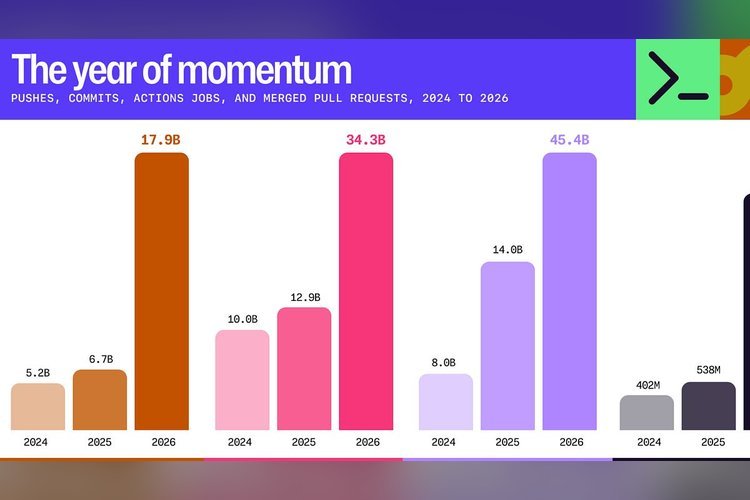
Some evidence points to the shift happening over the past year and not earlier. Revenue trends at Anthropic and OpenAI have climbed, the amount of code on GitHub has grown, and by around February 2026 it had become hard to find people who wanted to work without AI at all.
What to watch in 2027
The open question is whether these effects reach the numbers. If cheaper project starts and smaller teams are doing real work, they should eventually appear in output measures such as papers, products and shipped code. Meeting capture is the clearest candidate for a change that spreads once more teams adopt it.
For now, AI productivity gains look uneven, tied to skill, and easiest to see in the projects that exist only because starting got cheaper.
Source: newsletter.danielpaleka.com