Will AI end up like lightbulbs or like copper? The answer depends on AI price elasticity of demand, and the latest numbers from GPU rental markets, spend trackers and Anthropic’s first-half results point toward copper: cheaper tokens so far bring more total dollars, not flat ones.
Two ways a cheap commodity can go
Jevons paradox is the idea that the cheaper a commodity gets, the more of it people use. It has become the default explanation for why AI demand keeps rising as token prices fall. It leaves one question open: what happens to total revenue?
Lightbulbs show one outcome. Mass production crushed their cost, volume rose roughly 25,000x, and lighting stayed flat as a share of GDP. Copper shows the other. Usage grew and the total dollars grew with it.
The test is price elasticity. Picture a 50% price cut on bread that makes you buy double the loaves. The bill is unchanged, so elasticity is 1. If you buy only 25% more loaves, the bill shrinks, and the elasticity is 0.5. Anything above 1 means total spending rises when prices fall.
What GPU rents say
The hardware market is behaving like copper. Rents for GPUs at neoclouds are up 48% in a year. When leases come up for renewal, CoreWeave has repriced them 30% to 50% higher on Hopper and Ampere chips, based on data from 16 November 2026.
Rising rents on older chips point to demand outrunning supply, which is the opposite of a commodity in free fall.
Token data from Ramp and OpenRouter
Two public panels measure demand for AI tokens directly. Both show high elasticity.
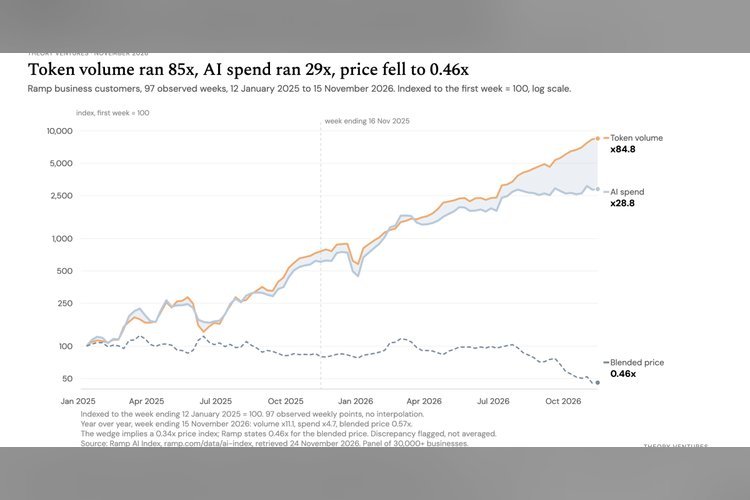
- On Ramp, a 1% drop in price brings 4.3% more tokens. Volume grew 11.1x while spending grew 4.7x.
- On OpenRouter, a 1% drop in price brings 6.8% more tokens. Volume grew 50x while spending grew 21x.
Spending rose less than volume in both cases, so the average price per token fell sharply. But spending still rose several times over, which is what an elasticity above 1 looks like. The gap between volume and spend is about 2.4x.
The Ramp series spans 97 weeks, starting in January 2025 and ending mid-November 2026. OpenRouter’s data runs to 23 November 2026.
Both panels have blind spots. Corporate cards miss direct enterprise contracts and cloud marketplaces, where nearly half of Anthropic’s revenue lands. Blended prices combine list-price cuts with traffic shifting to cheaper models, and cached tokens can cost up to 90% less. Treat the elasticity figures as estimates.
Anthropic’s filing as the counterpoint
Anthropic’s S-1 offers the strongest evidence for demand growing faster than price cuts. Revenue grew 13.6x to $16.3 billion in the first half of 2026, on net revenue retention of 900%. The filing also lists more than 11,900 customers paying over $100,000.
The timing of one price cut stands out. After Opus 4.5 made each task cheaper in November 2025, quarterly sales growth leapt from 48% to 132%. That implies an elasticity well above 1.0.
Cheaper tokens inside the labs
The same story has a cost side. Labs are pushing down the cost of producing a token in three ways:
- making models smaller
- serving repeated questions from earlier answers
- routing simple queries to lighter models
Together these cut token costs faster than GPU rents climb. That matters for margins. If rents climb while token prices fall, labs get squeezed in between.
Four numbers to watch in 2027
The question isn’t settled, and four measurements will decide where AI lands.
- Spending versus volume: will the 2.4x gap close toward parity, as with oil and copper, or grow like lighting did?
- GPU rents versus blended token prices: do they converge as new clusters open, or does the squeeze on lab margins continue?
- Frontier gross margins: can labs stay above 40% as token prices drop?
- Gross profit versus committed compute bills: does revenue grow quickly enough to pay for them?
The closest parallel is CPUs
Consumption of AI tokens looks unbounded. How much deflation hits commodity tokens is still up for debate. For now, the closest parallel is the CPU: commodity chips deflated, and still every new frontier generation made the market bigger in dollars. If AI follows that pattern, prices per token will keep falling while total spending keeps growing.
Source: Tomasz Tunguz