
Plenty of AI coding projects end as demos nobody can maintain, and one developer blames the model’s short sight. After several months of testing on large enterprise-scale builds, the developer settled on a document-first workflow that gives the AI the whole product picture before it writes any code.
Why AI builds demos, not products
The developer’s argument is that models are nearsighted. They are trained to finish whatever the current prompt asks, not to serve what the user wants at a deeper level.
That shows up most in prompt-by-prompt “vibe coding”. Each prompt hands the AI a limited slice of information, so it can only do a limited slice of work. The first rounds go well. Then the model fixates on the latest request and loses the original goal.
The example given: someone building a machine learning research platform asks for a login feature. The model’s instincts rank security highly, so it dives into permission systems and starts debating them. The result is a half-finished platform with a permissions system bolted on.
Where spec-driven frameworks fall short
Spec-driven development (SDD) frameworks such as OpenSpec, SpecKit and AIDLC address part of this. Before any code is written, the AI discusses the product with you, records everything in a spec, and codes from that. Because intent sits in a document, the model spreads its attention across it and follows it closely.
The developer points to two gaps that remain.
- Details slip through. Even with a full product requirements document, the implementation can miss things like a row limit on a query or an audit log on an export. Business logic is especially hard for a model to infer.
- Early answers distort the goal. If you say you’ll start with Kaggle competition data and use the competition’s metric, the AI may redefine the project as a Kaggle tool and design the stack around that, even though you wanted a production platform running models on live data.
Late fixes are costly. A system designed for offline use gets synchronous code, and supporting high-concurrency online inference then means rewriting it as asynchronous code and possibly planning distributed deployment. After the first version ships, the model also treats that version’s spec as ground truth and patches it instead of changing direction.
The document-first fix
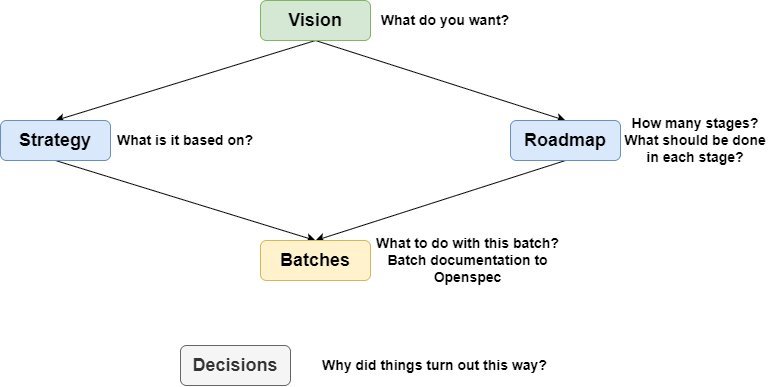
Instead of starting with a spec, the developer starts by acting as a product manager and talks through why the product exists, what it should become and what each phase should deliver. Features are then split into numbered batches, each with a write-up of scope and goal, stored in the project’s docs/ directory.
A small set of documents carries the context:
- vision.md describes what the product should become, who the users are, and what is in and out of scope.
- roadmap.md lists milestones, each pointing to its batch documents.
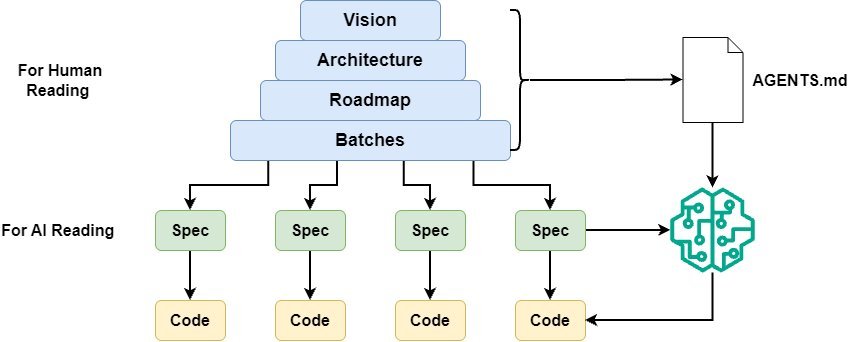
- architecture.md sets the tech stack and ground rules that run across every batch.
- decision.md records choices made in conversation, such as a CLI-only interface with no MCP interface, and OAuth instead of username and password.
- AGENTS.md indexes all of the above with a short description and path for each.
The set gives the AI a view across time and across the product’s structure. It knows where the product is headed, so it can leave room for extensions and pick a stack that suits growth. Unlike SDD specs written in a format that is hard for people to read, these documents are meant for humans, so you can reorder milestones as feedback arrives.
A packaged skill and how it runs
The developer wrapped the method into a skill called product-design-bible and published a sample project with it. It doesn’t depend on how you arrived at the design and works alongside any SDD framework.
In the walkthrough, the developer used opencode with the deepseek-v4.1-flash-1017 model and OpenSpec, building a machine learning platform that finds patterns in enterprise data and serves models online. A grilling skill, which asks questions to surface unconsidered issues, handles the design conversation. The skill then writes the documents and the AGENTS.md index.
Each batch starts bare-bones, so the developer picks one and runs opsx-explore to fill in detail, which reads the design documents automatically. Then opsx-propose creates the spec, opsx-apply and opsx-archive follow, and the batch is marked done in roadmap.md.
What to try next
Teams struggling with AI coding projects that stall at the prototype stage can test this cheaply. Write the vision, roadmap, architecture and decision files before the first prompt, and point your agent file at them.
The open question is how well the method holds outside the developer’s own projects. The results described come from one person’s workflow, so treat them as a tested idea rather than a benchmark. If readers’ feedback keeps shaping the skill, as the developer says it will, expect updates to the sample project.
Source: Data Leads Future