
A software engineer with 25 years of experience says AI coding agents now write 99% of his code, and his workflow shows where humans still fit. His agents write the code, and he handles two jobs: defining the work and judging the result. Most of his work runs through Claude Code, Anthropic’s coding agent, in about 80% of cases, with Codex covering the other 20%.
How AI coding agents split the work
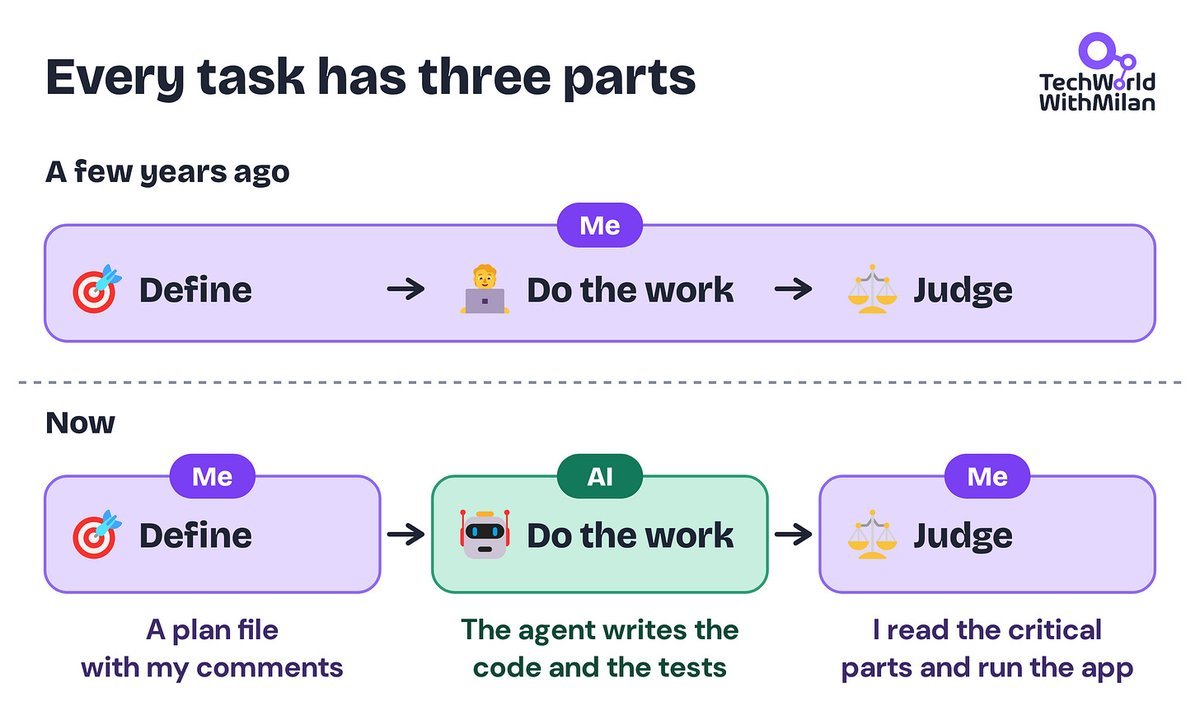
He splits every change into three parts: what to build, the implementation and the review. Agents take the middle part. The first and last now take more of his time than before, and he says they matter more to the outcome than the choice of model.
His definition of a task is four lines: what he needs in one sentence, who it’s for, the limits (budget, time, what must not change) and how to tell the result is good.
For anything non-trivial, Claude writes a plan from the current codebase using OpenSpec, and he gives feedback before any code is written, because fixing a plan is cheaper than fixing an implementation. A second model, such as GPT-6 Astra, then reviews the plan, since models trained differently don’t share blind spots. Bugs start with a failing test, and code coverage targets 80% or more.

What he still checks
He has reviewed less as models improved. He marks Opus 4.5, released in November 2025, as the turning point: after it, hallucinations mostly stopped showing up and the model was rarely wrong. He read every line for several months afterward. Now he reviews only the main and critical parts of a diff, then tries the app as a user would. For one project he reads no code at all.
A fresh session reviews each finished branch, because a new session hasn’t seen the reasoning behind the changes and can’t grade its own work. When his Azure cheat sheet shipped with wrong counts and missing services, he added a script that fails on that kind of error and made a green run part of the definition of done.
A short rules file
Every project has a rules file the agent reads at the start of each session, and the agent proposes a new rule whenever he corrects a mistake. His shared AGENTS.md runs 63 lines. AGENTS.md is an open format that Codex, Cursor, Copilot and other agents read, and more than 60,000 open-source projects use it. Claude Code has read it since September when no CLAUDE.md exists.
He keeps the file short on purpose. A study from ETH Zurich found that rules files didn’t raise agents’ success rates on real GitHub issues while costs rose 20% or more. A second study ran agents on 40 Python projects and found they followed an outdated rules file in 90% of cases, so one of his lines tells the agent to follow the existing code structure.

What AI coding agents can reach
- Command line: one repo holds more than 200 allowed command patterns and no MCP tools. He uses MCP for coding only for Microsoft Learn and Context7, which fetch current docs.
- Database: a read-only login lets agents check column types, sample rows and indexes. A production check showed a query reading a 4.5 GB index, and a nightly load that had grown past 30 minutes dropped to 11 after six missing columns were added to an index.
- Infrastructure: through the Azure CLI an agent traced a spike to about 1,600 active users in half an hour, found 95% of it was bot traffic, and a firewall change cut requests by 18% within a day.
Side projects built mostly by agents
He built a WordPress and WooCommerce webshop for his wife’s family bookstore in two months and never checked the PHP, relying on end-to-end tests and post-import checks. Imports of 10 to 100 products take 10 to 20 minutes. An agent also ran the shop’s Google Ads during the school season.
Other projects include aztree, an open-source Azure spending treemap, an Azure cheat sheet site with 19 service categories, and todo-exit, a tool for moving Microsoft To Do tasks to Todoist after Microsoft announced on November 18 that it is sunsetting the app.
What’s coming in part two
A second installment is due in two weeks. It will cover how he uses AI for writing and daily tasks, the tools he pays for and a tier list of AI tools for the end of 2026. He says his own multi-agent software factory isn’t ready to share yet.