A software team compared 75 open-source pull request reviewers and picked Alibaba’s Open Code Review (OCR) paired with Mistral Large 4 for AI code review. At OCR’s lowest effort setting it caught four of five historical bugs, and a review usually finished in a few minutes. The team behind the test, Strumenta, says it will run the setup for about $67 a month across all its projects.
Why the team needed a reviewer
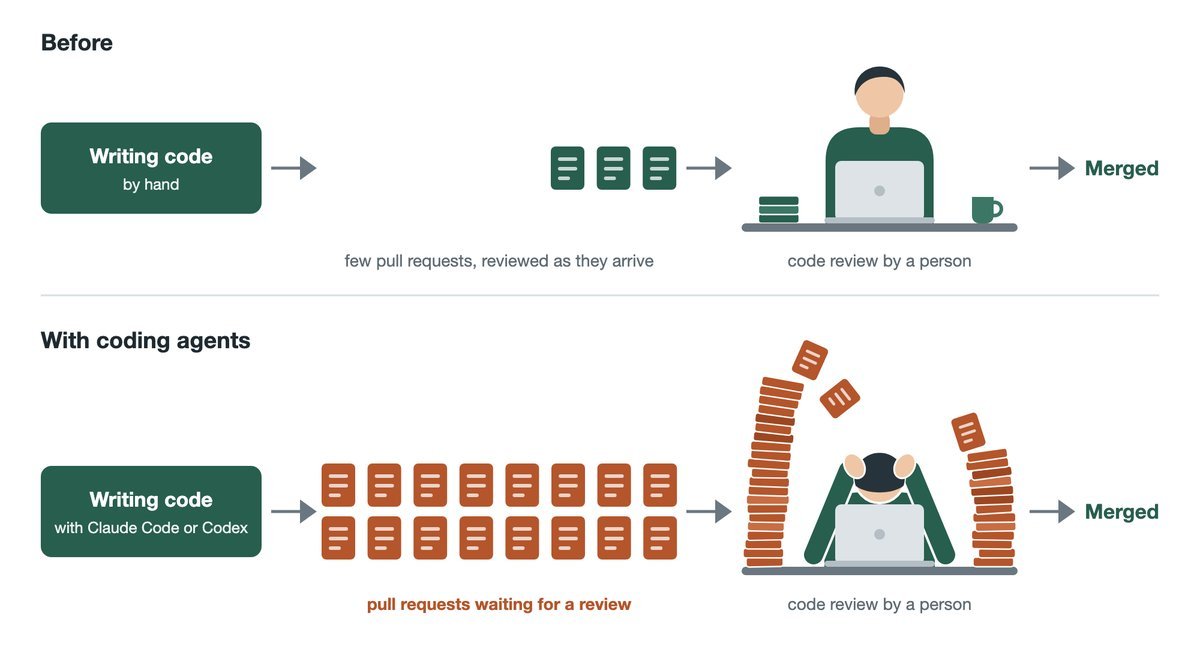
Strumenta’s developers already work with Claude Code or Codex in an agent session, which means far more code gets written each day. The bottleneck moved to review. Reviewing everything by hand isn’t realistic, and skimming makes reviews shallower without anyone saying so. The team has its own reviewer, called Olaf, but first surveyed what exists in open source.

From 75 projects to one
The survey began with 75 LLM-based pull request tools, and 20 looked credible. Six filters cut them to four. A candidate had to be truly open source, support several model families, be agentic, accept the team’s own API key, work on both GitHub and a self-hosted GitLab, and run in the team’s own CI. Kodus failed on license, GitLab Duo requires a paid plan in production, and OpenReview runs only on Vercel.
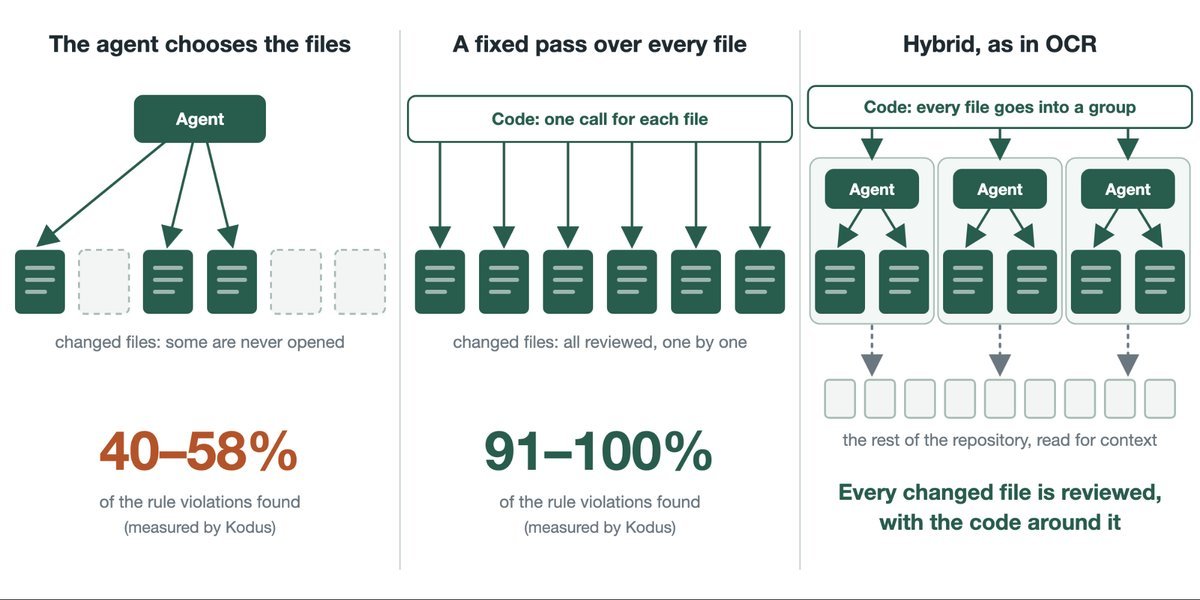
OCR won on how it directs its agent. It groups related changed files, makes sure every group gets reviewed, and lets the agent open the rest of the repository for context. That avoids two failures: an agent that never opens some files, and per-file calls that lack surrounding code. OCR is a Go command-line tool under Apache-2.0.
It has gaps. The team wants incomplete reviews to flag themselves and block merges, a feature still in progress upstream, and found the main loop ignores why a model stopped generating. The team added a small Python script that reads OCR’s JSON report and answers INCOMPLETE, HUMAN or READY.
How they tested it
The test ran on its own open-source projects, LionWeb JVM and Starlasu Kotlin. It used historical bugs traced with git blame, merged pull requests believed to be clean, and large pull requests of 750 to 1,250 changed lines. Fable 5.2 judged hundreds of comments against the code. One Mistral account served three candidates: Mistral Large 4, GLM 5.3 and DeepSeek V4.1 Flash.
Results
Higher effort made things worse. With Mistral Large, useful comments fell from 50% at low effort to 44% at medium and 33% at high. Higher levels cost more, produced more wrong comments, and one review failed when memory compression broke on a large file. None found a design bug Mistral had missed. The team settled on low effort for every pull request, plus a rule telling the model to search test sources, which OCR filters out of the diff. That rule removed complaints about missing tests.
A second model didn’t pay off. GLM on reduced reasoning caught the design bug, but also wrote 17 wrong comments across twelve reviews. A Mistral verifier rejected 12 of them, but also rejected that one bug. The team won’t adopt it yet.
On ten merged pull requests believed clean, Mistral wrote 32 comments: one bug, nine useful observations, seventeen noise and five wrong, so 16% wrong. The reviewers also surfaced seven real problems in code already merged, such as a NullPointerException in LionWeb JVM #486 and a lowercase-name bug in Starlasu Kotlin’s Scope.resolve.
Cost and provider choice
One low-effort review runs from 2 to 70 cents: about 3 cents flat plus 0.06 cents per line, with the token budget capping it near $2. Prompt caching matters most, since 75 to 85% of tokens are served from cache at one-tenth the cost. For 48 active repositories and around 160 monthly pull requests, spending has ranged from $37 to $147, so the team will set a $150 monthly cap.
Alternatives cost more. CodeRabbit would run $400 to $800 a month for 17 people. Swapping in Claude Sonnet 5.5 or GPT-6.2 Sol would multiply the bill by roughly 3.5, Claude Opus 5.5 by about 7, and flagship models by 13 to 14.
Mistral also suited client demands for European-controlled hosting under US CLOUD Act concerns. DeepSeek’s API is cheap but processes data in China.
Practical tweaks
Mistral closes non-streaming responses after 60 seconds. GLM hit that constantly, with one review taking 55 minutes and 74 retries. Streaming and a 900-second timeout fixed it. Setting reasoning_effort to low cut one GLM review to 18 seconds, via a second custom provider in OCR pointing at the same endpoint.
The team will review once when a pull request is ready, not on every push, which would cost four to five times more. It will keep comparing the setup with Olaf and rerun its test cases when new models ship.
Source: Federico Tomassetti