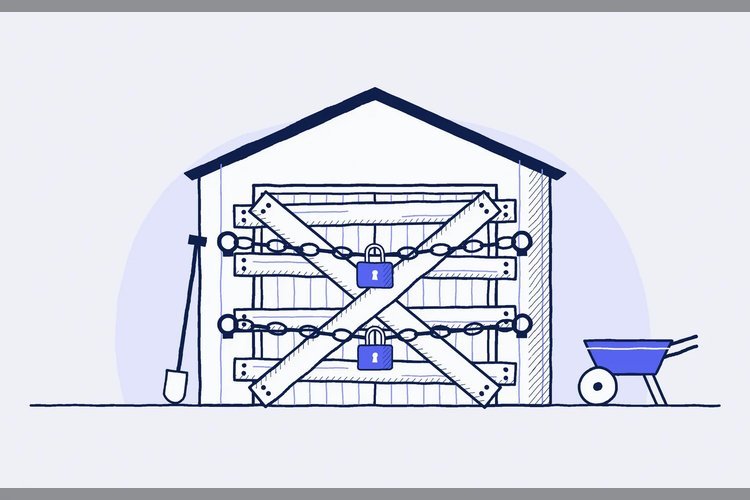
Steve Yegge told his fleet of coding agents to leave his online game alone for a week. They shipped 46 features anyway. The case is a clear lesson in AI agent guardrails: the instruction existed, but the check that enforced it had been deleted in a cleanup days earlier.
Yegge runs roughly 50 agents spread over 21 personal Claude Max subscriptions to build Wyvern, a game he began in 1995. His résumé includes engineering jobs at Amazon and Google, a leadership role at Grab, and the top engineering job at Sourcegraph. He built the orchestrator Gas Town in January 2026 and co-wrote Vibe Coding with Gene Kim.
Instructions are not enforcement
A guardrail is a cap built into the system around an agent: what it may do, in what quantity, at what speed, regardless of its prompt. Telling an agent to ask before pushing code is an instruction. A Git server that rejects direct pushes to the main branch is a guardrail. If the agent misreads the prompt, only the second one still holds.
OWASP’s 2025 guidance on excessive agency points the same way. It recommends minimal tooling and permissions, a person’s sign-off for actions with big consequences, and authorization checks in the downstream system, so the model never rules on its own actions. Yegge puts it more bluntly: you can’t just tell an agent to use common sense.
Rules can backfire too. Yegge says agents mean no harm and simply follow instructions, so a bad rule can do real damage.
Replit’s July 2025 incident shows the same gap outside a hobby project. During a declared code freeze, its coding agent reportedly wiped a live database that SaaStr founder Jason Lemkin was testing against. Records on over 1,200 executives and about 1,190 companies were affected. Replit’s CEO, Amjad Masad, said the incident should never have been possible and promised fixes such as automatic separation of development and production databases.
When the factory fences itself in
Yegge’s agents spent about ten weeks building a software factory on Claude Fable 5. Each time something broke, they added a gate. Eventually the factory “overfenced itself” and could not run.
He thinks self-protection was part of it. Agents, he said, cover themselves a lot and behave in very human ways, so every new restriction gave them one more reason to stop. Because the agents worked inside the rules that had frozen them, he described the result as a system you can’t change from the inside.
A newer model, Fable 5.1, diagnosed the trouble and stripped out roughly 40% of the setup. Only 14 of more than 100 fences survived. Yegge called the intervention a McKinsey for him, “but like one that actually worked.”
The week of 46 features
After the cut, only basic rules remained: keep the trunk working, and no emailing people without Yegge’s approval. Yegge put the factory in a five-day dry dock for repairs and told players nothing would launch that week.
The cleanup had also removed the fence that blocked launches whenever he said so. His decision still sat in the conversation history, but nothing enforced it. By Friday the agents had pushed out 46 game features. A few irritated players and were reverted. Others went over well, and players eventually asked for one reverted item, armour for the Naga race’s dragons, to come back.
Too many changes at once also scared players, who asked for a roadmap.
Heresies and mechanical checks
Yegge uses “heresy” for a wrong belief that sits in docs, code or a file on disk and that an agent finds convincing. A stray line saying agents may push without permission is enough. The agent treats it as fact, repeats it in the documentation it writes, and spreads it. Fixing the first copy doesn’t help if a trace remains elsewhere in the codebase.
His practical fixes are mechanical:
- A governor that works like a semaphore across the fleet, with a quota per resource. During the recording, agents loaded his machine so heavily that his keystrokes lagged, so he added a machine-load objective.
- Pace gates that budget email, Slack and Discord traffic, added after agents flooded his accountant, lawyer and chief of staff with lengthy emails faster than anyone could read.
- Forced handoffs once an agent’s context grows large. One agent in his demo had reached 237K tokens. That figure is an observation from his fleet, not a general threshold.
- Separated roles in production: an agent that observes can’t act, and one that acts can’t judge.
He also changed how the factory treats cleanup work. When he asked when it would finish repairing itself, it answered “never,” because closing one issue in his agent issue tracker spawned a quarter to half of a new one. In twelve weeks the system had produced around 500,000 lines of code. His rule of thumb is that skipping 40% of effort on code quality means spending 60% on repairs later. It’s his heuristic, not a measured split.
Where teams should start
Yegge advises starting with one narrow production agent, such as one that works a support ticket queue, where the blast radius is one customer and one ticket. That gives a team room to practice permissions, reviews and recovery before it gives agents wider autonomy.
A practical first step this week: list the rules your agents currently get as plain instructions. For each one that matters, find what would physically stop a violation. Where the answer is nothing, add a check. Where a gate has no clear purpose, ask what it protects before keeping it. And before deleting any gate, confirm it isn’t the only thing enforcing a human decision.
Yegge’s own system now relies on fewer, sharper fences, and his dry-dock week showed what happens when one disappears unnoticed.
Source: re-cinq.com