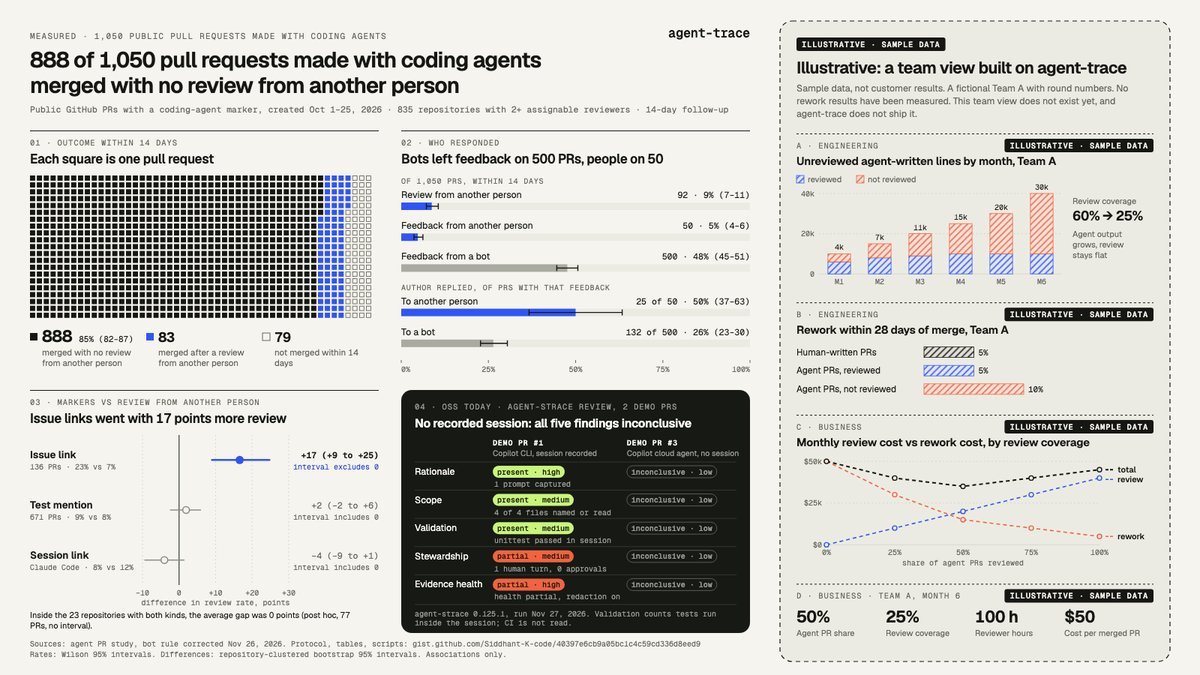
Most pull requests that coding agents produce get merged without anyone else reading them. In October 2026, 888 of 1,050 public agent-made pull requests (85%) were merged inside 14 days, and no other person had reviewed them. A set of command-line tools in agent-trace aims to help teams decide which agent pull request review actually needs a human, and to find code produced by agents that nobody looked at.
The test case: 49 lines in 19.5 seconds
The developer behind agent-trace ran its three commands on one public pull request. The change gives a small Python package a new sentence_count function. GitHub Copilot CLI 1.0.103 produced it from a single prompt while agent-strace hooks recorded the session. The session took 19.5 seconds and used 7 tool calls. Its commit contains 49 added lines in 4 files: an 8-line module, a 26-line test file, a 2-line export and a 13-line README section.
Nobody has reviewed it, and it stays open as a demo.
What agent-strace review reports
For an agent pull request review, the review command reads what the agent session recorded and returns five findings, each with a status and a confidence level. For this pull request, rationale and scope were present, validation was present at medium confidence, and stewardship and evidence health were partial. Stewardship was partial because the human contribution ended with the prompt: no approvals, no course corrections once the agent was running. Evidence health was partial because the Copilot CLI hooks have 12 known limitations, including no model name or token usage.
The validation finding is the interesting one. The prompt asked the agent to run the suite with python3 -m unittest. Because the tests folder lacked an __init__.py, that command discovered nothing. The agent piped the output through tail, which replaced the exit code. From Python 3.12 on, unittest returns exit code 5 if no tests run, yet the pipe made the shell call return 0. A check that trusted exit codes would have logged a pass.
The agent caught this and switched to python3 -m unittest discover -s tests, which ran 7 tests that passed. The tool reads the outcome from the runner’s summary line, and in JSON output the first run is marked unknown. When the developer deleted the second test call from a copy of the trace, validation dropped to partial. The default threshold fails only on missing findings, so the copy still passed. This command makes it stricter:
The command is agent-strace review with –fail-on missing,partial and –findings validation. It returns 1 for the edited copy and 0 for the real session. The tool doesn’t read CI results, so it reports only what happened inside the session.
Sharing a session without leaking it
The share command exports a session as a single standalone HTML file that needs no server. Content is minimized unless you ask otherwise, and a dry run prints counts of what the file would disclose. Here, 16 of the session’s 18 events carried content, and all 16 were minimized. The developer searched the 57 KB file for the repository path, module name, test command and prompt text and found none of them.
The file lists all 18 events in order with their time offsets, and closes with SHA-256 digests that let readers check integrity. None of it is signed. An –include-content flag adds prompts, commands and paths, and the tool warns that redaction is heuristic and can miss secrets.
Where cognitive-debt undercounted
The cognitive-debt command covers all sessions in a time window, which defaults to 30 days. It checks local git history, and GitHub reviews when given a token, for review signals on the files agents produced. On the demo it correctly reported zero reviewed and two unreviewed lines, an unreviewed ratio of 1.00. But the agent had added 49 lines in 4 files.
Two things in version 0.125.1 caused the gap. Copilot CLI creates files with a tool called create, which the tool’s list of write tools lacks, so 34 lines in the new files were missed. Its edit tool puts new text in a field called new_str, which cognitive-debt doesn’t check, so the 13-line README edit counted as 1. For Copilot CLI sessions, line counts should be read as a lower bound.
Two other limits apply. Run from a directory that doesn’t match the recorded one, such as a CI runner, the report says review coverage is unknown. That counts as unavailable, never as a pass. And review signals are estimates. A Co-authored-by trailer, which agents often add, can trigger a local signal on a branch nobody reviewed.
Pull requests with no session at all
Another pull request in the demo repository came from the Copilot cloud agent, which left no recorded session. Review rated all five findings inconclusive, at low confidence, and still passed it under default settings. Teams that want such pull requests to fail can use –fail-on missing,inconclusive –min-confidence low, which exits 1 on that example.
What comes next
No agent pull request review tool here measures whether unreviewed agent pull requests cost teams more later. The developer is running a separate study of merged pull requests in 200 public repositories, tracking each for 28 days and comparing agent changes with human ones. The protocol is frozen and collection is under way, with no results yet. A team-level view that would run these reports across many pull requests is only an idea so far.
To try it, install agent-strace with uv, run its setup for your agent, and use the review command on a branch.
Source: Siddhant Khare