
Vercel CEO Guillermo Rauch says the agent internet is already taking shape: software agents now visit sites, file support tickets and push code, and the numbers on his own platform show how fast that happened. In a recent interview with Codie Sanchez, he laid out how he thinks companies should respond.
Vercel is the company behind Next.js and hosts websites and applications for other businesses, so Rauch sees what gets put online and who, or what, is doing it.
Coding agents now drive most Vercel deployments
Rauch puts the share of Vercel deployments triggered by coding agents at about 3% in January 2026, and above 60% when the interview was recorded. His forecast for early 2027 is around 90%.
Totals have climbed as well. Reaching the first billion deployments took Vercel ten years, he says, and another billion now arrives about every four months.
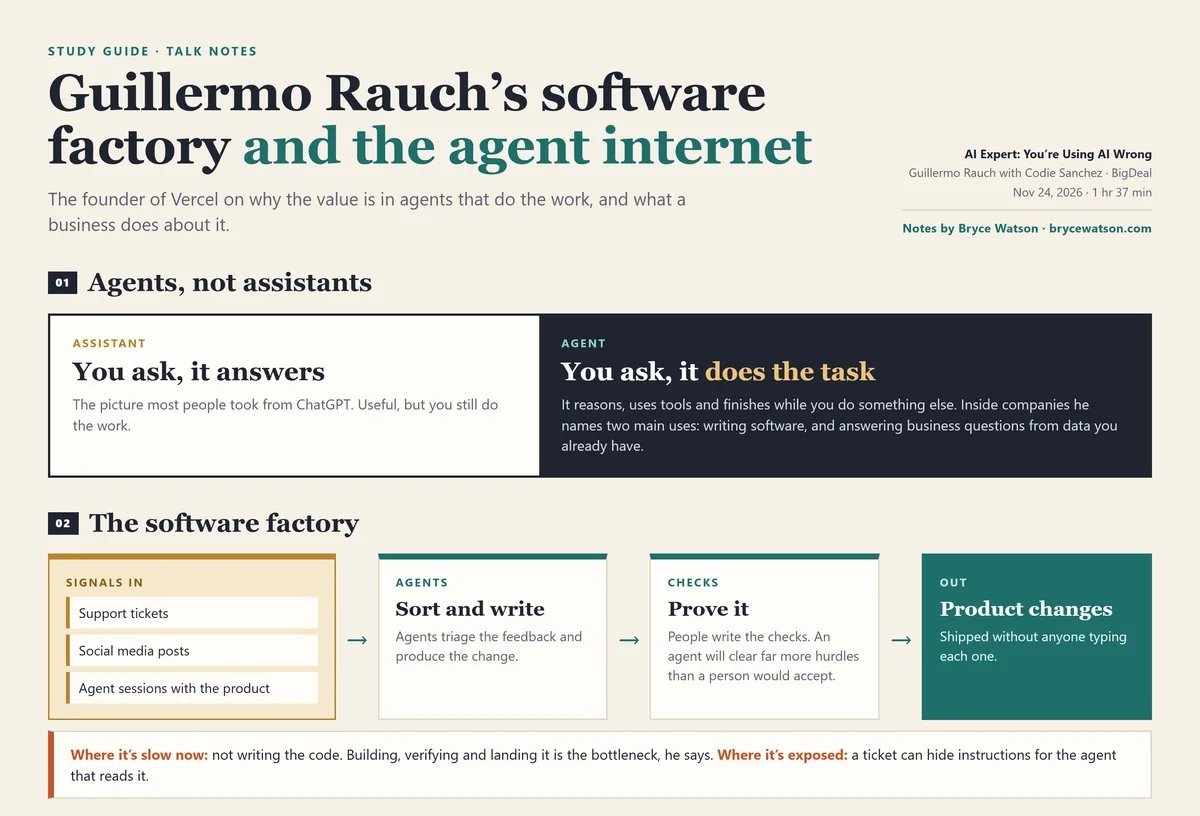
His distinction is simple. Rauch separates two things. A chat assistant replies to a prompt. An agent plans, calls tools and completes a job in the background. In his telling, ChatGPT left most people thinking only of the first. Before sitting down for the interview, he had set several research agents running and read their findings later.
Where agents pay off inside companies
He singles out two uses as the killer apps inside companies. One is writing software. The other is answering business questions: the agent pulls from data you can already reach, writes the code to join it up and returns a report, a chart or a small working app.
One product manager, he says, built a pricing simulator using internal data and customer comments. A project like that used to mean months of engineers’ time, if it got done at all. What holds people back today, he argues, is nerve.
Selling on the agent internet
The agent internet needs different plumbing from today’s web, which was designed for human eyes: buttons, attractive pages, one-click checkout. Rauch predicts a version aimed at agents shopping on behalf of people, with agent-to-agent trade eventually dwarfing trade between humans. In his framing, the Yellow Pages, web directories and search engines were earlier ways a business got found, and agents are the next.
Discovery is only step one. Say someone wants custom mugs. Their agent must locate a printer, send over the artwork and complete the order, all without a human stepping in. Rauch estimates 99% of businesses can’t handle that today.
The software factory and traces
His term software factory means a pipeline that takes in signals, such as support tickets and social posts, and outputs product changes. Humans supervise the checks rather than type the code. During a shift on Vercel’s support desk, he saw that customers’ own agents now file many of the tickets, so on the agent internet one set of agents reports bugs to another set that fixes them.
The slow step has shifted, he says. Producing code is quick now, while building, verifying and merging it lags, and unmerged changes stack up at most companies. His remedy is tougher gates, because an agent will clear far more hurdles than human colleagues would put up with.
Traces get heavy emphasis too. A trace logs a session with an agent end to end: the requests, the replies and the data it went to get. Rauch ranks them among the most valuable units of intelligence and says firms should hold on to their own. What worries him most is bringing the typical engineer up to the level of the best one when using agents. His answer is to let colleagues study how top engineers actually work. He added that Vercel had that day announced the purchase of a four-person trace company, whose team will lead a unit that once would have needed forty.
Habits he recommends
- Look back after every task. A nightly job could read the day’s traces and note one improvement. Vercel already does this for sales calls.
- Once a large deal closes, ask the customer what’s wrong with the product. Omissions often teach the most, like a job they still give to a competitor.
- Use reverse prompting, which means asking the agent where your thinking is weak and which questions you’ve missed. Rauch attributes the term to Brian Armstrong of Coinbase.
- Copy something that exists before improving on it. Rebuilding it shows what your own version should be.
He borrows Nat Friedman’s phrase “product prevention groups” for teams in large companies that end up blocking launches, which he says is how a firm throws away a lead. As for why some users get much more out of AI, he says they request things they assumed couldn’t be done.
What to try this week
Preparing for the agent internet requires no code. His advice comes down to a few low-effort steps. Choose one business question nobody has had time to answer and put it to an agent with access to the data. Then go through buying from your own business the way an agent would, and note every step where a person has to read a page, fill in a form or wait for a call. Those are the places an agent will get stuck.
Rauch also names risks, including prompt injection, where hidden instructions in text an agent reads, such as a support ticket, make it do what an attacker wants. Giving agents a sandbox, a computer set aside for their work, is one of the precautions he describes.
Source: Bryce Watson