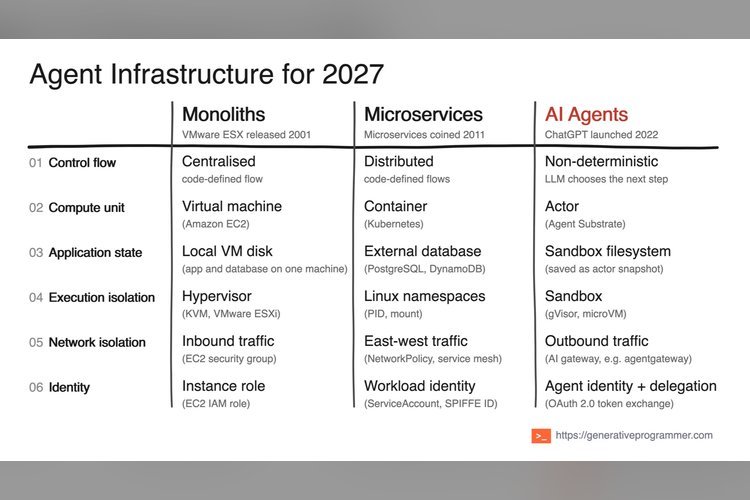
Agent infrastructure is shaping up as the next big rebuild of the cloud stack. One engineer’s analysis argues that autonomous AI agents change six core layers of how software gets run, in the same way microservices once replaced monoliths. The claim is that 2027 is when this goes mainstream.
Most of the public argument about agents centers on apps and models. Underneath, agent infrastructure is shifting more than people realise.
From written flow to model-chosen flow
Monoliths kept logic in one application. Microservices split it into bounded contexts, but developers still wrote the flow in code. Agents break that pattern: the language model picks the next step while the program runs.
That non-determinism drives the other five shifts: if you can’t predict what a program does next, every assumption about hosting and fencing it needs another look.
Compute and state come back together
Virtual machines hosted whole applications. Containers packaged a single service, so starting, stopping and scaling became cheap. Agents look different again. They run as stateful actors that suspend when idle and resume on a shared worker pod, so “startup” now means restoring a session. A warm resume takes hundreds of milliseconds.
State follows the same arc. Monoliths kept data on one VM disk. Microservices pushed state out into external databases and left the app stateless. Agents pull it back next to the compute: they work in a sandbox filesystem, saved as a snapshot when the actor suspends and restored when it resumes.
Stronger walls for code the model writes
VMs isolated applications with a hypervisor. Containers used Linux namespaces, which is finer-grained but still lets processes share one kernel. That’s a thin boundary when the code was just generated by a model and nobody has reviewed it.
Agent infrastructure therefore needs a stronger sandbox, such as gVisor or a microVM.
Outbound traffic becomes the border
Older setups worried about inbound traffic first, meaning who can reach the application. Microservices added east-west rules about which service may talk to which. For agents, the critical boundary is outbound. The goal is to protect data from the agent itself by controlling which endpoints it can reach and what it can send out.
The analysis says a new kind of AI gateway, with agentgateway as one example, is becoming a mandatory part of the stack.
Identity that follows the agent
Instance roles used to identify a VM. An IAM role covered the whole machine, so every process on it shared the same permissions. Workload identities improved on that by giving each service its own verifiable identity, through a Kubernetes ServiceAccount or a SPIFFE ID.
Agents need two more things. First, an identity that survives a change of worker, because an actor can resume on a different pod. Second, scoped delegation from the user, so an agent acting on someone’s behalf holds only the authority that person granted. The proposed mechanism is OAuth 2.0 token exchange.
The six shifts at a glance
- Control flow: the model decides the next step at runtime.
- Compute unit: suspendable stateful actors on shared worker pods.
- Application state: snapshotted sandbox filesystems beside the compute.
- Execution isolation: gVisor or microVM sandboxes instead of shared kernels.
- Network isolation: governed outbound traffic through an AI gateway.
- Identity: per-agent identity plus scoped user delegation.
What it means for agent tooling
Agent frameworks such as ADK, Claude Code, Codex and Deep Agents look different from the outside. Underneath they ask the same three things of the platform: stronger sandboxes, governed egress and agent identity. A new agent infrastructure stack is forming to supply them, with projects such as Agent Substrate.
The framing is that VMs defined the 2000s and containers defined the 2010s. The author expects agentic infrastructure to define the next decade.
What to watch in 2027
This is one engineer’s forecast, not a measured rollout, so the dates are a bet. Still, the pieces are concrete and testable. Teams running agents in production can already ask whether their sandboxes isolate beyond a shared kernel, whether outbound traffic is filtered, and whether each agent carries its own identity.
If the forecast holds, platform teams will spend 2027 adding those controls the way they spent the 2010s adopting containers. Vendors that offer snapshots, sandboxes and gateways as managed services stand to gain the most.
Source: X (formerly Twitter)