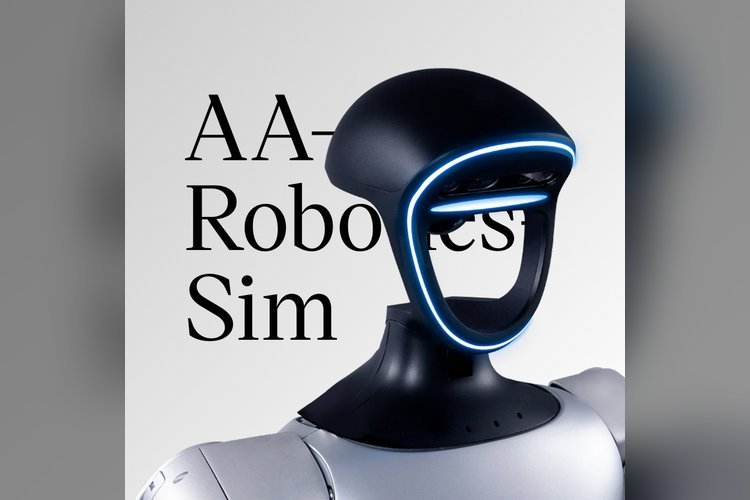
AA-Robotics-Sim v0.1 is a new research-preview benchmark that hands frontier language models control of a simulated Unitree G1 humanoid robot. The models face ten household and light industrial tasks. GPT-6.2 Astra leads with a score of 71.0, but several everyday chores remain out of reach for every model tested.
It follows last month’s preview of AA-Robotics v0.1, which used physical robot arms in a lab.
How the test works
Each model controls a simulated G1 with 29 joints, three-fingered hands and a head camera. It works through a coding-agent setup, so it writes and runs code to move the robot. The robot has to walk, look around and use two hands at once.
Before each task, a model gets five practice runs in a row, every one in a fresh scene, to learn the setting and jot notes. Whatever it saves as memory, notes, code or skills is all it carries forward.
Scoring then happens on ten unseen scenes that change the room, lighting, layout and task details. Every scored run begins from a copy of those saved files, so the model has to adapt what it learned rather than replay a memorized routine. This mirrors real deployments, where a robot would get practice on site before doing the job.

The ten tasks
The tasks fall into four groups:
- Embodied reasoning: work out an answer, then act on it. The robot plays a given tune on a toy piano, finds Black’s mate in one on a chess board, and adds a number to one already set on an abacus.
- Pick and place: carry a box from a table to a shelf, drop a dish in a dishwasher rack, and clear a chair of laundry into a washing machine.
- Assembly and tool use: seat a part on a cart delivered by a conveyor, pour kettle water through a dripper (at least 150 ml, no more than 5% spilled), and water every potted plant (at least 60 ml each, no more than 20% spilled).
- Mobility: walk to a green disc without touching the packages in the way.
A scoring script written for each task reads the simulator’s physics state: where objects are, what a hand touched or lifted, how much water sits in each container and how far the robot walked. Episodes score from 0 to 100 and partial progress earns partial credit. Lifting the dish in a grasp is worth 50 on the dishwasher task, and the piano task rewards the longest run of correct notes. The overall result averages the ten task scores, each of which averages ten episodes.
Results
GPT-6.2 Astra finished first with 71.0. Claude Fable 5.2 took second at 57.5 and GPT-6.2 Sol third at 53.7, so Astra leads by 13.5 points. Astra fully succeeded in 61 of 100 scored episodes, versus 43 for Fable 5.2 and 41 for Sol, and it went perfect on the piano, the abacus and the conveyor.
Some skills look solved. In every navigation episode, every model got the robot to the goal without disturbing a package, and most models played the whole piano melody in most episodes. A run ends when the model finishes, its step budget runs out or the robot falls.
Other skills are missing from every model. Across 90 dishwasher episodes, only five dishes ended up in the rack. No model finished with a single piece of laundry in the washing machine.
What it means for robotics
The gap is telling. Models do well on tasks where they can reason out an answer and then execute it precisely. They struggle where the job needs sustained, careful handling of objects, especially in cluttered spaces.
Because this is a simulation, the scores don’t transfer directly to a real humanoid. They do give a repeatable way to compare models on the same robot, and the practice-then-evaluate setup mirrors how a real robot would get to know a new site before starting work.
What comes next
The benchmark’s creators call this version 0.1 and say they plan to expand it. Expect more tasks and more models. The dishwasher and laundry results give the next releases clear targets: if a model can load dishes and sort laundry reliably, that would be a visible step beyond today’s scores.
Source: artificialanalysis.ai