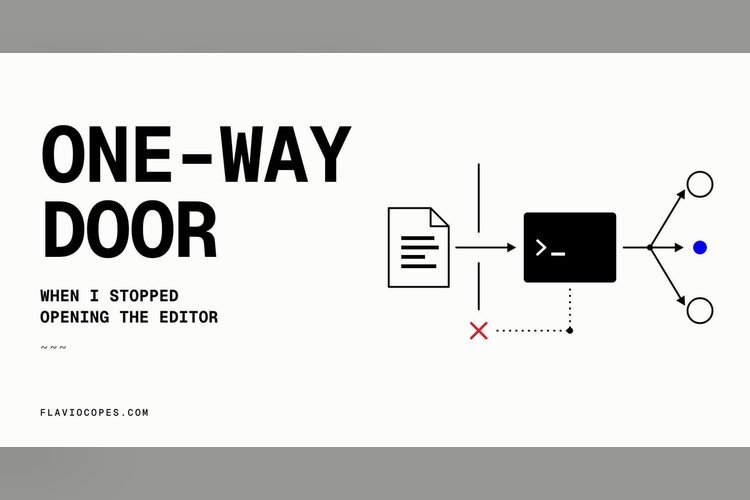
Developer Flavio Copes says writing code by hand is behind him for good, and he can’t say when it ended. Over a year ago he stopped launching an editor first. His workday now begins inside Claude Code, Codex or T3 Code.
His account is one person’s experience, not a study. It is still a concrete example of how far some developers have moved from typing code line by line.
The habit that shifted quietly
Copes describes no turning point. No day stands out as the one he closed the editor for good. The routine drifted until the editor simply wasn’t in it.
In September he published notes from six months of agentic AI work, covering workflows, plans and rules. That post ended with doubt about whether typing code manually still deserved his time. The doubt is gone: he now considers writing code by hand off the table.
Why he calls it a one-way door
Copes argues that an agent looks like a side tool until you commit to it. You plan to call on it now and then and type everything else.
Past that point, typing each line stops feeling like the job. He likens a return to hiking cross-country after getting used to flights. Having watched an idea become working software that quickly, he finds hand edits pointless.
The numbers behind the claim
Copes points to commit counts for his own website. The repository logged 434 commits across 2025. For 2026 up to late November the total is 4,010, with 1,221 of them in November.
That is a single repository. Over the same period he says he shipped more than 50 desktop apps, mostly Mac apps in Swift and a Windows app in .NET. He notes these are languages he couldn’t write by hand even if he wanted to.
Commit counts measure activity, not quality, and they depend on how someone chooses to commit. They do show a large change in output for this one developer. After a few months at that pace, he says, the old pace stops feeling reasonable.
What he says he gave up
Critics tend to ask what the cost was. Copes says he feels no loss. His JavaScript has gone rusty and he skips reading most agent output, a point he covered in an earlier post on AI eroding coding skills, and he isn’t bothered.
He puts his productivity at 100 times what it was when he typed each function. Ideas that sat in a notes file for a year now get built, tested and released within a week, and shipping has become the main task.
The 100x figure is his own estimate and he gives no measurement behind it. He also allows that he may eventually hit a problem where not typing code hurts him, though that hasn’t happened yet.
The developers who haven’t switched
Copes can follow developers who reject AI entirely. What puzzles him is a second group: people who track new models, use AI chat or autocomplete, know what coding agents can build, and still start each day in the editor.
He offers a few guesses. Muscle memory could play a part, or a day job with a team and a legacy codebase where letting go of the keyboard is harder. Some people also just like typing code, which he calls fair.
To him the split feels like two different worlds. Debates over keybindings, or a small feature estimated at two weeks, sound dated. A project that looks large from inside an editor looks like an afternoon with an agent.
What this means for teams
Copes says he isn’t urging anyone to close their editor. Anyone for whom manual coding works, or whose team expects it, should carry on.
For managers, the practical point is about review. Someone who doesn’t read most of the generated code is trusting tests and the agent’s own checks. That matters most on a team codebase, where a legacy system and shared standards make that trust harder to extend. Whether that tradeoff holds up at scale is the open question his post raises but doesn’t test, and it is the one to watch as more developers describe the same switch away from writing code by hand.
Source: flaviocopes.com