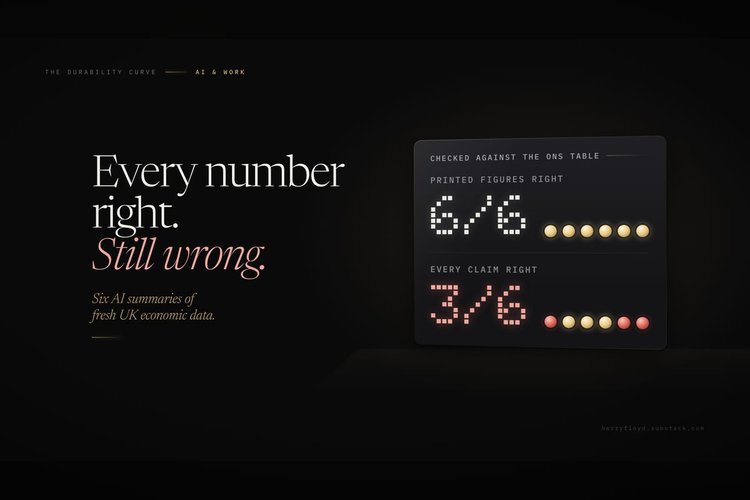
Deciding what to hand to AI at work comes down to two questions: who does the task better, and can you actually catch the AI’s mistakes? A review of 24 published frameworks and several large studies suggests most people’s checks catch less than they think.
Doctors with GPT-4 didn’t beat GPT-4
Three trials tested human review of AI in medicine. In the first, from late 2023, doctors with GPT-4 reached a median of 76% on diagnostic reasoning per case, versus 74% for doctors without it. That difference is within noise. GPT-4 by itself scored 92%. A second trial found physicians with GPT-4 scored 6.5 points above those without it, and about level with the model alone.
The third trial, from 2026, used a purpose-built GPT-4 system. Clinicians managed 75% with their usual resources, 82% when they committed to an answer and then viewed the AI’s, and 85% when they saw the AI’s view first. In none of the three did doctors with the AI beat the AI alone.
Order mattered for independence. When the AI saw the clinician’s answer first, it repeated all three of the clinician’s diagnoses in 14 of 29 checked cases (48%). If it wrote first, only 1 of 29 cases matched (3%).

What 106 experiments show
A 2024 pooled analysis by Michelle Vaccaro, Abdullah Almaatouq and Thomas Malone covered 106 experiments. On average, people with AI beat people alone but not the better of the two working alone. Where the person was the stronger half, the pair beat both. Where the AI was stronger, the pair scored below the AI by itself. An October 2026 update covering 420 papers on generative AI, not yet peer-reviewed, held the same overall pattern.
In a study of 758 BCG consultants using GPT-4 in April 2023, those without AI got one hard task right about 84.5% of the time. The AI groups scored 60% and 70.6%. Graders who didn’t know the right answer found the AI users’ recommendations more persuasive whether right or wrong.
The error also runs the other way. Radiologists given AI predictions more accurate than 78% of them gave the AI too little weight and didn’t improve.
The time cost of checking
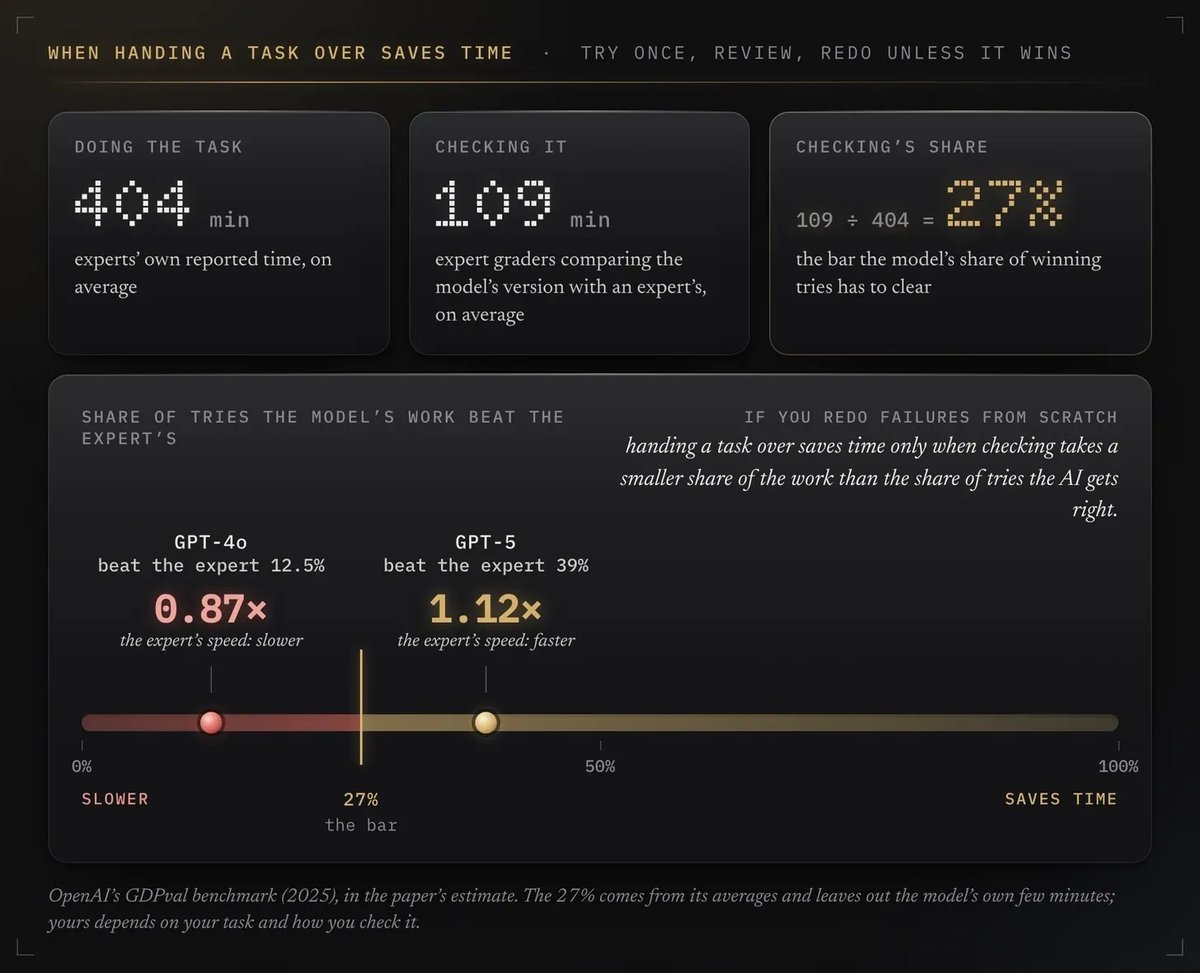
OpenAI’s GDPval benchmark prices review time. Experts took 404 minutes per task, and graders needed 109 minutes to compare a model’s version with an expert’s, a 27% check ratio. Handing work over only pays off if review takes less time, relative to the whole task, than the AI’s success rate.
- GPT-4o beat the expert 12.5% of the time, below 27%, so experts worked at about 0.87 times their normal pace.
- GPT-5 won 39% of the time, so a 90-fold raw speed advantage shrank to 1.12 times.
Those are 2025 models. Ethan Mollick reported in January 2026 that GPT-5.2 matched or beat experts in 72% of cases on that benchmark.

A half-hour check you can run
Feelings are a poor guide. In KPMG and the University of Melbourne’s 2025 survey, 66% of AI-using employees had at least sometimes relied on output without evaluating it, and 56% had made mistakes because of AI.
The suggested test is simple:
- Take a finished example of your riskiest AI task, ideally one with a trap in it.
- Note how long it takes by hand, then give the AI the same inputs.
- Check its version your usual way and time yourself.
- Compare against the known right answer and note which errors your check caught.
A single missed error exposes a weak check. A clean pass proves little: three correct answers in three tries is consistent with a real success rate near 37%.
Two instructions to paste today
For factual work, ask the AI to quote the source text behind every claim, then open the sources yourself. For judgement calls, tell it to commit to its own answer before it sees yours. The sources matter: a 2023 audit of four AI search engines found just 51.5% of their sentences were fully backed by the citations given.
What to do next
Pick the one task where a miss would hurt most and run the half-hour test this week. If your check missed mistakes, change how you use AI there. If checking took as long as doing, handing it over saves nothing. Keep the example as a test card and rerun it whenever your AI app switches models.
Source: The Durability Curve