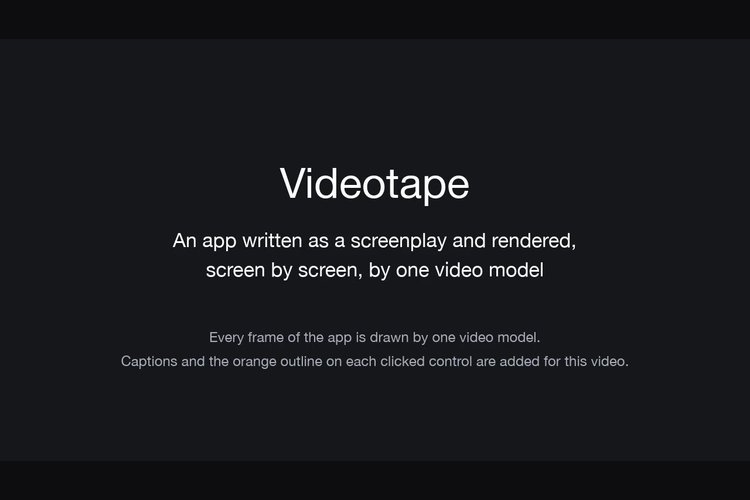
Researchers have built Videotape, a system that makes an app by filming it. The developer writes a screenplay, one video model renders every screen and every transition, and a player lets the user click through the footage. Its demo, a flight-booking app called Contrail, shows the app as video concept working end to end. Code and demo are open source under the Apache License 2.0.
The idea behind filming an app
Generative models already imitate pieces of software. NeuralOS simulates an operating system, GameNGen runs DOOM from earlier frames and key presses, and Genie builds playable worlds from video. The Videotape authors think whole applications come next, with pixels coming from a model and nobody building a front end.
Their pitch is range. Standard toolkits give every app similar boxes, fonts and icons. A video model can draw anything a paragraph describes, so one codebase could look like a dawn departure board in one version and a wall of travel posters in another.
Two inputs, then a render
A developer supplies user stories and a visual style. The stories are written as Python functions, one per screen, with each action pointing to the next screen and data held in JSON files. The style is a short set of prompts covering the overall look, each screen, each element type and each kind of move. Swapping in a different style restyles the app and leaves the code alone.
Before filming, Videotape explores every reachable state. Then one model produces a still per state and a clip per move. Two vision-language models from separate families read each result back, and a line passes only when both match the screenplay exactly. The finished tape is a set of clips plus a small map from each drawn button to its clip. The current player is a native macOS app, and the browser demo plays the same tape.
What Contrail demonstrates
Contrail has search, a date picker, flight lists, bookings, trips and a profile with two charts. The model gemini-omni-flash-1.2 drew all of it. Two visual styles exist, each a tape of 150 shots covering 58 screens and the moves linking them. A UI test followed all 164 steps of each journey on a clean copy. Each tape cost between $149 and $249.
Since the app is a finite graph, problems such as an unreachable screen, a button leading nowhere, or two buttons that look identical are flagged as errors before a frame is shot.
Numbers from the experiments
- A five-screen surf shop trial cost $3.48 with Wan 2.2 TI2V-5B, which drew 3 of 5 buttons legibly, and $15.00 with Wan 3.0, which drew all 5. Neither made screen changes feel like a camera move.
- Among 20 layout variants, drawing each alone preserved the layout 3 times. Starting from the scene’s first image preserved it all 20 times, at $2.35 per passing variant against $9.14.
- Drawing each screen as the end of the move into it let 7 of 12 terminal moves travel, up from 4 of 12, and eliminated cuts.
- The two readers examined 4,364 lines and agreed that 76.1% were exact. In about one line of fourteen only one was right, so both are needed.
Limits the authors admit
A tape grows with its data. Contrail has six destinations and three dates, and anything broader needs states drawn on demand, which doesn’t exist yet. Screens keep no memory, so a booking never shows up under Trips.
Three elements were trimmed to suit the model: the date picker became day tiles, the charts span June to November, and the trips heading changed. Dense numeric visuals, such as line charts, remain hard. Only 53% and 71% of shots were right on the first try, 16 failures were accepted once money ran out, and only one person scored the checks.
The bigger claims, and what comes next
The authors bet that every platform already plays video, that apps could be shared like clips without app store review, and that a player might become the layer apps run on. Device sensors would still need native code. The next steps are fine-tuning an open video model on these takes, then pre-training one for interfaces. Players for iOS, web and Android come first, and they will show whether the app as video approach travels past a single Mac demo.
Source: arjmandi.github.io