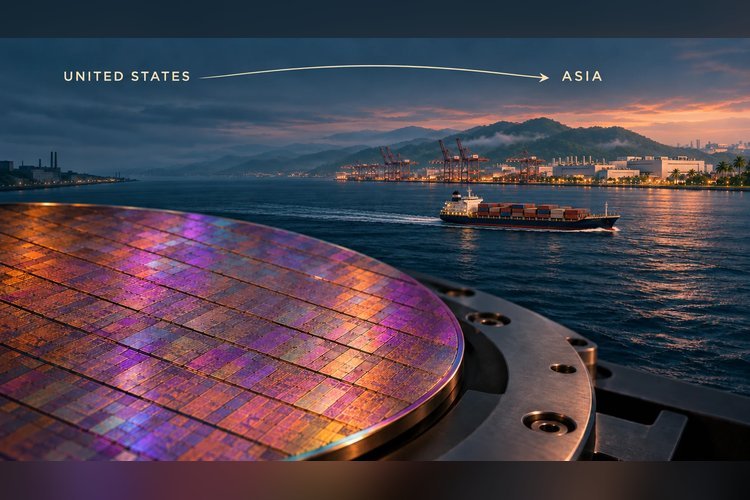
The US still lags badly in chip manufacturing investment, and new 2025 data shows the gap widening. Semiconductor equipment billings in East Asia reached $116.1 billion last year, while North America took just $10.9 billion. That is the core finding of a fresh look at how American companies came to rely on offshore chip manufacturing between 1963 and 2026.
The 2025 equipment numbers
Industry group SEMI tracks billings for new chipmaking tools, covering both front-end wafer fabs and back-end assembly and test, by destination region. East Asia booked $116.1 billion in 2025, three years on from the CHIPS Act. China accounted for $49.3 billion, Taiwan $31.5 billion, South Korea $25.8 billion and Japan $9.5 billion.
North America dropped 20.5% to $10.9 billion. It held 8.1% of global equipment billings, against 85.9% for East Asia. Asia’s lead had shrunk to 6.9 times in 2024 ($94.4 billion against $13.7 billion), then jumped back to 10.7 times.
The last year North America topped any single SEMI region was 2011, with $9.3 billion, just ahead of South Korea ($8.7 billion) and Taiwan ($8.5 billion). By 2021 East Asia’s yearly lead had grown to 11.5 times.
Sixteen years of spending
A separate tally of capital spending by 73 major chip, memory, wafer, optics, substrate, packaging and tool companies from 2010 to 2025 sorts money by where factories physically stand. Plants that foreign companies run in the US count as American soil. That covers TSMC Arizona, Samsung in Austin and Taylor, GlobalWafers in Texas, Bosch in Roseville and NXP in Austin, about $75 billion combined.
- East and Southeast Asia: $1.19 trillion, including about $173 billion from US firms and about $28.5 billion from European companies such as Infineon, Siltronic, ams-OSRAM and STMicro.
- US soil: $339 billion, a 3.5 times gap.
- Five years of CHIPS Act fab grants: $39 billion, about 30 times smaller than the Asian total.
Measured by equipment billings across those 16 years, East Asia leads North America 6.7 times, $852 billion to $127 billion. The difference from the 3.5 times figure has two causes. Chinese state-backed private fabs like YMTC (and CXMT until it listed in July 2026) purchase tools that appear in SEMI’s numbers but in no public company filing. Also, an Arizona or Ohio fab costs two to three times as much as an Asian one for the same wafer equipment, so US dollars buy less actual capacity.
Where the money went instead
Thirty publicly listed East Asian firms invested $1.05 trillion in factories between 2010 and 2025. Over those years, 26 core US chip and tool companies sent $755.5 billion to shareholders, $482.8 billion in buybacks and $272.7 billion in dividends. They spent only about $246 billion on US plants, or about $264 billion across all 30 US firms including GlobalFoundries and Wolfspeed.
Even that money partly leaks abroad. Roughly 75% of a fab budget goes to equipment and 25% to construction, and much of the gear is sourced from ASML (Netherlands), Tokyo Electron and SCREEN (Japan) and US toolmakers who assemble in Singapore and Malaysia. Only about 25 cents of each global capital dollar US chipmakers spend lands in US construction (14 cents) and US-assembled tools (11 cents).
Designers profit, East Asia builds
American-headquartered companies captured 53.4% of worldwide chip revenue in 2025, compared with 36.5% in 1990. They also supply more than 72% of electronic design automation software and over 40% of wafer-fabrication equipment. The four biggest US fabless designers, Nvidia, Broadcom, AMD and Qualcomm, earned $480.6 billion in revenue and $252.4 billion in net income over their latest twelve months, on just $27.5 billion of net property, plant and equipment.
Physical capital keeps compounding in Asia. TSMC’s noncurrent assets in the US slid from 16.0% to 13.9% in 2025, while Taiwan’s share climbed to 80.0%. In fiscal 2026 Micron added more property and equipment in Taiwan ($8.65 billion) than in the US ($6.02 billion). Its US share is 22.6% ($14.5 billion), and the new Boise and Clay fabs won’t produce wafers until mid-2027 and 2030 respectively. Intel’s US net property and equipment peaked at $72.1 billion in 2024 and slipped to $71.2 billion in 2025.
What it takes to close the gap
The numbers suggest subsidizing factory shells will not be enough. Higher US construction costs, a tool supply chain based abroad and a decade of payouts that outran plant spending all work against catching up. Next year’s equipment billings will show whether the CHIPS-era buildout can again narrow the 10.7 times gap seen in 2025.
Source: everysingleindicator.com