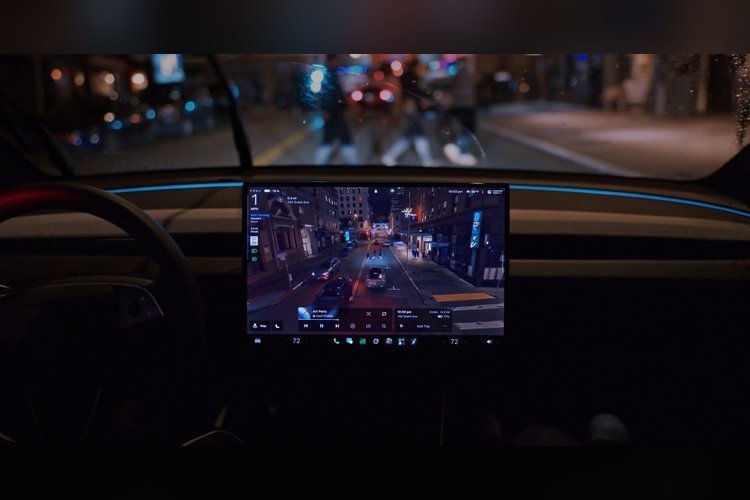
Tesla FSD v15 has started rolling out to owners, and the release notes read like a checklist of the system’s best-known problems: missed road signs, potholes and speeding in school zones. Tesla also claims a 25x improvement in handling safety-critical cases. The company announced the update on X, and its Tesla Super Intelligence account followed with the full notes.
Tesla hasn’t said which vehicles get the software first. Investors were told earlier that cars with the AI4 (HW4) computer have the horsepower for v15.
What Tesla FSD v15 changes
Tesla describes v15 as a rework touching each piece of its end-to-end driving stack. The headline change is a new vision encoder shared by FSD, Robotaxi and the Optimus robot. It was trained on millions of internet videos, and Tesla says it improves the critical intervention rate by 25x.
- A single visualization called Tesla Augmented Reality that replaces the separate model signals and uses less compute.
- Navigation built on a model trained with route preference data from the fleet.
- Parking spot selection based on your own parking history, with several options shown at the destination.
- Better detection of road signs, small animals, debris, chains, potholes and deep standing water.
- Speed handling tuned for each driver profile, school zones, speed limits and bad weather.
- Gear changes in Autoshift that follow FSD’s own gear predictions.
The main announcement adds two more items. the car will now ease off for speed cameras, and a Bike Rack Mode lets it run with a bike rack or similar hitch accessory fitted. The navigation learning currently covers only the start and end of a trip. Tesla says later v15 releases will extend it to the whole route.
Reality View changes the screen
The most visible change is the display. In Tesla’s video, the center screen draws a rich, lifelike model of the surroundings, a big step up from current FSD graphics. The announcement names it Reality View. Tesla pitches it as a way for drivers to watch and steer the car’s plans.
If it works on real roads, supervising the car gets easier. A driver who can see what the system intends to do can step in sooner.
Where v15 goes after known weak spots
Almost every driving fix in the notes hits something owners and regulators already complain about.
Signs come first. A September test by the Brussels nonprofit Johanna.be measured FSD speeding in 55% of the 30 km/h areas on its route, at an average of 44 km/h. The dashboard typically displayed 50 km/h there, so the sign went unread.
Potholes are next. In August, Elon Musk said pothole avoidance was “coming soon,” a feature he had already promised in 2019. FSD still drives straight through them today.
School zones matter for regulatory reasons. NHTSA is reviewing a petition claiming Tesla’s Robotaxis speed through active school zones. A separate NHTSA probe from October 2025 covers FSD breaking traffic laws, red-light running among them. Easing off near speed cameras fits that pressure, though it also hints that the car may exceed limits when no camera is around.
One change goes in the opposite direction. Driver monitoring gets looser for the higher-speed driver profiles. That comes while stories about sleeping drivers on FSD keep appearing and while Tesla tightens monitoring in Europe at regulators’ request.
What the 25x figure means
The notes clarify that 25x refers to the critical intervention rate, which is the right metric for judging progress toward unsupervised driving. Tesla still hasn’t published the underlying number, only the multiplier.
A rough calculation shows why that matters. Earlier estimates put FSD v14 at a couple of thousand miles between critical interventions. Multiply that by 25 and v15 lands near 50,000 miles, well beyond the roughly 10,000 miles that a limited unsupervised service would need. That only works if the gain holds across the whole fleet, and nothing public confirms it yet.
A record of big promises
Expectations are already high. In April, Musk predicted v15 would be far safer than a human driver, even fully unsupervised in complicated settings. He had made similar predictions for v12 and v14. By August, Tesla was describing v15 to JPMorgan as a step-change resting on seven core technologies, roughly 40% of which already ran in the Austin Robotaxi fleet.
Progress on FSD has been uneven. v14 launched in October 2025 with phantom obstacles, hard braking and speeding, and early crowdsourced tallies came to about 732 miles per critical disengagement. Later builds improved a lot, then v14.2 regressed, and Musk sold v14.3 as the release that would finally supply the missing final piece.
Seven months and a string of point releases on, owners still have to supervise. The job v14.3 was supposed to do now falls to the new version.
What to watch after the rollout
Tesla FSD v15 brings a visible redesign that can be judged from the video, but the driving gains can’t, because “improved detection” says nothing about how much better the car is. Independent checks on sign reading, pothole avoidance and school-zone speeds will show quickly whether the update fixes what it targets.
The bigger test is data. Until Tesla publishes real critical intervention figures, or files for California’s driverless testing permit, which requires disclosing such numbers, the 25x claim stays hard to verify.
Source: Electrek