
Strands Decider v2 is out, and it comes as five open models built on Gemma 4, ranging from E2B to 31B. They’re released under the Apache-2.0 license, with weights on Hugging Face and v2 support added to the project’s open-source repository.
The makers call Decider a system one model. It never writes text. You hand it a set of choices and it returns a probability for each in one forward pass.
Why a model that only chooses
Plenty of agent decisions have a closed set of answers, such as picking a tool, routing a request or judging whether a reply is good enough. A full language model can do that work, but at a high price. Engineers on one of Amazon’s biggest internal ticketing systems used v1 instead of Claude Sonnet 4.6 to label tickets. They report 98% lower cost and calls that finished 78% faster.
Users outside Amazon have applied it to model routing, tool selection and guardrails. One even classifies browser tabs locally with WebGPU. The install is a single pip command, pip install strands-decider, and a decision takes one call that returns a probability per option, with no parsing.

The v2 numbers
Strands Decider v2 31B averages 82.1 across six public text benchmarks, compared with 70.0 for the v1 26B-A4B model. Image tasks come in at 90.1 and video tasks at 70.2. Smaller sizes gain too: v2 E4B rises from 62.7 to 74.4 on the same average.
Calibration also improved. The 31B model has an expected calibration error of 0.027, down from 0.062. Better calibration matters because an agent can read the confidence score and choose between acting, escalating to a bigger model and asking a person.

What changed under the hood
The design behind Strands Decider v2 differs from v1 in three places: how it scores answers, how it handles context and how it was trained.
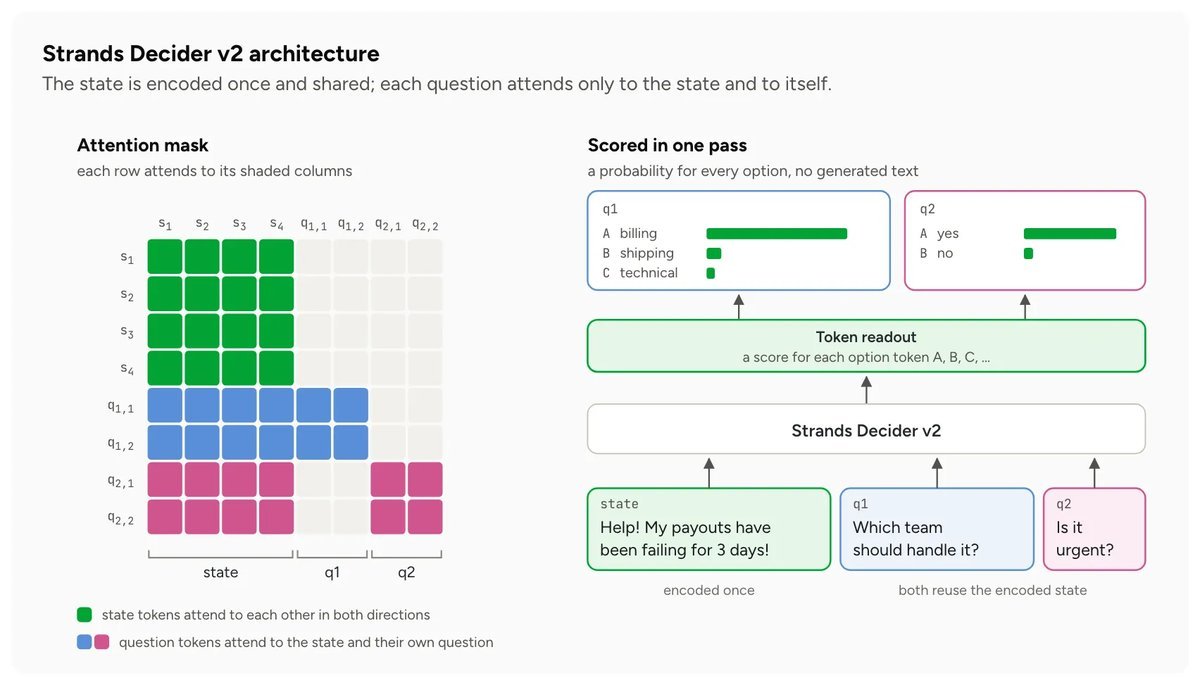
v1 used an added pointer head to pick an answer. v2 replaces the language-model head with a token readout. It’s a 255-row layer seeded from the original rows for option tokens like A, B and C, and it’s trained along with the model. Each probability is taken from the matching token at the prompt’s final position.
v2 also encodes shared context once, using attention in both directions. Each added question only needs to process its own tokens. Since a decision model never generates text, it doesn’t need causal attention, so a detail early in a long agent trace can be read in light of the question that follows.
Training used 17.48 million decision examples for one epoch, starting from each Gemma 4 instruction-tuned model. The data mixes openly licensed human-labeled sets, synthetic examples made from task descriptions and problems with computed answers. The team used rank-64 LoRA, averaged weights from three seeds, and tuned a calibration temperature on questions held out from training. That value is included in the released checkpoint.
Routing and cascading results
Calibration makes a cascade work: a small model answers first, and a large one steps in only when Decider is unsure. On AutoMix reading-comprehension tests, the half of Llama-2-13B’s answers that v2 rated least reliable went to Llama-2-70B. That captured 94% to 99% of the bigger model’s improvement, while a random half captured 50%.
As a router with no fine-tuning, Decider divided customer-service and app-automation requests between two Claude models, Haiku 5.5 and Sonnet 5.5. Against Sonnet working alone, it completed 94% as many tasks while spending 44% as much. On LLMRouterBench, a DeepSeek V3 and Gemini 2.5 Pro pairing delivered 88% of Gemini’s accuracy for 18% of the price.
Where to run it next
Amazon Bedrock AgentCore Evaluations uses Decider in custom evaluators. It checks each interaction for unsupported claims, and an LLM evaluator reviews only the cases Decider flags or can’t judge confidently. In a simulation, v2 31B even steered a robot arm by choosing each movement from a short menu, finishing a two-mug task in 25 decisions.
You can run the same server locally with CUDA, on a Mac or just on CPU, or deploy it to a SageMaker AI endpoint or AWS Lambda. For developers building agents, the quickstart in the repository is the place to begin. Anyone already building agents with Strands can place Strands Decider v2 straight into an agent loop, for example to gate a tool call so an ambiguous request prompts a clarifying question.
Source: Strands Agents