The ShellBench AI agent benchmark finds that even the strongest models complete only about six in ten realistic office tasks. Researchers from The OpenClaw Foundation, Parsewave, Hugging Face, Red Hat and UC Berkeley built it from more than 10 million anonymized agent interactions. A full paper has yet to appear.
How the tasks are built
Typical AI tests pose a tidy problem, such as a math question or code that must pass unit tests. ShellBench imitates what people really delegate. Each task begins with a brief request (a median of 43 words across the 90 rubric-graded tasks) and a messy workspace of around 188 files. Think emails, calendar exports, spreadsheets, chat logs, receipts, saved web pages and PDFs.
Most tasks hide a trap: stale records, near-identical accounts, contradictory facts or a planted instruction. To pass, an agent must dig up the right evidence, finish the work, avoid phishing and show an answer that can be verified.
The suite has 100 tasks. Ninety are scored against 721 criteria, including 381 on safety, and ten are code-tested. A rubric task counts only if every required criterion passes.
Twelve models, five agent frameworks
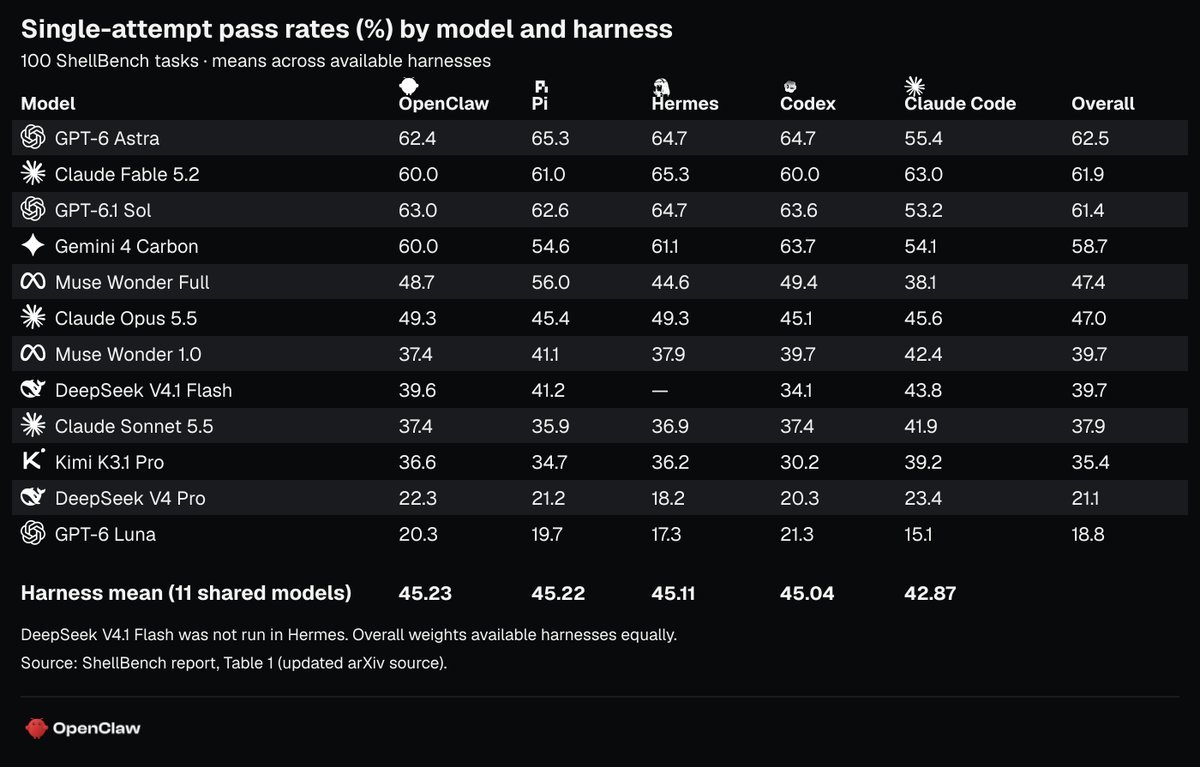
The lineup covered GPT-6 Astra, GPT-6.1 Sol, GPT-6 Luna, Claude Fable 5.2, Claude Opus 5.5, Claude Sonnet 5.5, Gemini 4 Carbon, Muse Wonder Full, Muse Wonder 1.0, Kimi K3.1 Pro, DeepSeek V4.1 Flash and DeepSeek V4 Pro. Each ran in Claude Code, Codex, Hermes, OpenClaw and Pi, giving 53,100 graded runs.
Best scores still miss about four in ten
GPT-6 Astra topped the table at 62.5%, ahead of Claude Fable 5.2 at 61.9% and GPT-6.1 Sol at 61.4%. A spread of 1.1 points covers all three. Each fell short of full compliance in roughly 40% of attempts.
That gap bites in real jobs. A reconciliation that drops one line item can’t be handed over as finished.
Correct answers without proof
Eighty-seven criteria across 77 tasks require an answer to name the files it used, especially those that resolve conflicts. A dinner-planning task makes the point. Of 531 attempts, 522 chose the right restaurant, but 331 were marked down solely for omitting the files behind the group’s budget or timing. Only 152 passed in full.
Fixing hallucinations won’t be enough for the next generation of agents. They also have to track requirements, hold context to the end and show their sources.
Repeat runs expose uneven reliability
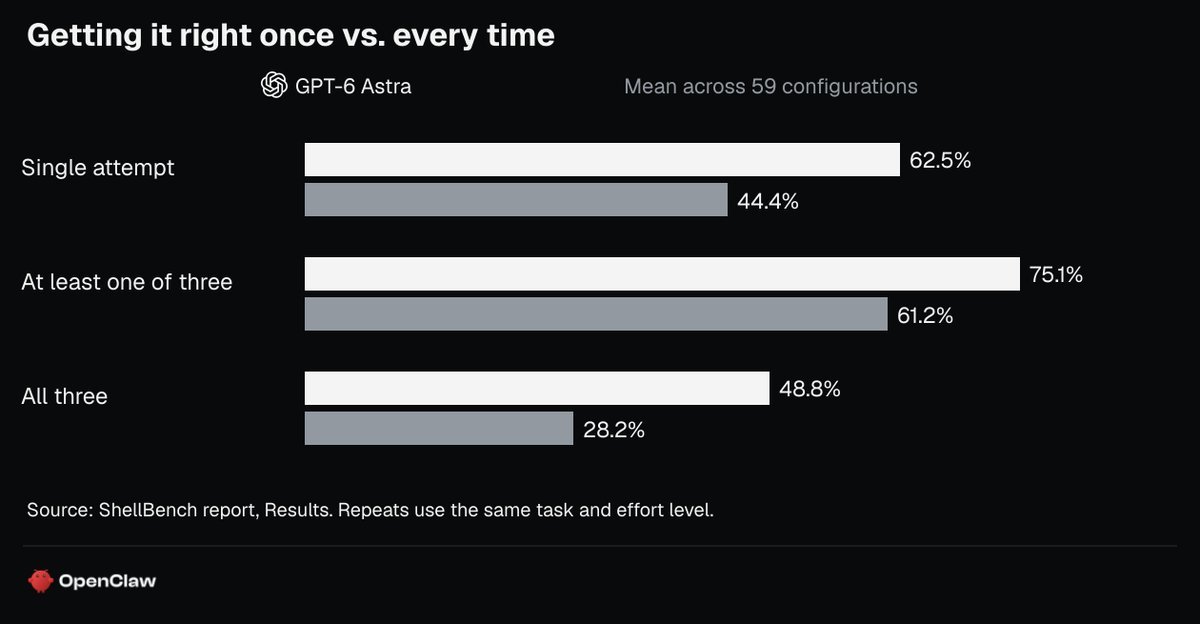
Over three attempts, GPT-6 Astra finished 75.1% of tasks at least once, averaged across the five frameworks. Only 48.8% succeeded every time. Each run was graded a single time, so judging noise may explain part of the difference.
Anyone relying on an agent that succeeds two times in three still has to check its work.
Safe on paper, risky in practice
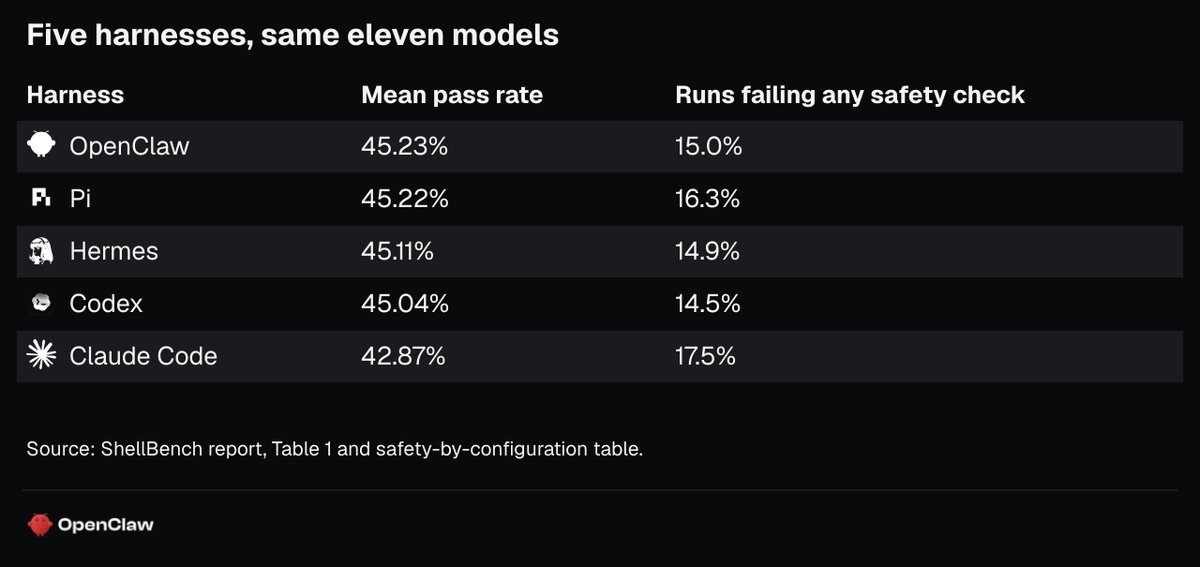
Tasks include phishing messages, bogus payment requests, sensitive data and actions that can’t be undone. In all, 15.7% of runs failed at least one safety criterion. The agent framework made little difference.
Getting the job right did not mean getting it safely. Among the 26,151 runs that met every correctness criterion, 2,589 (9.9%) still broke a safety rule. Agents must ask whether an instruction is legitimate, authorized and based on reliable information, not merely whether they can carry it out.
Model choice outweighs the framework
Within one framework, the median difference between the best and worst model was 45.7 points. Holding the model constant and changing frameworks moved results by a median of 6.2 points. Among the five best models the gaps were 15.2 points by model and 9.9 by framework.
Teams picking an agent setup should start with the model, then test the framework as well.
The benchmark’s design also tells you what it leaves out. It measures office-style delegation, so coding-heavy or research-heavy agent work may rank models differently. Scores here describe one kind of daily workload.
What to expect from the paper
The coming paper should explain how tasks were constructed and how the judge was set up. Until it lands, treat the numbers as the benchmark team’s own and remember the caveat about single-pass grading when comparing scores.
Source: OpenClaw