Shared CXL memory comes with a software tax, according to a hardware test by researchers at the University of Texas at Arlington and Intel. When four servers shared one memory pool, every lock taken on shared data added a delay of 3 to 5 microseconds. The results were presented at Supercomputer 2026 (SC26), just as memory makers are pitching CXL pools as a home for AI’s KV cache.
Why locks get expensive
Think of a lock as a traffic light for shared data. A server takes it before modifying anything in the pool while the rest wait, so two machines never write the same data at once. Within one machine, CPU hardware passes the lock along in well under a microsecond.
Between servers, the hardware gives no such help. The test platform lacks cross-host cache coherence and atomic operations, which pushes both jobs onto software. Writers push their cached copy out to the pool and wait for it to finish. Readers discard stale copies before reading. The locks themselves are built from plain reads and writes, using methods such as Lamport’s fast mutex.
CXL 3.0 defines a hardware fix for the cache problem, called Back-Invalidate. The researchers had no vendor confirmation that their platform supports it.
The shared CXL memory test setup and numbers
The rig used four 86-core Intel Xeon 6787P servers with 256GB of DRAM each, linked over PCIe 5.0 to a single CXL memory box. That switch is the only commercially available option the team could use, according to UT Arlington’s Peiran Du, and it limits the setup to four servers.
Cross-host visibility took about 0.94 µs one way, compared with 1.91 µs for an RDMA write on their 400Gb/s InfiniBand, so the link isn’t the culprit. A local compare-and-swap takes about 100 ns. Across servers, a lock’s median time was 3.7 µs when uncontended and 132 µs at the 95th percentile when several servers fought over one lock. That’s roughly an order of magnitude slower than a local hardware spin lock.

What scaled and what didn’t
Breadth-first search, a common graph benchmark, got no benefit from a second host and ran slower on four: 0.74 seconds against 0.55 on a single server. Locks and barriers took only about 3.5% of the time. Most of the penalty came from flushing shared state again at each level of the search.
A hash table with independent buckets and per-host allocators fared far better, with throughput growing almost linearly as hosts were added. Triangle counting, another graph benchmark, ran in less than half the time going from one host to four.
Why KV cache makers are watching
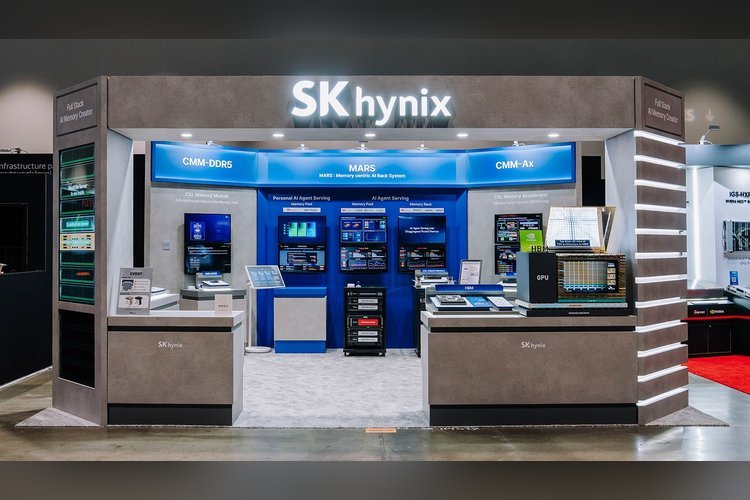
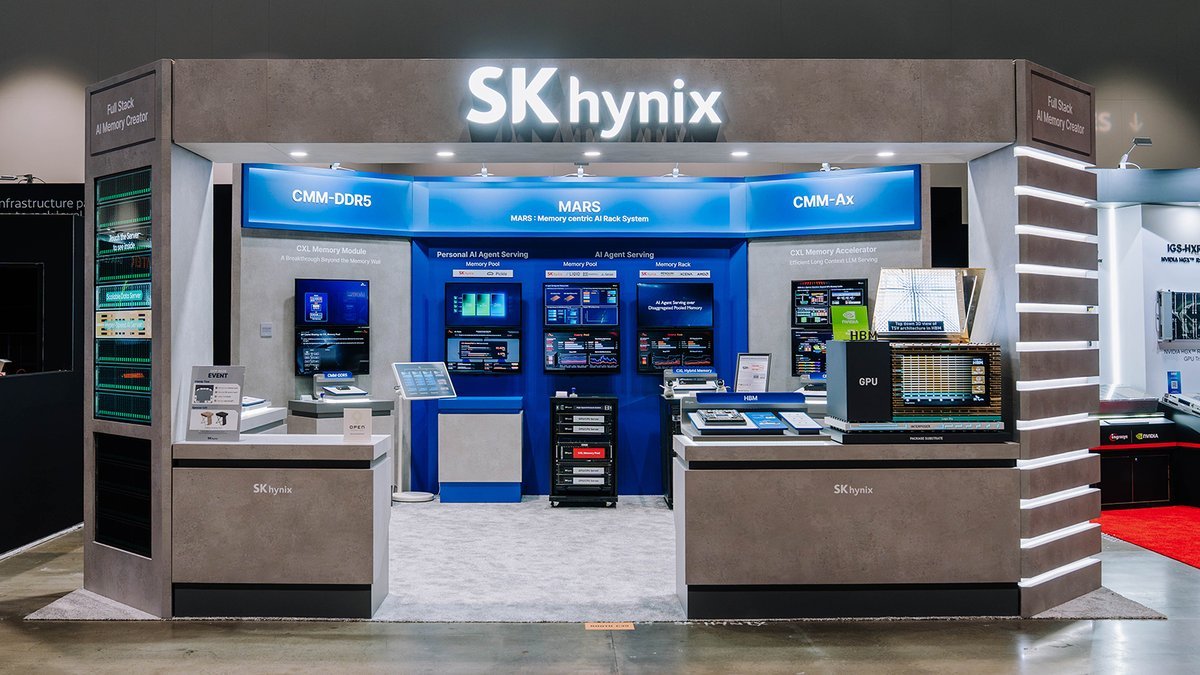
KV cache holds what a model has already worked out about a conversation. Once it no longer fits in GPU memory or local DRAM, a shared pool is a natural overflow area. SK hynix showed a design that passes KV cache between GPU servers through a pool and claims 2.6x faster time to first token than standard RDMA setups, plus 3.0x lower P99 latency and 1.9x higher throughput. Micron showed its Abaco reference design, claiming 10x to 30x agentic AI gains.
Demand is not in doubt. Nvidia Research’s Vikram Sharma Mailthody said the KV footprint per token halves about every twelve months, yet context windows keep stretching toward millions of tokens. Agents add pressure too: a session that calls back about two minutes later, once its tools return, can find only 1% of its context in a 160 GiB cache, forcing the GPU to recompute the rest.
Capacity, then, matters more than raw speed. Prices push the same way: last year a 128GB DIMM cost over four times as much as a 64GB module. Intel’s Anil Godbole argued that CXL can add memory beyond the number of DIMM slots, including reused DDR4.
Why the results may be less grim for KV cache
Passing KV cache between servers is a write-once, read-many job, the pattern that scaled well in the tests, although the UT Arlington team never ran KV cache itself. Researchers behind the OCEAN CXL emulator said software coherence is fine for read-heavy work, while hardware matters more as writes climb. In emulation, hardware coherence gave an 11x gain at full coverage on Tigon database workloads.
Micron laid out two ways this goes wrong: written data never arrives in the pool, or a reader misses an update. The remedy is a flush by the producer before a block is published and an invalidation of cached lines by the consumer before it reads. Because KV cache is content-addressed, Micron flushes each slot only once to save time. Nothing crashes in either failure. Reads return believable but incorrect data, and some requests end up with the wrong tokens when the cache is under pressure.
Where the technology still falls short
Godbole noted that pooling stops at the rack boundary today. CXL also handles small 64-byte accesses, so RDMA is the better tool for bulk transfers. Marvell, Penguin Solutions and Lightelligence have demonstrated pooling over optical links, which could extend reach past a single rack.
UT Arlington’s Jia Rao said vendors’ implementations don’t always match the CXL specification. SK hynix’s 256GB second-generation CMM-DDR5 has only been shown, and its KV-selection device remains a research prototype. A research system called Beluga reported an 89.6% cut in time to first token and 7.35x higher throughput against an RDMA setup using a commercial CXL switch pool.
What to watch next
No commercial switch yet ships with confirmed coherence across servers, so every KV cache figure for shared CXL memory comes from vendor demos and prototypes. Back-Invalidate should reduce the software overhead UT Arlington measured, but Du expects it to bring delays of its own. Real deployments will likely mix hardware coherence with software techniques like Micron’s.
Source: Tom's Hardware