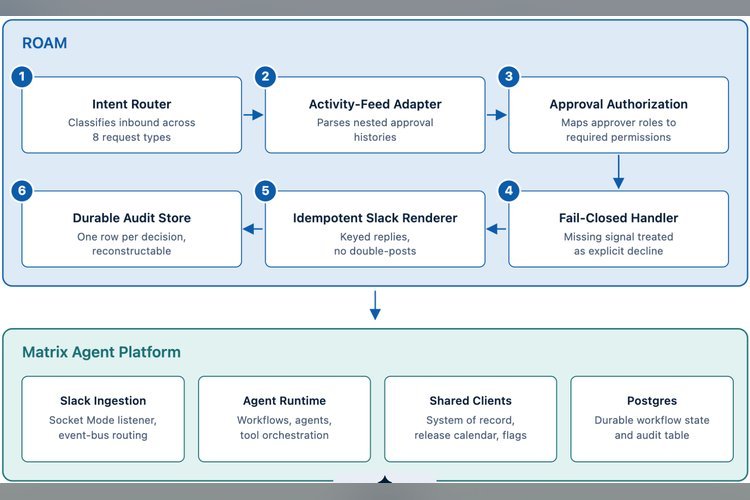
Salesforce ROAM, an AI agent for release operations, now reviews production change requests in a median of about 12 seconds. The same review used to take around 24 hours. The tool covers 18 Salesforce products and became mandatory for every production patch after a three-week trial.
The agent is short for Release Operations Agentic Manager. Its design rule is simple: deterministic code decides, and the language model only explains.
The bottleneck it replaced
The Salesforce ROAM project began with a worry about what an AI might do if it approved a change on the assumption that QA and an architect had signed off, without ever checking either.
Kamal Devarakonda, a senior director of software engineering at Salesforce, leads the team behind it. The team handled 15 to 20 production patches a week, including for Revenue Cloud. Evidence for each one sat in Slack threads, change records, QA results and release calendars.
Requesters chased updates, reviewers asked for missing links, and cloud leaders couldn’t see which changes were blocked. A plain checklist wouldn’t work, because approvals were buried in nested comments and each team followed its own conventions. A strict list would reject valid changes, and a loose one would let risky ones through.
So the team mapped the full Change Advisory Board (CAB) process and committed the flow diagrams to GitHub. Then it built ROAM on an Agentforce-style design, running on Salesforce’s internal Matrix Agent Platform. When the team was interviewed, a person still clicked the final approval.
A silent bug that shaped the design
An early production incident taught the team a lesson. One client read the wrong field name in nested Slack replies and silently dropped some approvals, so the model saw an incomplete history.
The fix was API contract testing. Recorded live payloads are checked on every pull request, and a mismatch fails the build. The team’s view is that a better prompt cannot recover an approval that never reached the model.
The gate decides, the model narrates
Code reads the change fields, the linked test run, the pull request and the approval trail. The model writes the explanation but cannot create or overturn a verdict. If the two disagree, the model loses. After generation, a validation step re-reads the change record and rejects any explanation that conflicts with the evidence.
Each requirement is checked on its own:
- QA needs a passing linked test run on the target release branch.
- Code review needs two approving developers with commit rights, not counting the pull request’s author.
- Architect signoff must come from the architect named in the change record.
- Cloud-leader approval must come from a current member of a versioned leader roster.
When a gate can’t be verified, the request goes to a human. About 8% of requests get no automated decision. Duplicate-post guards and idempotency keys stop retries from changing outcomes, and every result goes into a durable audit table.
Building the agent with AI help
About 70% of the ROAM code was drafted or refined with Agentforce-assisted coding. Engineers wrote the rest, including core orchestration and the activity-feed parsers. Generated pull requests could run to hundreds of lines, and test runners sometimes skipped suites while reporting green.
The team reviewed every AI-assisted change line by line. A verifier agent reruns affected test suites and checks exit codes before trusting a fix agent’s report. Coverage reached the nineties against an 80% target, and ROAM reached production in about four weeks.
The results
Speed alone wouldn’t have earned the release team’s trust, so the team judged ROAM on whether it could verify complete requests and decline unclear ones.
Across roughly 550 CAB reviews over 10 weeks, Salesforce ROAM produced zero incorrect approvals. The 95th percentile response time was under 45 seconds, and most latency came from upstream API calls. A manual database query for pending CABs became a slash command that returns in under a second.
What happens next
Release engineering has made ROAM mandatory across all 18 supported clouds. The team says it optimized for accuracy over the share of reviews automated, which is why that 8% still goes to people. Other teams building agents on approvals or compliance checks can copy the pattern: verify first, let the model explain, and send anything unclear to a human.
Source: Salesforce Engineering Blog