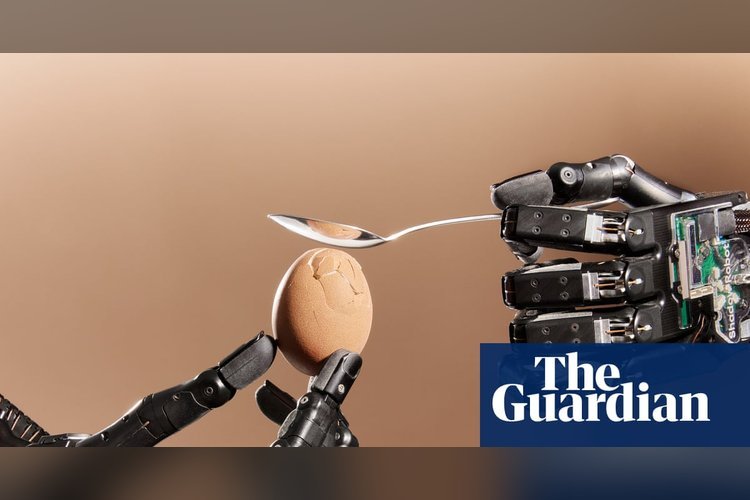
Robot hands are what still holds back humanoid machines, and a visit to an Amazon warehouse near Luton shows why. The site is the size of four football pitches. Yellow shelving units glide around the floor while software decides nearly every judgment call, and people supply the hands.
The system lights up the exact spot on a shelf where a worker should place each item. It also picks the size of the box for an order and the amount of tape to seal it. Amazon employs more than 1.5 million people worldwide.
Why the hand is the hard part
Humanoid robots, often called embodied AI, have improved quickly over the past decade. China recently held a five-day robot Olympics. But a machine that can pack a shelf, tighten a bolt and pick a raspberry has proved surprisingly hard to build.
Alistair Hunter, a hand and wrist surgeon at University College London hospitals, explains the difficulty. A hand contains 27 bones, and nerves and muscles run through all of them. Behind that sits the brain, which reads what the hand senses and adjusts every millisecond. Specialist receptors detect vibration, roughness and smoothness, and how the fingers stretch around an object.
Take a raspberry. Your fingertips register how soft and slippery it is, your brain checks that against expectation, and your grip eases off if the fruit begins to squash. That feedback takes about a tenth of a second. The brain also predicts the right pressure before contact, which Hunter calls feed forward. That’s partly why a baby fumbles: the predictive model isn’t built yet.
Replicating both feedback and feed forward at once, using a model learned over years of experience, is what makes dexterity so hard for engineers. Hunter expects robots to get there eventually, though he says building a computer that predicts the outside world and returns the right sensory information will be difficult.
Money is already moving
Investors are betting humanoid robots will become as common as large language models. The Chinese government has pledged more than £100bn for robotics and high-tech industries over the next two decades. Earlier this year Tesla halted production of the Model X and Model S so its factories could build Optimus humanoid robots.
Tesla chief executive Elon Musk has been direct about the obstacle. “In order to create a robot that can be a generalised humanoid, you must solve the hands problem,” he told a conference last year.
Where dexterous hands come from
Hunter argues that humans owe their evolutionary edge to intelligence and dexterity together. Over millions of years the hand separated from the limbs, fingers learned to grasp branches, and larger thumbs followed. Tool use began about three million years ago, once the joint at the base of the thumb allowed both a fine pincer grip and a strong grasp.
Shadow Robot, based a minute from London’s Hampstead Heath, is Europe’s premier maker of dexterous hands. It started in the 1980s as a collective of hobbyists meeting in a north London attic. The company was founded after its first commercial order in 1997, for a leg. For about a decade its focus has been hands alone.
Until robots match human dexterity, people will stay necessary on warehouse floors. That marks how far automation can go today. Machines handle the movement and the decisions, and workers handle the touch. Engineers have long built task-specific robots for the same reason: copying everything a human hand can do is a far bigger job.
What happens if the hands problem gets solved
The open question is employment. If engineers replicate the human hand, then combined with AI, few jobs would be safe from automation, including manual trades that people often suggest as a fallback.
The warehouse offers a preview. Amazon’s guides describe a partnership of robots and humans, with robots doing the work that doesn’t tire. The people are there for what machines still can’t do. Watch for the first products that combine reliable fingertip sensing with prediction, since that’s the point where this arrangement could change.
Source: the Guardian