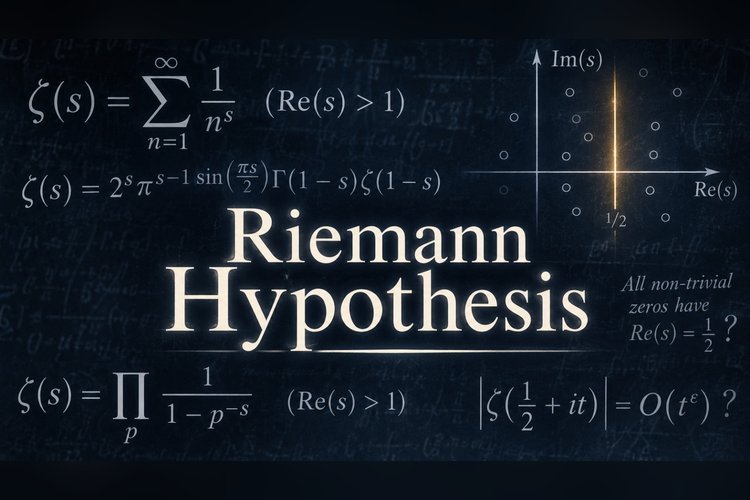
Two claimed Riemann Hypothesis proof attempts surfaced within hours of each other on Friday. One was produced with AI help and released only as computer-checkable code. The other is a traditional human argument, published in a hurry by the president of the American Mathematical Society. Neither has been confirmed.
The problem has stood open for 167 years. If both claims hold, it will have been solved twice in one day.
The AI-assisted claim
Levent Alpöge, a mathematician at Anthropic, posted a note on his website claiming to have proven the Riemann Hypothesis and its generalization, GRH. He worked with Claude and released the result only as Lean code. The note says a human-readable write-up would exceed 250,000 pages.
Its appeal is machine verifiability. Early on, mathematician Elliot Glazer judged that the formal statement in the code does state GRH, and Andrew Sutherland of MIT built the Lean code on his own. Compiling alone doesn’t settle things, since experts must still confirm that the definitions are right and no extra assumptions crept in. Understanding is the missing piece, and the author himself says some parts lie outside his expertise.
By Alpöge’s own timeline, the effort ran 41 days, October 6 through November 16. It adapts Stepanov’s method from function fields, using iterated theta lifts.
The all-human claim
Within hours, Ravi Vakil of Stanford, who presides over the AMS, published a short blog post saying Alessandro Masullo has put forward a GRH proof. Vakil wrote that it is “all human, with no AI.”
Vakil says Brian Conrad, the Stanford number theorist known for exacting standards, has examined the proof closely for months and given extensive feedback. It is “so far looking good,” Vakil wrote. The original plan was a year-long Stanford stay for Masullo to refine the draft before any announcement. Vakil released the current version instead and asked the community to check it, formalize it and fill small gaps.
His post doesn’t mention Alpöge or Claude. The timing makes the reason for the rush easy to guess. Vakil does say there is a longer story to tell later, and that he hopes very much the proof works.
Two different kinds of evidence
A computer can check the first, though nobody yet grasps it. People can read the second, though it hasn’t been fully verified. Masullo’s draft is unpolished and unformalized, and its main endorsement is Conrad’s private review, which Vakil calls encouraging but not final.
Masullo is little known outside specialist circles. He co-wrote lecture notes with Conrad on the étale cohomology of number fields. Science journalist Kevin Hartnett wrote that Masullo “thought he had more time but didn’t.”
A pattern of rushed releases
Glazer argued that holding results back until they’re fully confirmed no longer works as a strategy, and that people should post sketches sooner. A rival announcement has now forced an early release twice in three months. In September, OpenAI announced a Navier-Stokes proof hours after Alpöge and NYU’s Tristan Buckmaster published related work, leading to a bitter credit dispute. This Friday, Buckmaster and Alpöge posted a Navier-Stokes blow-up proof, with no rival forcing their hand, explaining that “after last time, we couldn’t risk waiting.”
Who gets credit?
Convention gives credit to the first person to publish a complete, correct proof. Here the first public claim is unreadable, and the second spent months in private circulation. The two arguments look independent. The Clay Mathematics Institute won’t award the $1 million Millennium Prize until a proof has been published and has stood accepted for two years, so no prize decision is near. If both hold, shared recognition is possible.
What to watch in the coming days
For Alpöge’s claim, watch whether other people’s builds of the code also succeed, and whether experts agree the Lean statements capture the Riemann Hypothesis with no added axioms. For Masullo’s, mathematicians now have the draft Vakil hoped they would read, and it starts with months of Conrad’s review behind it. Checking both has only just begun.
Source: OfficeChai