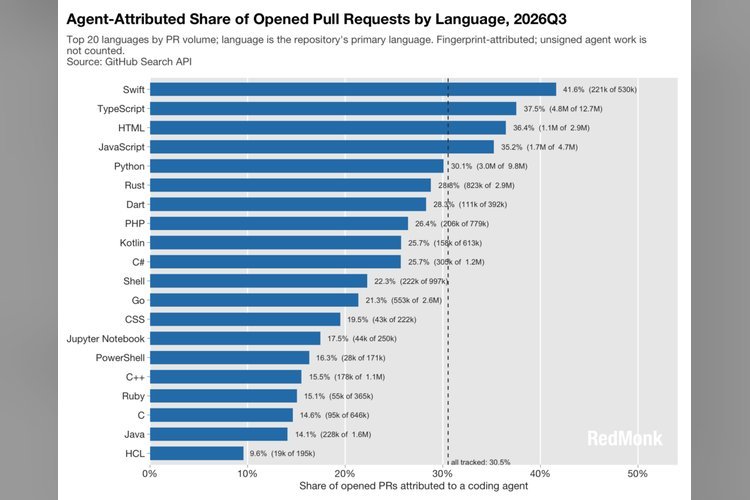
The first RedMonk Agent Activity Index finds that AI agents opened 13.9 million of 45.4 million pull requests on GitHub in the third quarter of 2026, or 30.5%. RedMonk, the developer-focused analyst firm, built the index to track agents the way it has tracked programming languages for more than fifteen years.
The sample covers thirty languages: the top twenty by pull request volume plus ten chosen for their significance. RedMonk says the figure is a floor, not a ceiling.
Why RedMonk built it
RedMonk’s language rankings compare GitHub and Stack Overflow, and it says both sources have degraded, partly because of agents. A rethink of those rankings is due within weeks. While looking at the data, RedMonk found there was also useful information about the agents themselves.
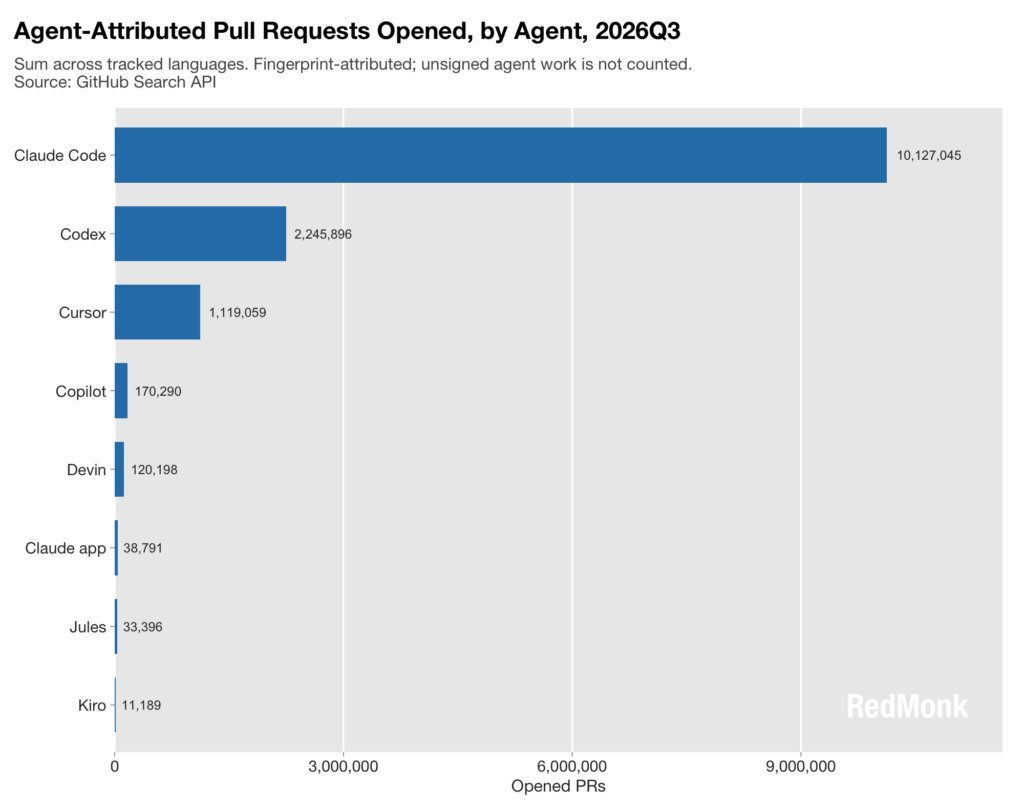
Caveats up front
- Different agents leave different fingerprints, and some leave none, so the data shows only a usage floor.
- Tools that leave marks are over-represented, and unreported human assistance isn’t counted.
- Forges differ in API access, so many charts cover GitHub only.
Agent traction
GitHub’s own figure for September was over 40%, up from 17% in March. RedMonk explains the gap: GitHub counts public and private repositories and has inside access to pull request creation, while RedMonk surveys public repositories over three months. Both point to accelerating adoption.
Claude Code stands out
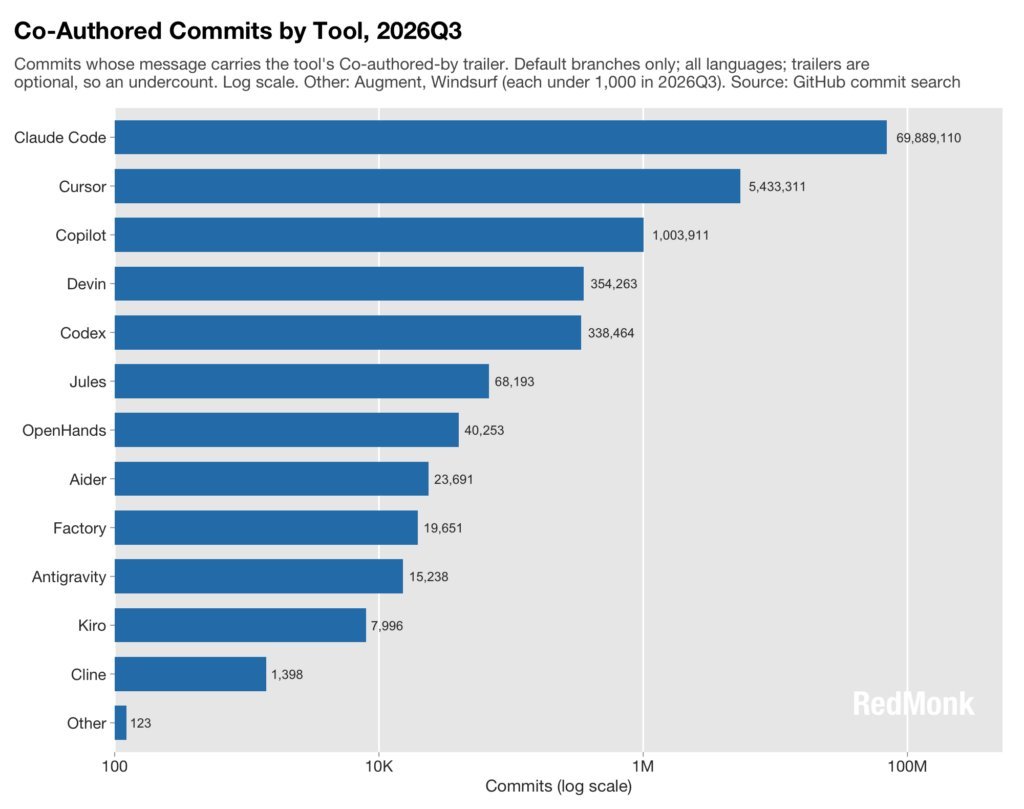
Among tools that mark their pull requests, RedMonk writes that there is Claude Code and then everything else. Some tools, including Antigravity, Cline and Windsurf, are nearly invisible because they leave no imprint. Co-authored-by trailers in commit messages give a fuller picture, plotted on a log scale given Claude Code’s volume.
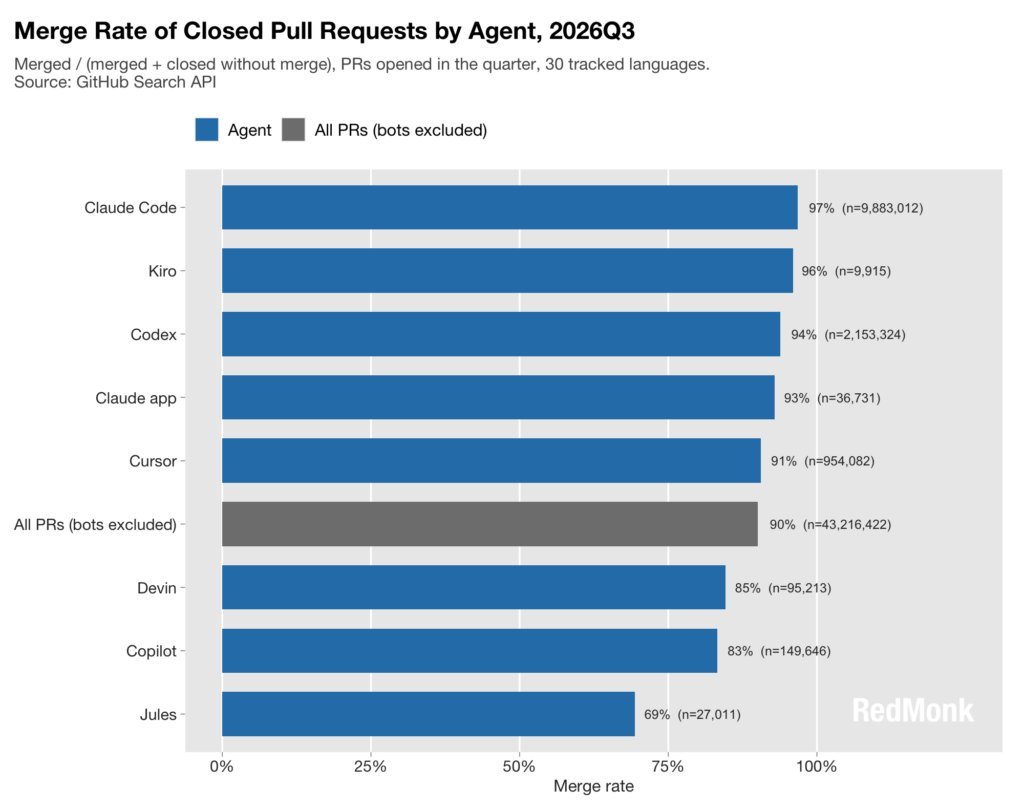
Claude Code also leads on merge rate, with Kiro second. The recently sunsetted Jules had the worst merge rate tracked. RedMonk warns about selection bias, since agents may get quick, easy tasks.
Differences by language
Swift tops the chart of agent-attributed pull request share, which RedMonk calls a mild surprise that could come from large repositories or a small sample. TypeScript, JavaScript and Python rank high as expected. Rust places relatively high and Java lower.
AI policies and AGENTS.md
Open source has adopted AI-authored code slowly. RedMonk asked whether it is more skeptical than the wider industry, and among projects with an AI policy, a clear majority permit AI in some capacity.
The index also scans for AGENTS.md files. It can’t tell whether they are used, but a multi-vendor standard instead of vendor-specific configuration could lower the cost of switching platforms. RedMonk says it will watch whether the standard sticks.
Downloads, forges and code review
RedMonk also tallied weekly downloads from npm and PyPI. Tools that ship as installers, such as Antigravity, Cursor and Kiro, aren’t counted, and it dropped tools under 100,000 weekly downloads. Claude Code and Codex lead. OpenCode’s steady rise stands out, as does Copilot’s. Gemini CLI has been deprecated in favor of Antigravity, which this method can’t measure.
On contribution policies, RedMonk searched CONTRIBUTING.md files. Of more than 1,500 policy files found, almost 70% allowed AI contributions and 5% expressly forbade them. Almost half the surveyed projects have no AI policy at all. Of those that do, most allow AI, followed by allow with disclosure, then restrictions, then a ban. RedMonk adds that these are model classifications that shift several points between runs, so the ordering is reliable and the exact percentages are approximate.
Across forges, sample sizes differ so much that RedMonk calls the results indicative only. GitHub shows a visibly higher share of agent activity, which may relate to its multi-year focus on AI starting with Copilot. The index also looks at “reviewed-by” data to see which agents developers use for code review.
Consolidation and the next edition
RedMonk says observable traction is concentrated in a few players, which allows for consolidation, though it needs more analysis to say. The RedMonk Agent Activity Index will be repeated to show how the data shifts over time. Watch the next edition for whether Claude Code’s lead holds and whether the agent share of pull requests keeps climbing.
Source: tecosystems