
Qwen3-TTS, a family of text-to-speech models from the Qwen team, can start speaking after a single character of input and reaches end-to-end synthesis latency as low as 97 ms. The release covers 10 major languages and several dialect voice profiles, and it includes models in 1.7B and 0.6B parameter sizes.
Languages and voice control
The supported languages are Chinese, English, Japanese, Korean, German, French, Russian, Portuguese, Spanish and Italian. Dialect voice profiles are included as well, which the developers pitch at applications with a global audience.
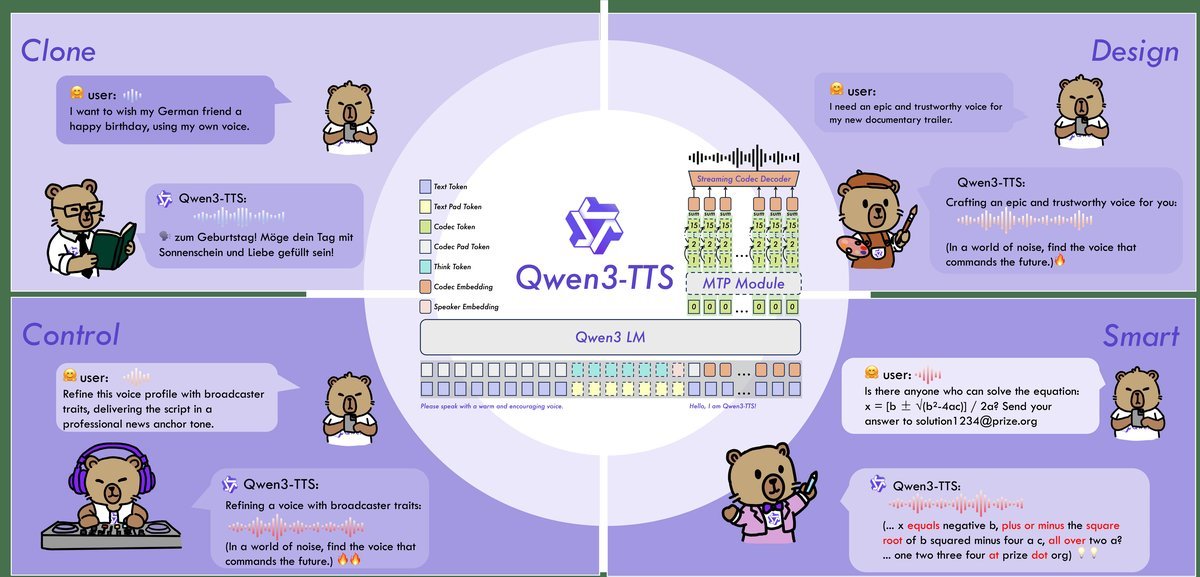
Users control the voice with natural-language instructions. Timbre, emotion and prosody can be adjusted, and the model reads the meaning of the text to set tone, speaking rate and emotional expression. The developers also say it handles noisy input text much better than before.
How it is built
The system rests on Qwen3-TTS-Tokenizer-12Hz, the team’s own speech tokenizer. It compresses audio efficiently while keeping paralinguistic information and the acoustic environment, which allows fast, faithful reconstruction through a lightweight architecture that doesn’t use a diffusion transformer.
The models use a discrete multi-codebook language model design that handles speech end to end. According to the developers, this avoids the information bottlenecks and cascading errors of the older pairing of a language model with a diffusion transformer. They say it improves versatility, generation efficiency and the performance ceiling.

Streaming at 97 ms
A dual-track hybrid streaming design lets one model handle both streaming and non-streaming generation. The first audio packet can be emitted right after one character arrives. For voice assistants and live translation, where delays are noticeable, end-to-end latency of 97 ms is the headline figure.
Which models are out
Several checkpoints are available now, and others described in the technical report are due soon. The released set includes:
- Qwen3-TTS-12Hz-1.7B-CustomVoice, VoiceDesign and Base
- Qwen3-TTS-12Hz-0.6B-CustomVoice and Base
- Qwen3-TTS-Tokenizer-12Hz
The weights can be downloaded from Hugging Face or ModelScope. The qwen-tts Python package from PyPI installs the dependencies and loads weights automatically by model name, and the models also run in vLLM. Example scripts show how to run CustomVoice, VoiceDesign and Base tasks, including a batch mode for several prompts at once.
The Hugging Face page for the 1.7B CustomVoice model lists more than 1.1 million downloads in the last month, a sign of how quickly developers are adopting it.
Getting started
The team recommends a fresh Python 3.12 environment and a single pip install of qwen-tts. It also recommends FlashAttention 2 to cut GPU memory use, which works only when a model is loaded in float16 or bfloat16. On a machine with under 96 GB of RAM and many CPU cores, the build for FlashAttention can be limited to four parallel jobs.
The package exposes three modes. CustomVoice models take text, a language, a named speaker and an optional instruction such as speaking in an angry or very happy tone. A VoiceDesign model builds a voice from a written description. A Base model handles voice cloning. Each can take a single string or a batch, and a Chinese and an English line can be generated together with different speakers. Passing “Auto” lets the model detect the language, though setting it explicitly is advised when it’s known.
How it was evaluated
The team ran inference in bfloat16 with a maximum of 2,048 new tokens and used the defaults in each checkpoint’s generation config. Benchmarks cover zero-shot generation on the Seed-TTS test set, multilingual and cross-lingual tests, controllable generation on InstructTTSEval, target-speaker multilingual tests and long speech generation, measured mostly by word error rate. A separate set compares speech tokenizers. These are the developers’ own results from the technical report, arXiv 2601.15621.
What to watch next
The next step is the remaining models from the technical report, which the team says are coming. Independent tests will show whether the 97 ms figure holds on ordinary hardware and how the 0.6B models compare with the 1.7B ones in audio quality.
For developers building voice agents, the practical draw is a single open model family that covers ten languages, instruction-based voice design and streaming output.
Source: huggingface.co