
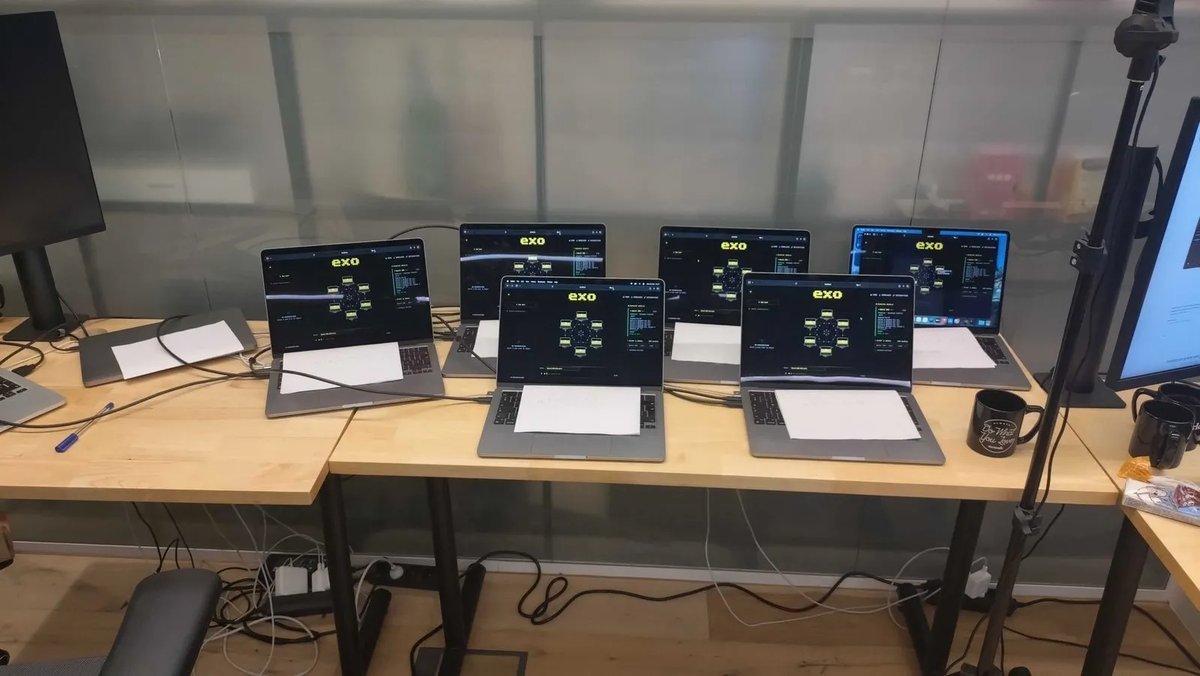
A team at Quickchat AI turned six idle MacBook Airs into a private LLM cluster in one morning, and the private LLM on MacBook Airs answered its first prompt at 13:54. Each machine has an M2 chip and 16 GB of RAM, so the group holds 96 GB, enough to run a model that fits on none of them alone.
Where the Macs came from
The six laptops used to be the team’s remote development machines, each hosting a Linux VM packed with Docker containers. When the work moved to Boxes42, the remote development product the company builds, the Macs had nothing left to do.
The plan used EXO, open-source software that divides a single model among several Macs, with each machine keeping one slice. Six MacBook Airs can be joined in a line over Thunderbolt, each cabled to the next, which takes five cables.
Cables and permissions
Cables took most of the time. The office drawer held many USB-C cables that look like Thunderbolt ones but carry little or no data. After finding one that worked, the engineer connected two Macs first.
Claude Code, which could reach the machines over SSH, handled the setup. It shut down leftover dev-machine services to free memory and installed EXO. Then the two Macs ignored each other, each acting as a cluster of one with no error message.
The cause was a macOS privacy setting that controls which apps can talk to devices on the local network. It was silently blocking EXO. Running EXO as a root system service fixed it, and the pair discovered each other in seconds. By 13:12 they were jointly serving a small model cut in half.
Four more cables followed, and two of the five links failed. Macs 5 and 6 appeared only as ordinary USB devices because nobody had approved the accessory prompt on screen. Between Macs 4 and 5, a cable was detected but no data moved, and Claude concluded a charging cable had slipped in. Swapping it solved that. Claude could see both faults, yet a person had to fix them physically.
One download instead of six
The chosen model, Qwen3-30B-A3B, weighs about 16 GB, more than any single laptop can hold. EXO has each Mac fetch the full file, though each only needs a sixth. Claude suggested downloading once and copying over the cables. The engineer declined at first.
Twenty minutes later one Mac had the model, the rest were still pulling it across the office wireless network, with the slowest facing another 80 to 90 minutes. Copying the file from the finished machine to the other five via Thunderbolt took roughly half a minute.
What it runs like
A private LLM on MacBook Airs is slower than a cloud service but usable. The cluster writes about 20 tokens a second, faster than most people read, and it got the first 40 primes right. Short questions get a first word in about a second. Long documents are slower, taking a minute or more before an answer starts, because the model reads the entire prompt first.
Adding Macs allows a larger model but not a quicker one, because each token has to travel through the whole chain. EXO counts roughly 50 GB of free memory across these six, so a model of roughly 45 GB should fit, which is around 80 billion parameters at 4-bit.
Privacy is the main draw. The model runs entirely on the six machines, so nothing anyone asks leaves the office. Each Mac also serves an OpenAI-compatible API, so most tools built for that API can point at the cluster.
Who can copy this
Building a private LLM on MacBook Airs is within reach. Anyone with spare Apple silicon laptops can try it, and the shopping list is short: Thunderbolt cables that carry data, a free afternoon, and the patience to click through macOS permission prompts. Claude Code did the remote setup work here, but the hardware problems still needed a person at the desk.
The next step for a team like this is a larger model. With about 45 GB of room, an 80-billion-parameter model at 4-bit is the ceiling for these six machines, and the speed limit stays the same no matter how many laptops join the line.
Source: Quickchat AI