Pay-per-job AI pricing is gaining ground as software companies leave per-seat subscriptions behind. The reason is cost: every time a customer uses an AI product, the vendor pays for compute. ICONIQ surveyed about 300 software executives and found that consumption-based pricing rose from 35% to 42% of AI products between Q4 2025 and Q2 2026. Kyle Poyar found 76% of AI-native companies use variable or hybrid pricing, against 49% of SaaS firms.
Three things you can bill for
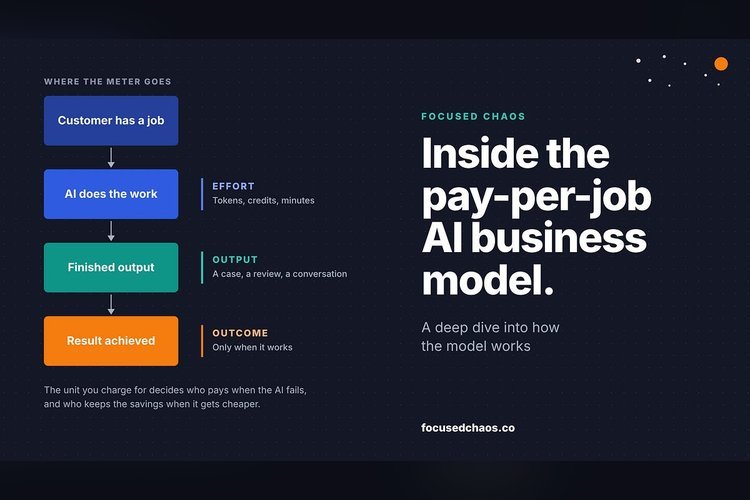
Bain & Company reviewed public pricing at roughly 200 B2B software companies in June 2026. Among those that meter AI, about 55% charge for output, 35% for effort and 10% for outcomes. Two questions separate the models: who pays when work takes longer than planned, and who pays when the result falls short?
- Effort: the customer pays for tokens, compute or time, including failed attempts.
- Output: the customer pays per job, such as a contract review, and the vendor absorbs extra work.
- Outcome: the customer pays only when the work meets an agreed standard, and the vendor eats the cost of misses.
Outcome pricing gets the hype, but Orb tracked 80 AI agent companies this year and found 91% charge on usage and fewer than 4% on outcomes, a lower share than last year. Fin, now part of Salesforce, charges only for resolved conversations. Its finance VP Tommy Bettles said the product launched with negative margins, and improved as the resolution rate rose from the 30s to the high 60s.
Defining a job
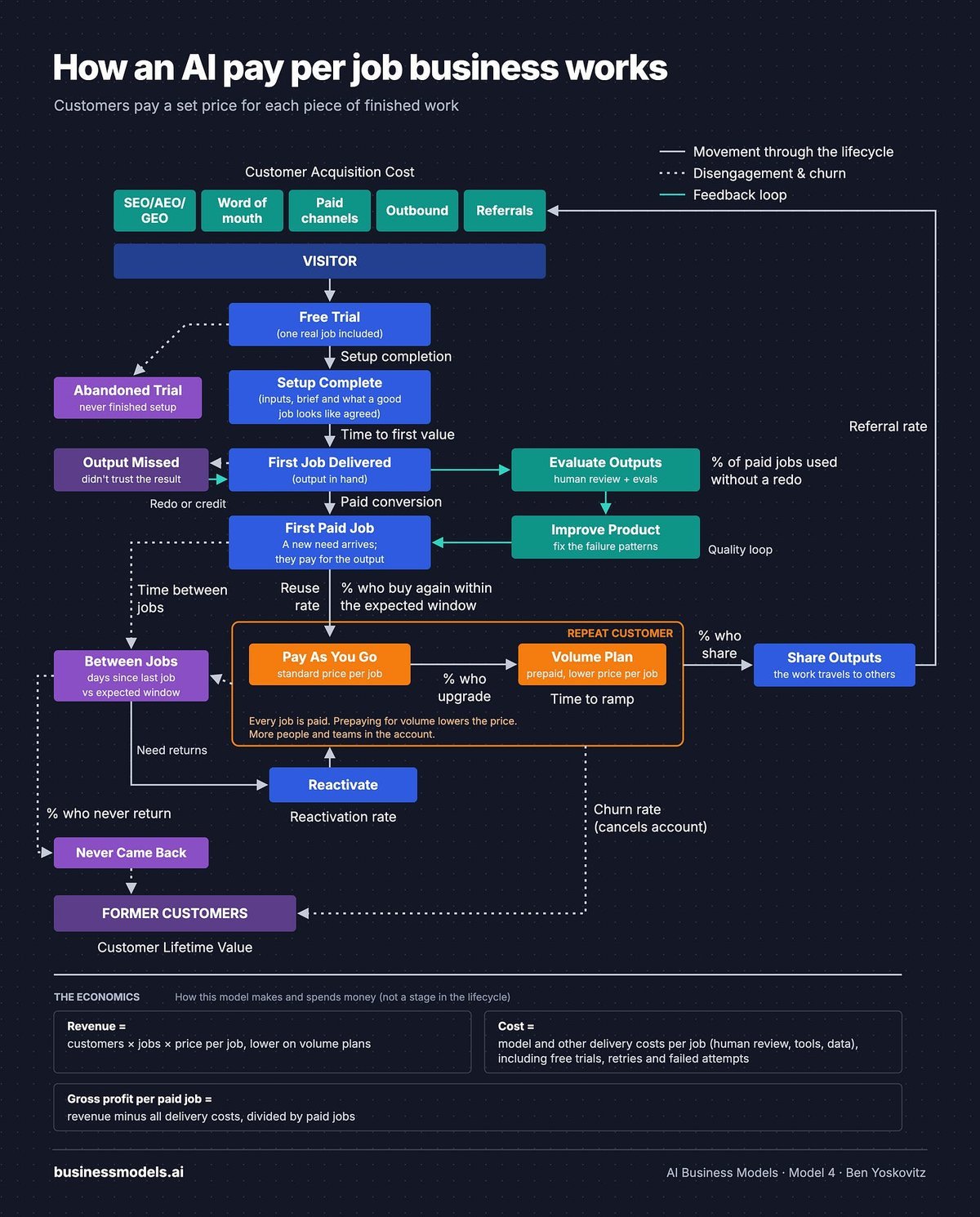
Pay-per-job AI pricing only works if the job is clear to both sides.
A good job unit is one customers already count, can use as delivered, and can predict. EvenUp charges per case, which law firms already track. Decagon says most customers choose to pay per conversation. A two-page grant application and a 40-page federal one aren’t the same job, so price by size or split the big one up.
Quality needs a written bar before work starts: what a junior writer or paralegal would deliver. Offer a redo or credit when a job misses it, and count the jobs customers accept, not just the ones sold.

One good month isn’t recurring revenue
Take a tool that drafts grant applications at $40 each. In month one, 200 nonprofits try it, 150 pay, and revenue hits $10,000. Annualizing gives $120,000 in ARR, but it’s a run rate from one month. Whether it repeats depends on whether those nonprofits return for their next application. Fortune has reported on founders counting pilots as ARR, and one VC called much of it “vibe revenue.”
Retention is the worry. ChartMogul found AI-native companies with at least $250,000 in ARR had median gross revenue retention of 40% in 2025, and products under $50 a month kept only 23%. Ben Murray found usage-only companies churn more but reach 108% net revenue retention, against 98% for seat-based pricing. Expect to lose more customers and grow faster with the ones who stay.
Margins vary widely too. ICONIQ found AI products average 45% gross margin, and Sacra estimates Replit’s rose from -14% in April 2025 to 23% by July 2025.
Five metrics to track
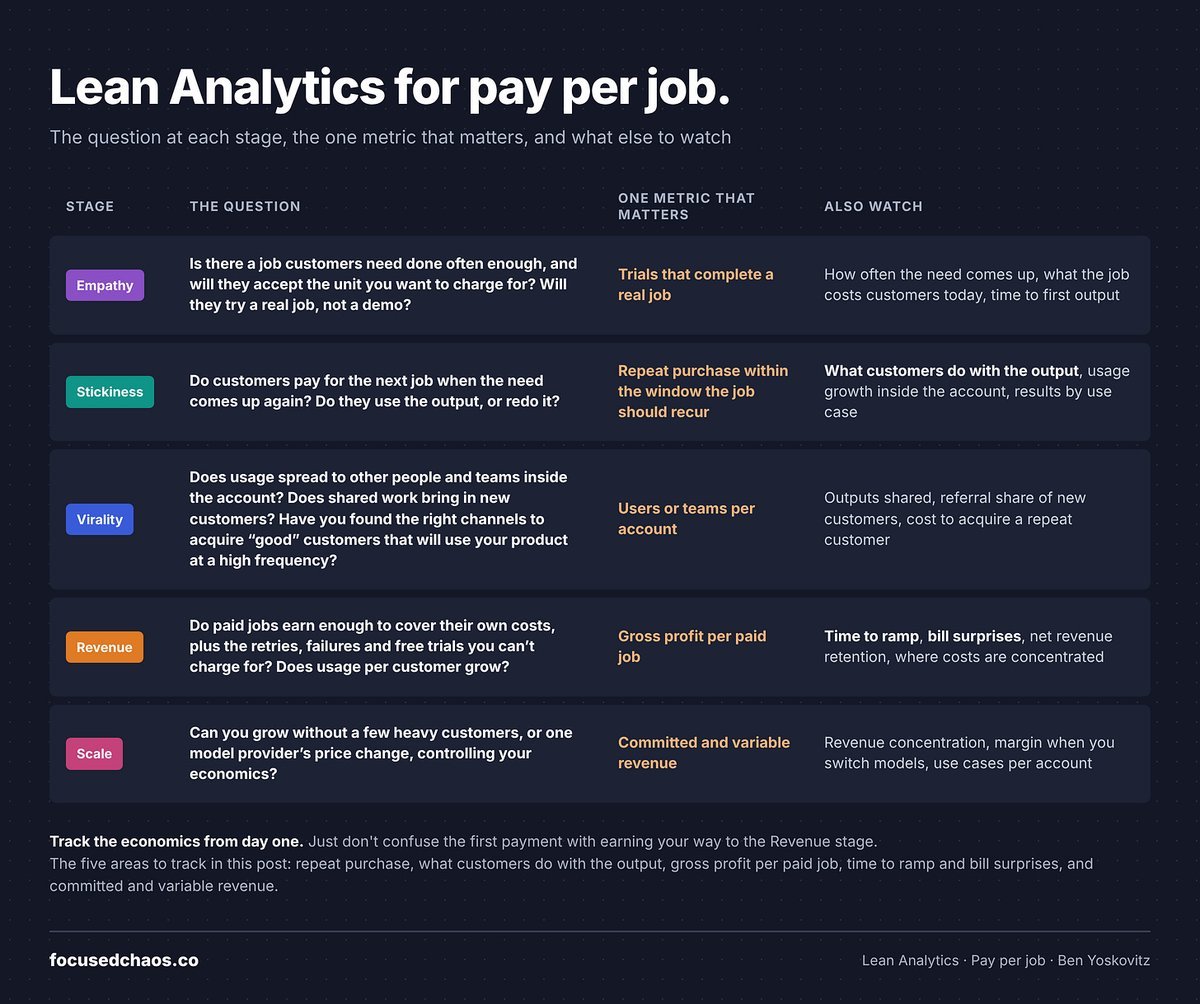
- Repeat purchase within the window when the job should recur, judged only on cohorts that have had the full window.
- What customers do with the output, such as exporting or heavily rewriting a draft.
- Gross profit per paid job, including retries, human review, free trials and unbillable attempts.
- Time to ramp, meaning how long a customer takes to use 80% of what they bought, plus bill shock.
- Committed versus variable revenue, reported separately.
Cheaper tokens don’t guarantee better margins
Epoch AI found in March 2025 that the price of GPT-4-level performance on PhD-level science questions fell 40x a year. But take a $10 job costing $3 in model calls and $1 in other costs. Halve model prices and profit rises to $7.50. Then a better model uses three times the tokens and profit falls to $4.50. A rival selling at $7 forces a match, and you keep $1.50.
Real companies hit this. Cursor changed pricing in June 2025 because newer models spend more tokens on long tasks, then refunded unexpected charges and apologized. GitHub said flat per-request Copilot pricing was “no longer sustainable” and moved every plan to token-based credits in June 2026.
What lasts
Durable pay-per-job AI pricing rests on a unit buyers already understand.
If a price is mostly a markup on someone else’s model, rivals can undercut it. Gumloop charges model cost plus 8%. Companies that sell a unit customers already compare to human labor, like a case or a conversation, can hold prices longer. Most buyers also want predictability, so hybrids with a base subscription plus usage are common. The evidence is still early, with small samples and many self-reported figures.
Source: focusedchaos.co