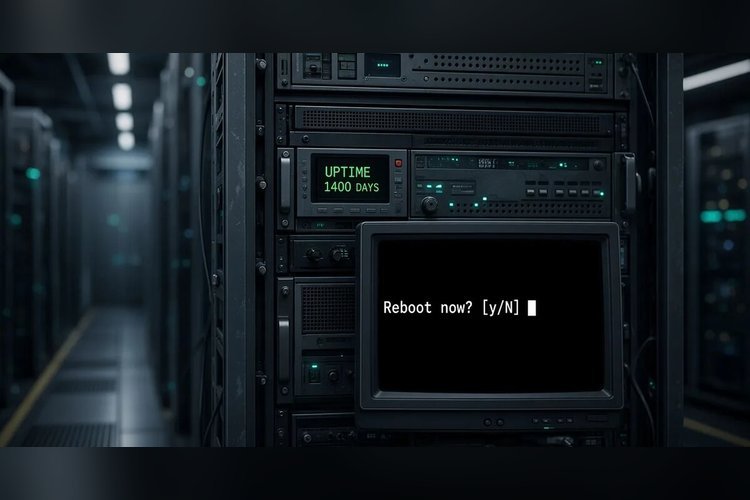
The patchpocalypse has arrived, and a run of outages at Microsoft, the FAA, Chase, United and the NSA looks like its first big invoice. Every one of them denied being hacked. An analysis of vulnerability and outage data points elsewhere: long-neglected systems got changed in a hurry and failed.
Five outages in six days
Microsoft 365 was unavailable for nearly a full day starting Thursday. Friday brought a nationwide FAA ground stop. By Monday a bug at Chase was affecting several banks and United had planes on the ground, and Tuesday saw the NSA’s classified internal network drop out.
Each pointed at its own software or upkeep. Chase named a bug in on-premise hardware, and the NSA called it degraded service during planned maintenance.
The FAA case is the clearest. During a copper-to-fiber upgrade at a radio site, a newly installed router started blasting the air traffic network with about 1,000 connection attempts every few seconds. Older gear became unstable, the agency said. The cutover happened around 3:30 pm on a Friday, at peak travel time, with some 3,500 aircraft flying.
Microsoft’s problem was older. A defect pushed to its cloud gateway in July lay idle until a normal November failover triggered it, locking up 80% of the gateway servers. Test hardware had fewer CPU cores than production, so it never showed up. Reboots failed too: queued traffic swamped each server as it restarted.
What the vulnerability data shows
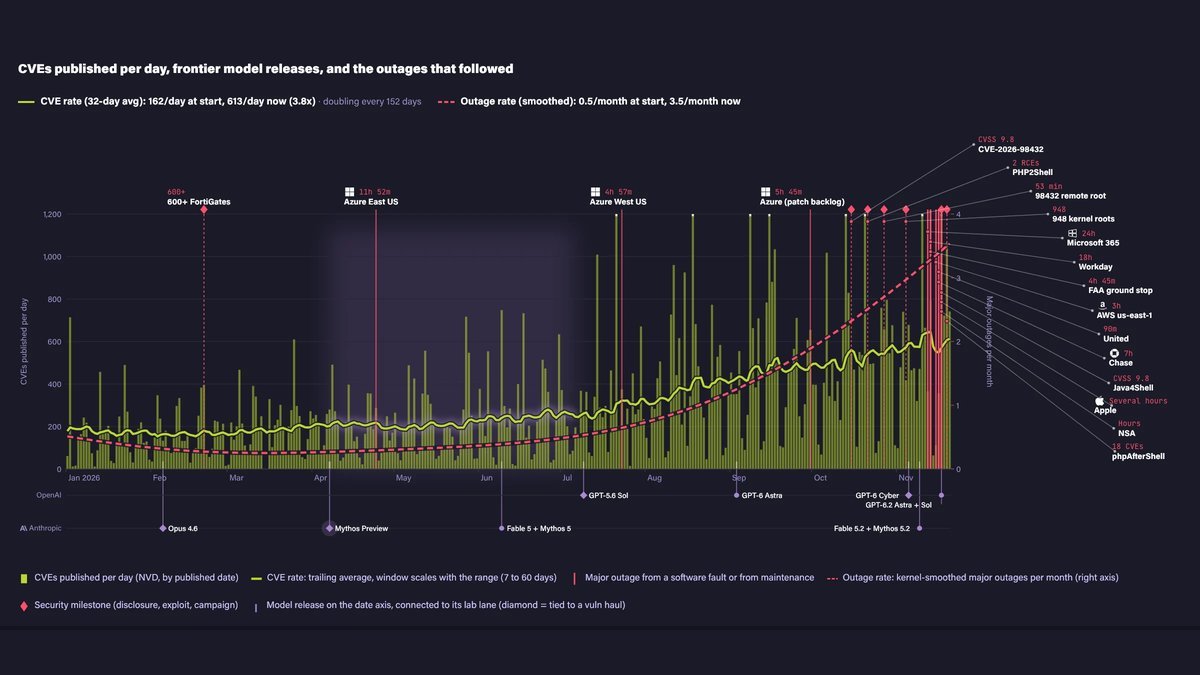
A CVE is a numbered public record of a software flaw. Between 2019 and 2023 the world logged 50 to 85 of them daily, rising to roughly 110 in 2024 and 140 in 2025.
Then 2026 broke the trend. Daily counts hit 200 in March, 400 in August and above 600 in November. October’s 17,481 was a monthly record, and October 13 peaked at 2,308 in a day. With six weeks to go, the 104,709 CVEs published so far are over twice the 2025 total.
The timing follows frontier AI launches. Each major release this year appeared in the CVE feed one to two months later, since a new model acts like a fresh scanner aimed at all deployed software. Four such models arrived between October 28 and November 18, the busiest stretch yet.

The bugs driving the patchpocalypse
- CVE-2026-98432, a Linux kernel flaw scored 9.8 that gives an unauthenticated attacker root access via the TCP handshake. It dates to 2016, and an AI model produced an exploit for it in 53 minutes. Fixing it means installing a new kernel and rebooting.
- Java4Shell, a heap overflow in Java’s Base64 decoder, exploitable before login and present only on newer processors with AVX-512. Oracle shipped a patch, though applying it requires a restart.
- Two PHP engine bugs from October, plus a release that fixed eighteen more issues, seven of them critical.
These are old flaws being found with new tools, not AI models attacking companies. But attackers have the same tools. AWS has documented an unskilled, non-state attacker who used a commercial AI service to break into over 600 FortiGate firewalls and extract full credential databases.
The one genuine attack in this period came from North Korea. On October 29 its TraderTraitor unit drained $6.3 billion from Binance in around twenty minutes, about four times last year’s Bybit theft. The encryption held. Entry came via a booby-trapped installer, a bogus job interview and finally Binance’s internal AI tool.
Why institutions are breaking first
Over the past seven years the outages on the chart mostly hit hyperscalers such as Cloudflare, AWS, Azure and Google, which change systems all the time and absorb the cost in small, visible chunks. This time the casualties were the FAA, a bank, an airline, an HR platform and an intelligence agency, all running systems left untouched for years.
The US went first for mundane reasons: CISA sets firm patch deadlines for federal agencies, banking and aviation regulators run their own schedules, and an American outage makes headlines fast. Organizations that patch to a calendar fail early and recover early. Those that don’t will surface later, some through breaches rather than downtime.
The failures hurt because each was a shared dependency: an identity gateway, the FAA’s network, weight and balance, NSANet. Cloud provider outages tend to be regional. These were all-or-nothing.
What the next year could look like
Historically the world has seen about one big self-inflicted outage per 10,000 CVEs, a ratio that held every year since 2019. In November it hit 6.5. A base-case projection, assuming growth fades by 20% each month after the late-October releases, puts March 2027 near 33,000 CVEs (over 1,000 daily) and six or seven major outages monthly. Before 2025 the norm was one every four months. It extends a hand-built outage list and shouldn’t be read as a prediction.
The advice for operators is plain. Reboot on your own schedule before an emergency forces it, and find out what each system needs on startup, including clusters, control planes and boot-time jobs. Rehearse on hardware that matches production, disable unused services, and reserve patch windows right after each major model release. For individuals, a local backup of irreplaceable files and an alternate way to contact key people are sensible.
Source: doxx.net