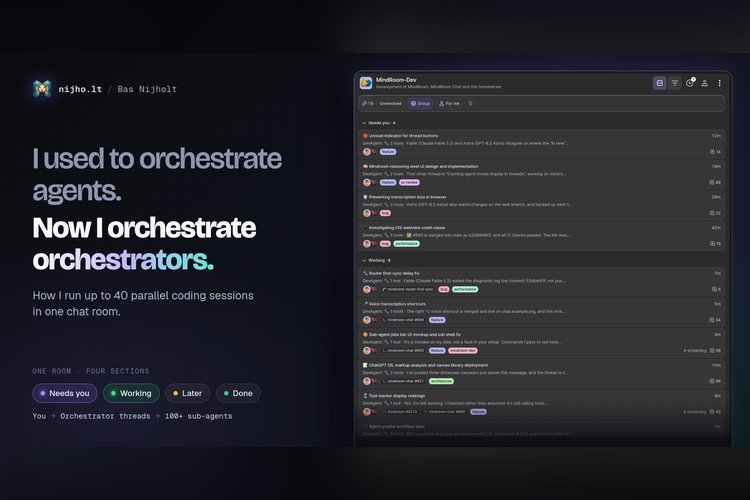
One developer who once juggled thirty terminal windows now runs up to 40 parallel coding agents from a single chat room. The setup, built in an open-source tool called MindRoom, turns every task into a thread and uses a parent agent per thread to hand work to cheaper sub-agents.
From thirty terminals to one room
The path started in August 2025 with six features at once, one terminal tab each, checked every 10 to 15 minutes. In January it became a single command, agent-cli dev, that creates a git worktree and opens a tab with an agent already working. That held while tasks took minutes. As models improved and tasks grew, so did the wait, and the developer ended up with up to eight tasks spread over thirty panes, running Codex and Claude Code side by side. Telling which pane needed attention meant opening it.
Next came cmux, a terminal built for agents, for a couple of months from June 2026. Then the Codex desktop app, which gave a clearer view of what was running. After Fable 5 shipped in June, the developer went back to the Claude Code CLI, then found T3 Code, an open-source web interface that runs the original Claude Code and Codex. It struggled past twenty concurrent sessions: long threads took seconds to open, and threads with background tasks showed as idle. The developer ported its best ideas into MindRoom.

Leaving the native tools
Every one of those apps runs the model maker’s own agent tooling. The developer had assumed a model works best with the tooling it was trained on, then tested that. Over 4,000-plus runs of brief terminal tasks, only one model gained a clear efficiency edge from its own tooling. The bigger factor was the payload sent with each request. A bare agent with a single shell tool and a twelve-line prompt spent 58 to 76% fewer tokens than MindRoom’s standard agent.
That freed the setup from vendor lock-in. In MindRoom, models from Anthropic, OpenAI and Google can work in one thread, and each sub-agent runs in the minimal mode.
How the orchestrators work
Two things let agents work unattended. Newer models handle far bigger scopes: Opus 5.5 and Fable 5.2 from Anthropic. And a public skill set called baspowers has the agent draft a spec and plan and then work test-first. On an unclear point it consults a second frontier model, such as GPT-6.2 Astra, before interrupting the user. In a trial, agents wrote a failing test ahead of a bug fix in none of 32 runs without the test-driven skill and in all 32 with it. A task may now run for an hour or for more than a day.
In each thread the developer talks to one parent agent on Opus 5.5, which holds the skills, memories and review standards. It hands the heavy work to minimal sub-agents. Gemini 4 Neon writes code by default because it’s cheap. Then three reviewers, GPT-6.2 Sol, GPT-6.2 Astra and Opus 5.5, each read the whole diff at once, and a model never checks its own output. After a round of fixes, a new reviewer starts fresh. Fable 5.2 only writes code on very hard tasks or if two reviews still turn up serious problems, and Claude Haiku 5.5 answers simple lookups. Forty sessions can put a hundred agents in motion.

The room itself
A thread is the context window the agent sees, compacted when it fills, and each coding thread gets its own git worktree with linked pull requests. A meta-repo checkout lets the agent infer which project is meant. The developer also records phone screen captures, dictates by voice and uses an Apple Watch app to start tasks.
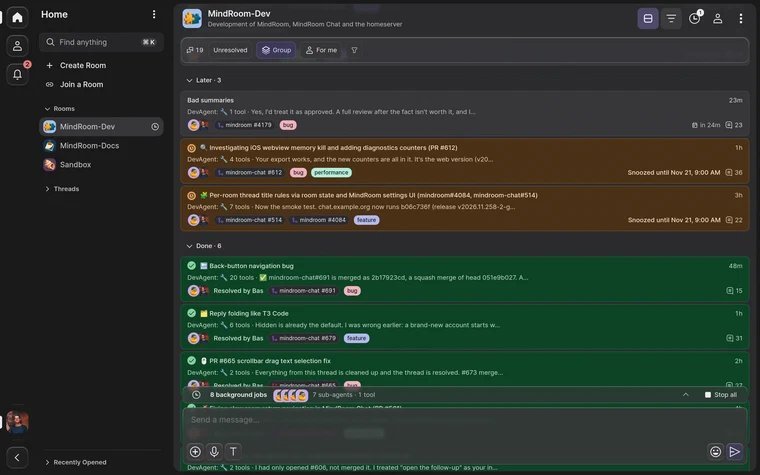
The room view went through six versions: first messages, AI-generated titles, a resolve status, sorting and filtering, one-card-per-thread, and finally four sections:
- Needs you: the agent finished or asked something, and nothing is running.
- Working: a reply is streaming, or a sub-agent or background job continues.
- Later: the thread is snoozed or has a scheduled task.
- Done: resolved.
Reasoning and tool calls stream live and fold behind one row when the agent finishes, leaving its conclusion, which is the model’s own output and not a summary.
What the output looks like
The developer’s tool trueloc counts about 1.4 million lines across 848 merged pull requests from November 2024 to October 2025, and about 10 million lines across 5,148 pull requests in the next twelve months, about two thirds in code files. Almost 30% of November’s total is repeated commits in a stack of six pull requests. The developer says lines of code are not a measure of quality and reads the chart as work in flight.
The limit is human. Fifteen sessions feel comfortable, and up to forty is possible after a good night’s sleep. When tired, the developer can’t hold that many threads in mind, so the room’s job is to show which one needs a decision.
Source: Bas Nijholt