OpenAI Pando is a new backend for Git, built to handle the load that coding agents put on a monorepo. OpenAI says it cut median push latency by nearly 80%, and it now runs all development in the company’s monorepo.
The system went into production in April 2026, and OpenAI Pando now serves close to a petabyte of Git data every day. Agents are the reason the load grew.
Why agents broke the old setup
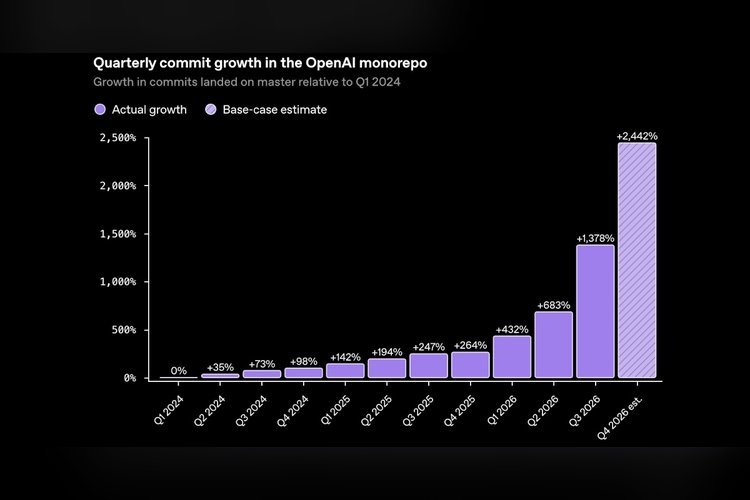
OpenAI blames the growth in traffic on Codex-driven development. Agents push far more often than people do. Each push can also start several CI jobs, and every one of those jobs fetches the same history.
That pattern punishes a Git server that funnels updates through one shared point of coordination. Pando was designed to remove that bottleneck while leaving Git itself alone. Developers keep the same client, the same protocol and the same workflows.
How a push works in OpenAI Pando
When a push arrives, Pando validates the incoming packfile while it streams into immutable blob storage. It never unpacks the file into a local repository. A metadata transaction then records a reference version, which holds the new branch tip, the packfile and its dependencies on earlier versions, and atomically moves the reference pointer.
Updates to unrelated references run independently. Two updates to the same reference still have to be coordinated.
OpenAI describes the guarantee as causal consistency, with serialisable updates to each individual reference and read-your-own-write consistency. A reader receives the history needed for the revision they asked for. Fetching several branches does not give a repository-wide snapshot, so two clients can briefly see different combinations of branch versions during concurrent updates.
Reusing packs to speed up fetches
Pando also changes which objects travel over the wire. When a client pushes a new feature branch, the server advertises only a designated trunk branch as the base. That limits what the resulting packfile depends on, so Pando can hand the same pack to any reader who already has the trunk history.
The cost is some repeated data. Stacked or repeated branch pushes can resend objects that sit outside trunk, which uses extra bandwidth in exchange for packs that can be reused.
On fetch, Pando maps the commits a client has and wants onto reference versions, then selects stored packs that cover the missing history. It uses Git’s packfile-uri capability to return download links instead of building a custom pack per client. A regional cache called Express serves those downloads. OpenAI reports cache-hit rates above 99%, and in tests clone and fetch operations filled 10 Gbps network links.
In the background, compaction merges packs into larger, geometrically sized covers, much like compaction in a log-structured merge-tree. The covers compress better and work like a skip list for planning fetches. Pando keeps packs at every level so clients with different histories can still be served.
How it differs from Anthropic’s Scion
Anthropic’s Scion tackles a similar problem from the opposite side. It replaces Git’s model with changesets that record files changed relative to the first parent, plus content-addressed pointers to compressed file contents. Commits, merges, rebases and history queries run on the server. Its clients fetch missing immutable trees and blobs instead of negotiating packfiles, and they rely on bounded local caches and sparse or virtualised checkouts.
Both designs use immutable data and regional caches to avoid repeating work. They draw the compatibility line in different places. Pando keeps Git’s object model and client workflows and changes only the backend. Scion assumes an online client and moves repository operations into a dedicated service.
The reported gains can’t be compared directly. OpenAI measured push latency, while Anthropic reported checkout speedups and infrastructure savings against its earlier Git setup.
Migration still took work
Staying compatible with Git did not make the rollout free. OpenAI first ran Pando as a read- and write-through proxy and moved clients over in phases. It migrated hundreds of integrations that used legacy APIs, webhooks and repository downloads. It also shipped its own Git build that downloads and indexes independent packs in parallel.
Some of those client improvements are already upstream in Git. Others are available in OpenAI’s public repository.
What teams building on Git should take from it
For anyone designing source control for agent workloads, the lesson is to settle two questions separately. Which operations belong on the server, and which consistency and transfer guarantees does the workload actually need?
OpenAI Pando answers by dropping the repository-wide snapshot across branches and accepting some redundant transfer. In return it removes shared coordination between unrelated pushes and cuts the computation done per fetch.
Source: InfoQ