
Open-weight model safety has two new reference points. Pretraining data filtering, described in a paper called Deep Ignorance, kept biothreat knowledge out of models even after thousands of steps of adversarial fine-tuning. A second paper, on distilling unlearned models, offers a fallback for models that are already trained. Neither is airtight, but both hold up far better than the post-training safeguards used today.
The problem with open weights
Open-weight models spread AI capability widely and support economic growth. They also put dangerous cyber capabilities in more hands and could provide guidance on bioweapons development. Anyone can fine-tune a released model, strip its safeguards and upload the result to Hugging Face, where it becomes a one-click download.
Safeguards added after training tend to collapse within a few dozen steps of fine-tuning. That is why researchers are looking earlier in the pipeline.
Deep Ignorance: filter the data first
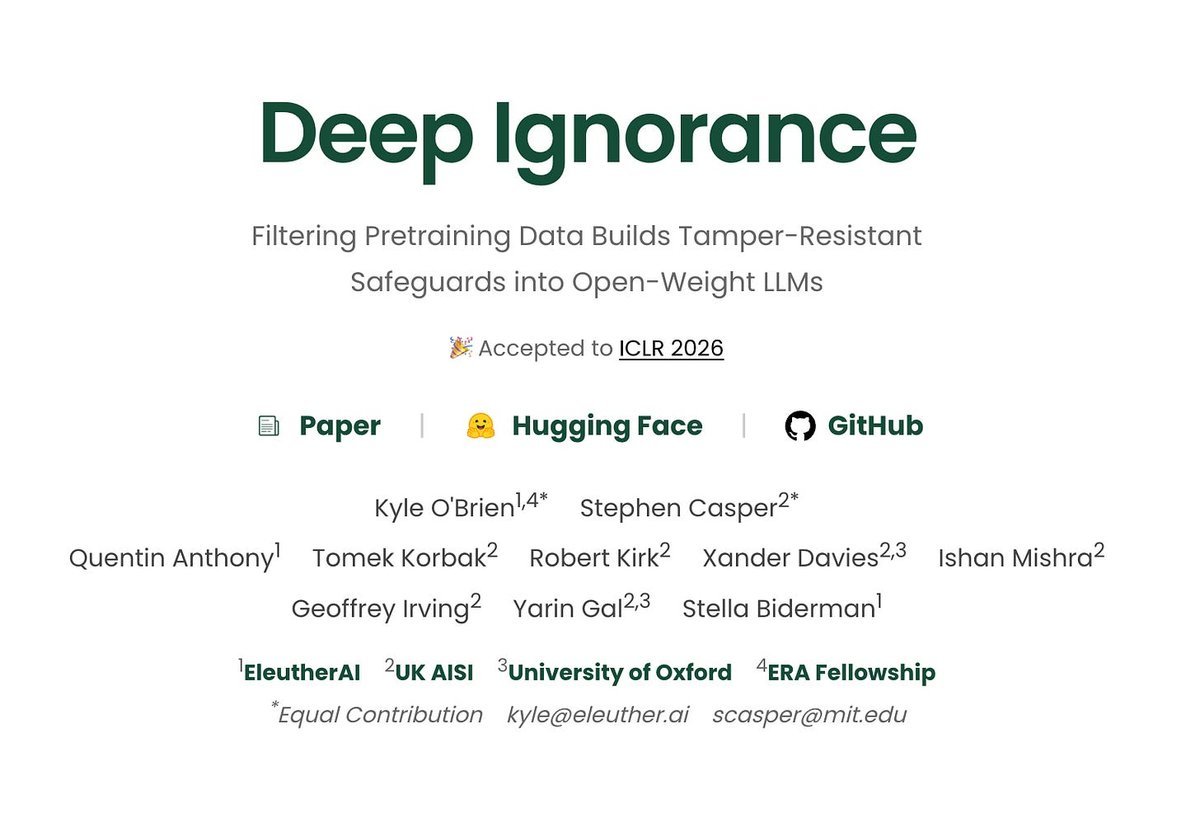
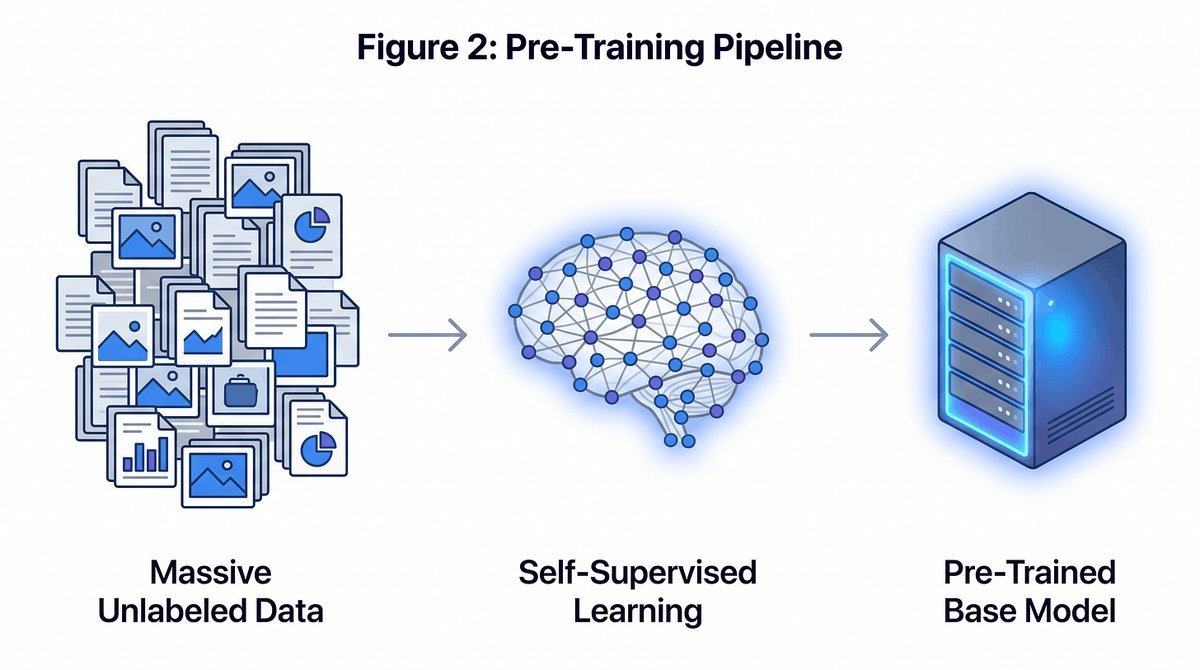
Pretraining is the stage where a model picks up most of what it knows about the world. The Deep Ignorance study, by O’Brien and colleagues, asks whether removing hazardous documents from the pretraining corpus can stop a model learning unsafe technical capabilities such as CBRN knowledge. The authors targeted material that could help with bioweapons development.
The filter has two stages. First, a keyword pass: a model generated a list of potentially dangerous terms based on the WMDP-Bio Forget dataset, and only documents containing two or more of those terms moved on. That removes the need to review over 90 percent of documents. The remaining roughly 10 percent go to a ModernBERT classifier, a small, fast model that sorts text into categories. It was fine-tuned on 198,184 documents, a mix of expert-labeled biothreat text, expert-labeled general biology and LLM-labeled general text.
The classifier ran only during the annealing phase, the final 50B of 550B training tokens. The full filtering cost less than 1 percent of total training FLOPs.
What the results show
The researchers compared filtered models with an unfiltered baseline on four general-capability benchmarks and found no broad loss in ability. They then fine-tuned each model on the WMDP-Bio Forget set to see how fast the missing knowledge returned. They describe the result as tamper resistance for up to 10,000 steps and 300M tokens of adversarial fine-tuning on biothreat text, more than an order of magnitude better than post-training safeguards.
Ten thousand steps is not a lot. At current GPU rental rates it probably costs well under $100. But it was not a breaking point: the filtered models were still scoring below the adversarially fine-tuned baseline at the end, and the run stopped only because the fine-tuning data ran out after two passes.
The test also used the strongest possible attack. A real attacker would not have the Forget set and would need to assemble their own data. The WMDP datasets and evaluations cost over $200,000 to make, which suggests that building a comparable dataset for truly hazardous material would be costly and need expert input.
Distillation and unlearning
The second paper (on distillation and unlearning) covers a case filtering cannot: capabilities that emerge from many harmless-looking documents, where no single one contains the dangerous whole. U.S. national security law has a similar idea, mosaic theory.
Unlearning with gradient ascent pushes a model away from a forget set while ordinary training on a retain set preserves everything else. It works until someone fine-tunes the model on the forget material, and then the capability returns within a few steps. The paper’s fix is to distill a new, randomly initialized student model from the unlearned one. At its strongest setting, the UNDO method matches a model retrained from scratch on perfectly filtered data while using 60 to 80 percent of the compute and requiring only 0.01 percent of the pretraining data to be labeled.
For an existing model, that still means paying 60 to 80 percent of the original training bill, against under 1 percent for filtering. It is 20 to 40 percent cheaper than retraining from scratch, so the better option depends on how far along training is.
Limits and a policy angle
Neither method is fully reliable, and in-context learning alone makes that unlikely, a limitation the Deep Ignorance paper names itself. The more important point is that safeguards must hold against the most capable and motivated attacker, because one successful strip-and-upload exposes everyone. Safeguards buy time, and should come alongside hardening of society against cyber and bio threats.
The analysis also floats a diplomatic idea. The Bureau of Industry and Security appears to be moving to close the cloud access loophole that let Chinese firms rent restricted Nvidia chips through providers such as Amazon Web Services. Narrowly licensed cloud access, such as compute earmarked for distillation to make unlearning stick, could become something the U.S. offers in any serious AI negotiation.
What to watch
Whether developers adopt pretraining filtering for biology is the main test. Cyber risk is harder to filter than bio, so other measures remain relevant there.
Source: counterfactual.blog