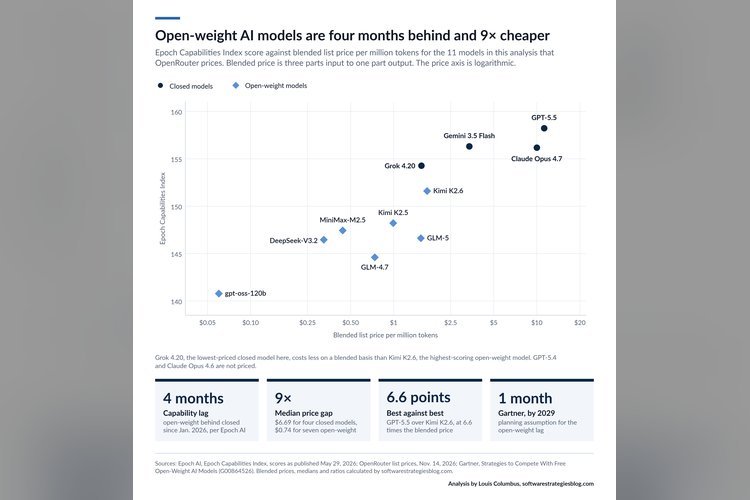
Open-weight AI models now trail the closed frontier by about four months and eight capability points, and they cost far less to call. Kimi K2.6 tops the open-weight field on the Epoch AI Capabilities Index with 151.60. Calling it through OpenRouter costs $0.95 for a million tokens in and $4.00 for a million out. GPT-5.5 posts 158.22 but charges $5 and $30 for the same volumes.
The closed model’s 6.6-point edge carries a blended price about 6.6 times higher. When the free alternative trails by only four months, charging extra per token for raw intelligence is a tough sell.
How big the gap is
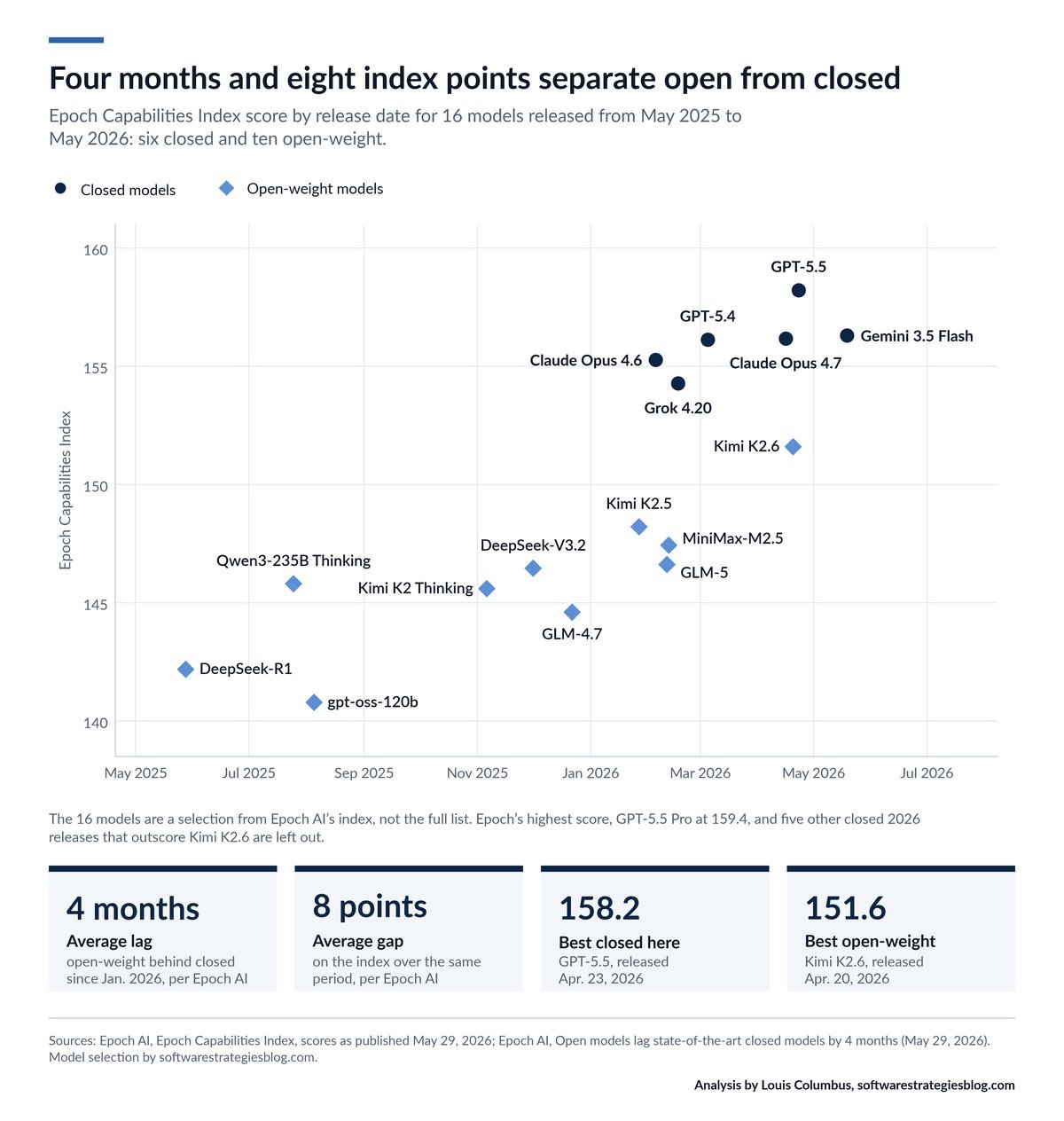
Epoch’s index rolls many benchmarks into one score. One comparison covers 16 models released from May 2025 to May 2026: six closed, ten with open weights. The closed group averages 156.1 and the open group 145.9. Every closed model landed between February and May 2026 and scores from 154.28 to 158.22. GPT-5.5 sits on top, with Gemini 3.5 Flash (156.31) and Claude Opus 4.7 (156.18) next.
On the open side, Kimi K2.6 leads, with Kimi K2.5 (148.22) and MiniMax-M2.5 (147.44) behind it. Epoch puts the average distance since January 2026 at eight points, about what separates GPT-5 from GPT-5.5.
That 16-model set understates the top of the closed field. It omits GPT-5.5 Pro at 159.35, Epoch’s highest score, and five other 2026 closed models that beat Kimi K2.6.
Analysts expect the lag to shrink further
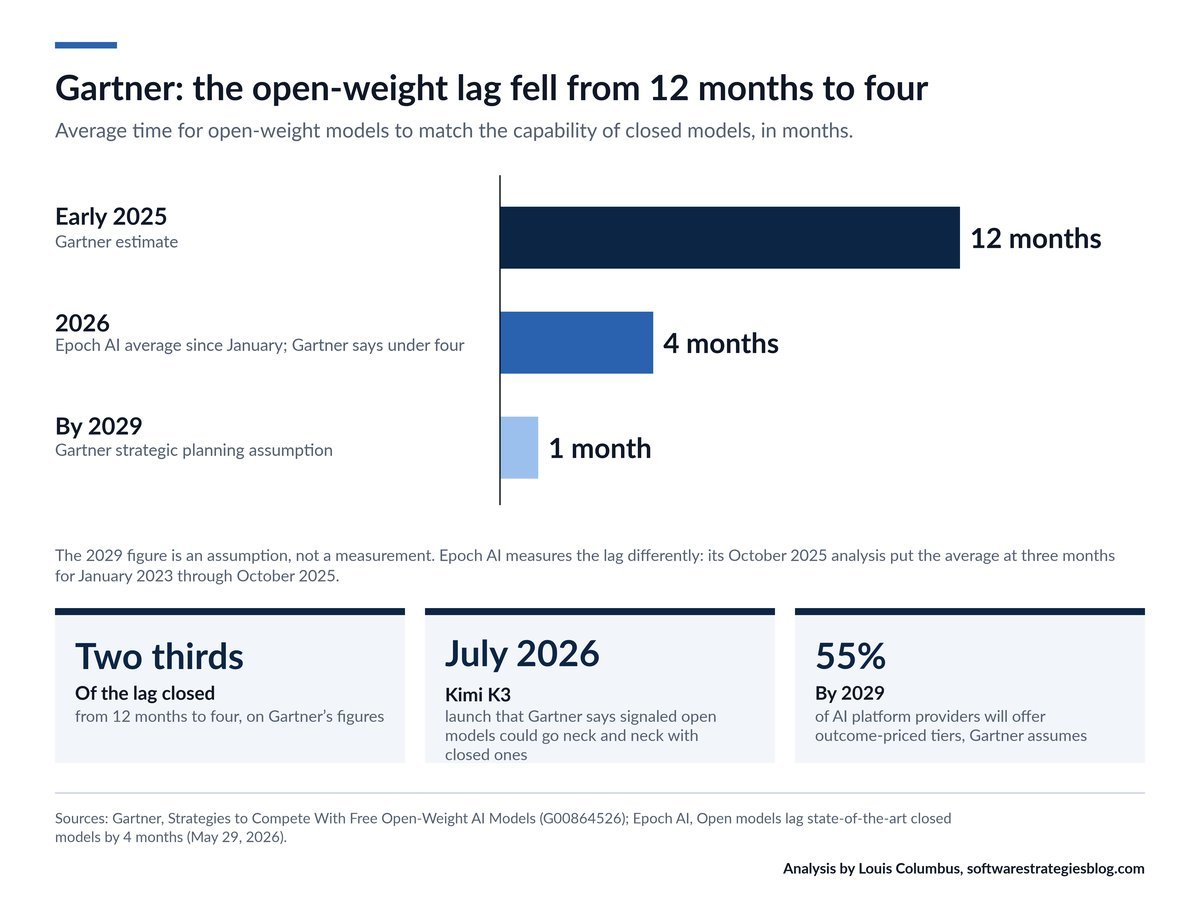
A Gartner note dated Nov. 12 says open models needed about a year to catch closed ones in early 2025 and now need under four months. Its forecast of a single month by 2029 is a planning assumption, not a measurement. The note cites July 2026’s Kimi K3 as evidence that open models can keep pace with closed ones on long-context reasoning, agentic workflows and tool use. Epoch’s May 29 analysis predates that launch.
The two sources don’t measure the same way. Epoch’s October 2025 analysis found an average lag of three months from January 2023 through October 2025, so by Epoch’s numbers the gap has stayed in a three to four month band. The claim that most of the lag has already vanished is Gartner’s estimate.
The price spread
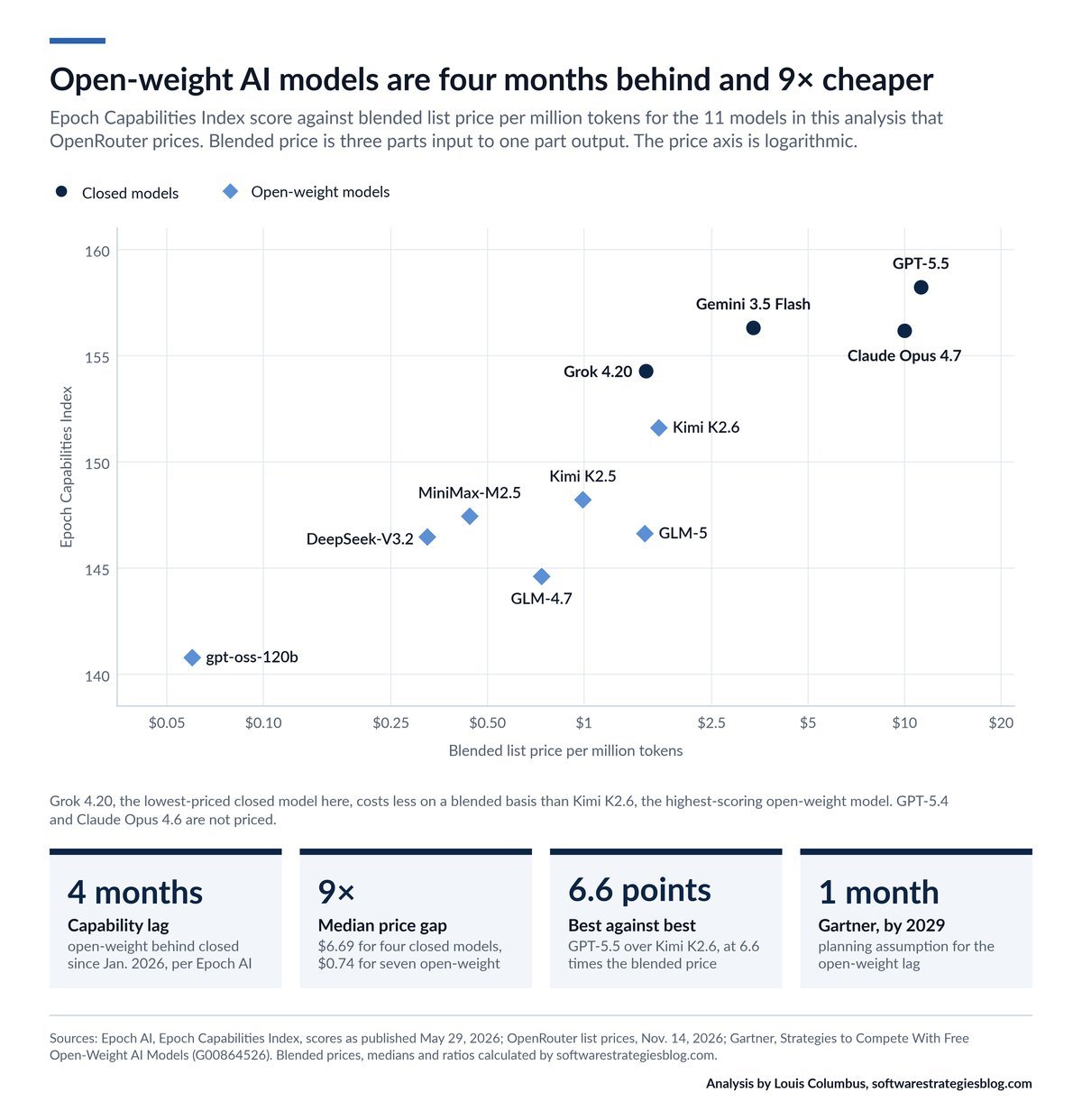
List prices on OpenRouter for 11 models on Nov. 14, 2026 show how wide it runs:
- GPT-5.5: $5 input, $30 output per million tokens
- Claude Opus 4.7: $5 and $25
- Gemini 3.5 Flash: $1.50 and $9
- Kimi K2.6: $0.95 and $4.00
- GLM-5: $1.00 and $3.20
- DeepSeek-V3.2: $0.29 and $0.43
- gpt-oss-120b: $0.03 and $0.15
Weighting each price by three input tokens for every output token, the middle closed model costs $6.69 per million tokens and the middle open-weight model $0.74. That is a 9x gap. Frontier output tokens run up to 200 times more than the cheapest open option: $30 for GPT-5.5 against $0.15 for gpt-oss-120b.
Closed doesn’t always mean expensive. Grok 4.20 charges $1.25 and $2.50, which blends to $1.56 and comes in below Kimi K2.6 at $1.71. These are also list prices. Caching and provider discounts lower real bills, and the figures above skip the temporary markdowns OpenRouter showed that day: 59% off Kimi K2.6, 40% off GLM-5 and 28% off DeepSeek-V3.2.
Free weights shift the bill to the buyer
Gartner calls free open models an illusion, because whoever hosts them absorbs three costs: compute to serve the model, MLOps staff to run it, and every bit of legal and compliance exposure for what it produces.
The liability piece matters most for security and risk leaders. OpenAI covers generated outputs and IP claims by contract in its service terms, and Anthropic does the same with wider commercial API protections. Neither yet backs agentic transactions with money. Download the weights and that cover stays with the provider. When an agent running on a self-hosted model does something that draws a claim, the enterprise answers for it.
Hosted open-weight APIs from providers like OpenRouter sell inference well below frontier prices, and some are adding sovereign AI and data localization options.
What it means for providers and buyers
If open-weight AI models reach a one-month lag, a capability a closed provider ships would show up in open weights before most enterprises wrapped up a pilot. The analysts’ advice to model makers follows: stop selling raw capability and sell risk absorption, orchestration, context and trust. They also expect 55% of AI platform providers to offer tiers priced on outcomes by 2029. Proving an outcome takes telemetry, and security teams will have to vet that data flow.
What to do with the numbers
Buyers weighing a switch should price the whole decision, not just the token rate. A cheap model that adds MLOps payroll and unindemnified legal exposure can cost more than it saves. For teams whose workloads don’t need the last few index points, the case for open-weight AI models is already strong. The deciding factor is who carries the risk when an output goes wrong.
Source: Software Strategies Blog