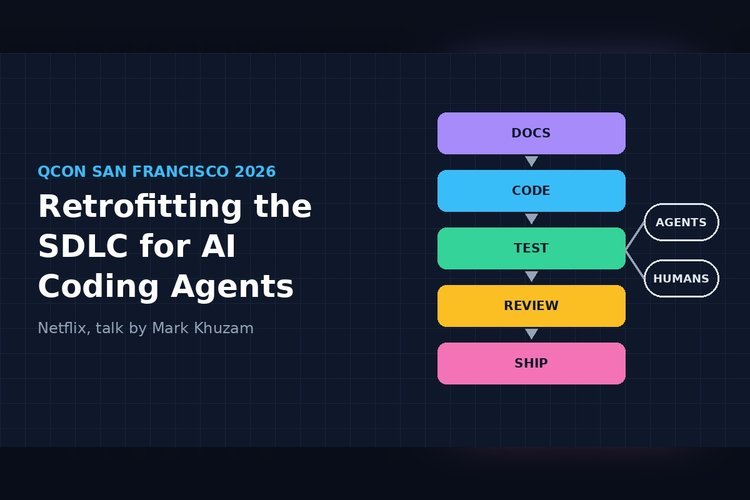
Netflix says it cut serious incidents and lifted developer satisfaction after rebuilding how its Commerce team works with AI coding agents. Senior software engineer Mark Khuzam laid out the changes at QCon San Francisco 2026, and the Netflix AI coding agents story is mostly about documentation, not models.
The numbers he shared are specific. A core service had no Sev 1 incidents in 2026, pull requests rose 32% year over year, and developer Net Promoter Score climbed from -3 to +25 over three quarters.
Why the first attempts failed
Commerce at Netflix runs largely on server-driven UI. A single service sits behind the API gateway and assembles screens for iOS, Android, web and TV. Khuzam opened his talk with a mock company email announcing that all engineers had Claude Code and wanting to know how much quicker releases had become.
Reality was slower. The team’s first experiment asked an agent to migrate tests, and it took four tries. The prompt started as a bare file name, then grew to include instructions, the APIs to call and a mocking approach.
Two problems kept derailing the Netflix AI coding agents. The docs were hard to find, so an agent used up its context window before finding the right page. They also contradicted each other, since tests followed different styles across the codebase. Khuzam’s summary: the company had spent 20 years building for humans.
Writing decision records for two readers
The team’s fix was context engineering, which Khuzam framed as moving engineers’ knowledge into the agents’ view. The team produced 45 architecture decision records, each aimed at both people and agents.
Every record has the same parts:
- background and the decision itself
- a recommended pattern and one to avoid
- guidance for agents on how to act
- links to related docs and code
Almost every repository now carries the records. Making them and 300-plus other documents easy to locate meant borrowing from web search. An AGENTS.md file, the instructions file coding agents read first, plays the role robots.txt plays for crawlers.
Reviewing what agents write
Once code exists, the pipeline looks familiar. Builds, tests, screenshot comparison, merge queues and canary releases remain deterministic. What changed is where agents plug in.
A review agent now checks every pull request against the docs and decision records before a person looks. It flags anti-patterns and checks what depends on the change. The first version was noisy: it left 23 comments on one PR and opened with “Overall this PR looks great!” Today it speaks up only for confirmed blockers, giving proof, a suggested fix and the rule at stake.
Engineers can add a revise label so an agent reads the review and pushes a fix to the same PR. Nothing merges automatically. Engineers still own the code.
The cross-service problem
Single-repo work was the easy part. A product engineer building one feature may reach payments, billing, the gateway and each client app, which raises the question of who owns the context and how it travels with the work.
Khuzam listed what failed. Pulling in every repository was too much. Git submodules broke easily. A Git MCP server only sees single files, not the whole system. Shared copies went out of date.
The goal was context that stayed correct, worked with any agent, belonged to one domain and stayed current. It settled on a GraphRAG graph for each domain, with structure drawn from code and meaning drawn from the docs and decision records. Every graph is tied to particular commits and exposed through one Model Context Protocol tool.
Claude Code, Cursor, Codex, a Slack bot and CI review all query the same graph. Every answer cites a file and a line, which lets an engineer check it quickly.
What other teams can take from it
The Netflix AI coding agents rollout offers a clear order of work. Khuzam closed with three rules: define the agents’ job and say so, make the how-to easy to find, and keep human judgement in the loop. In his words, none of it is new; it is ordinary good engineering aimed at a different reader.
Netflix fixed docs and consistency first, then added review agents, then tackled context that spans services. The stakes are high, since the services involved reach more than 300 million members and Khuzam has described confidence in shipping Tier 0 services as the real question.
What to watch next
Session video is expected in the coming weeks. Until then, the open question is whether the review agent’s low noise and the NPS gains hold as more services adopt the same graph setup, and whether Netflix eventually lets its AI coding agents merge changes without a person, which it doesn’t allow today.
Source: InfoQ