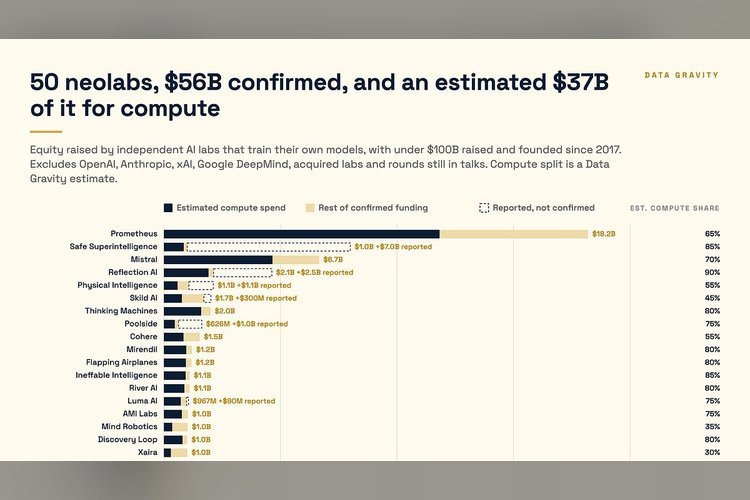
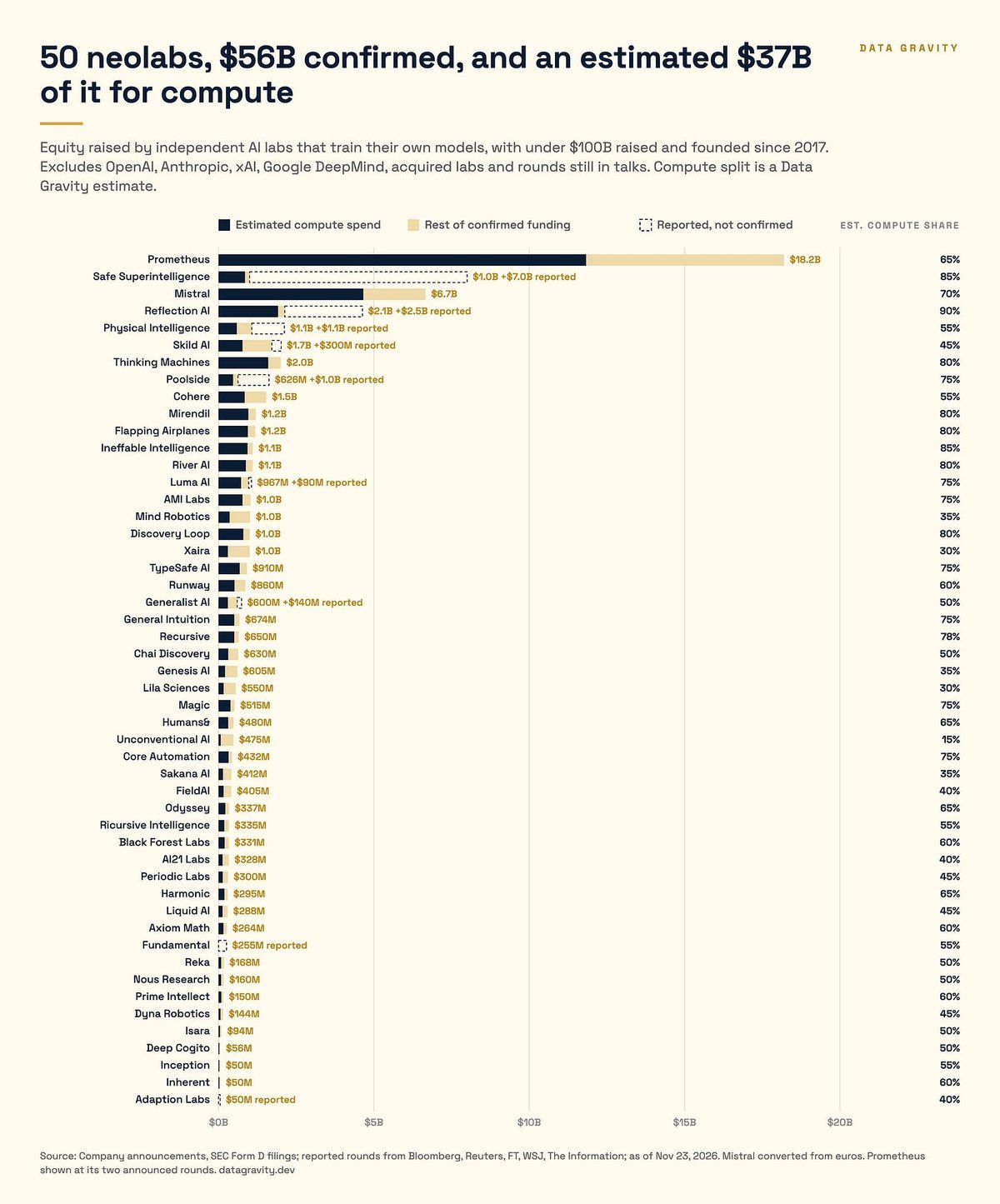
Fifty independent AI labs have confirmed $56 billion in funding, and an estimated two-thirds of it is headed for compute. This neolab funding tally leaves out OpenAI, Anthropic, xAI, Google DeepMind, acquired labs and Chinese labs. A further $12 billion has been widely covered but never confirmed by the companies.
How the $56 billion was counted
To qualify, a lab had to train its own models and have taken in around $50 million or more. A round counts once the company has announced it, put it in an SEC filing or confirmed the amount. Talks that haven’t closed, including a possible $5 billion for Thinking Machines, don’t count.
Several deals that were covered widely sit in a separate bucket because the lab never confirmed the size. SSI’s $2 billion round from 2025 and Nvidia’s July investment in SSI are two. That bucket accounts for the extra $12 billion.
Most of it arrived lately: $30.6 billion closed in 2026, which tops every previous year added together.
Two labs dominate. Prometheus, the industrial AI lab co-led by Jeff Bezos, announced $6.2 billion at launch and $12 billion in June. Mistral has raised about $6.7 billion. Together that is 44% of the confirmed total. Fourteen more labs sit between $1 billion and $2.1 billion apiece, and most of those are less than a year old.
Where the money goes
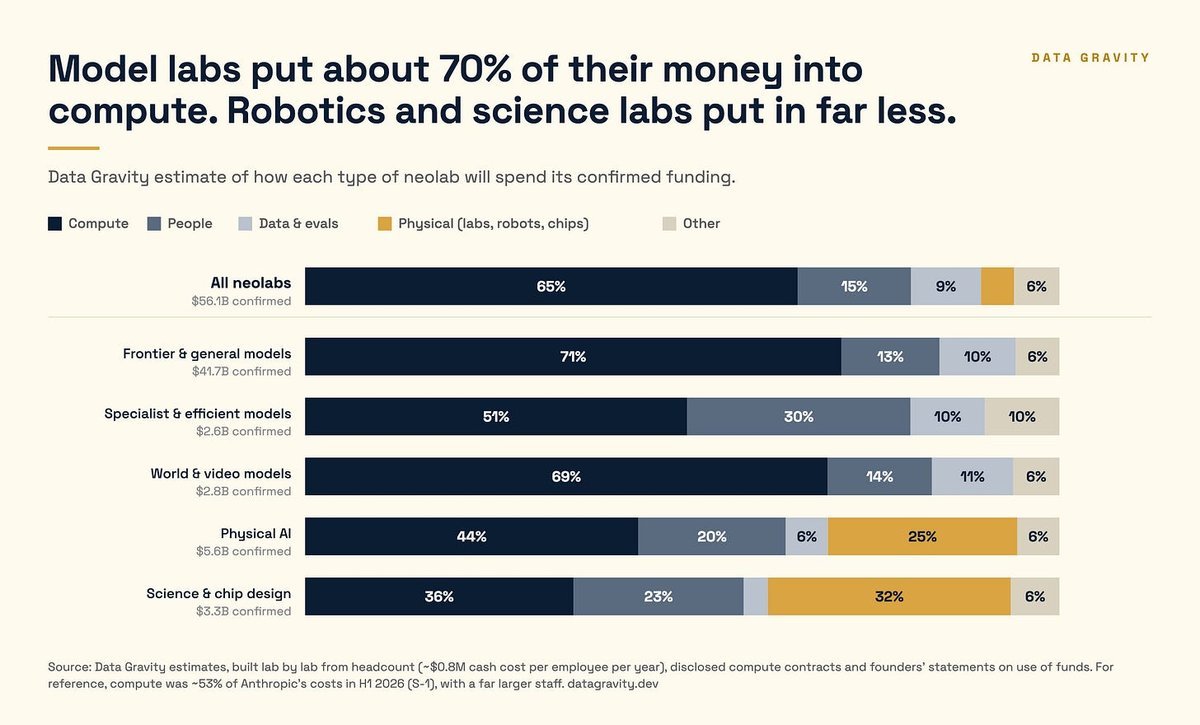
Labs don’t disclose how they spend, so the split here is an estimate built from team size. Recursive had under 30 staff when it raised $650 million. Assume $0.8 million per head per year for pay, benefits and space, and a 50-person team costs $120 million over three years. On a $1 billion round that is just 12%.
Known contracts agree. Recursive’s $410 million AWS agreement is 63% of what it raised. Reflection has a Nebius contract above $1 billion and a separate SpaceX arrangement at $150 million monthly through 2029. Add them up and they pass the $2.1 billion Reflection has confirmed in equity.
Founders agree. Humans& co-founder Andi Peng said the lab “will spend the majority of the capital on compute.” For comparison, Anthropic’s S-1 puts compute near 53% of first-half 2026 costs even with thousands of employees, so a lab with dozens of staff should skew higher.
Across all fifty, the estimate is 65% compute, 15% people, 9% data and 6% other. Labs building language models sit near 70% on compute. Physical AI labs spend 44% on compute and 25% on robots and hardware. Science and chip-design labs put 36% into compute and 32% into labs and chips. Lila Sciences operates automated wet labs, Genesis AI hires people wearing sensor gloves to gather training data, and Unconventional AI designs silicon.
Who supplies the compute
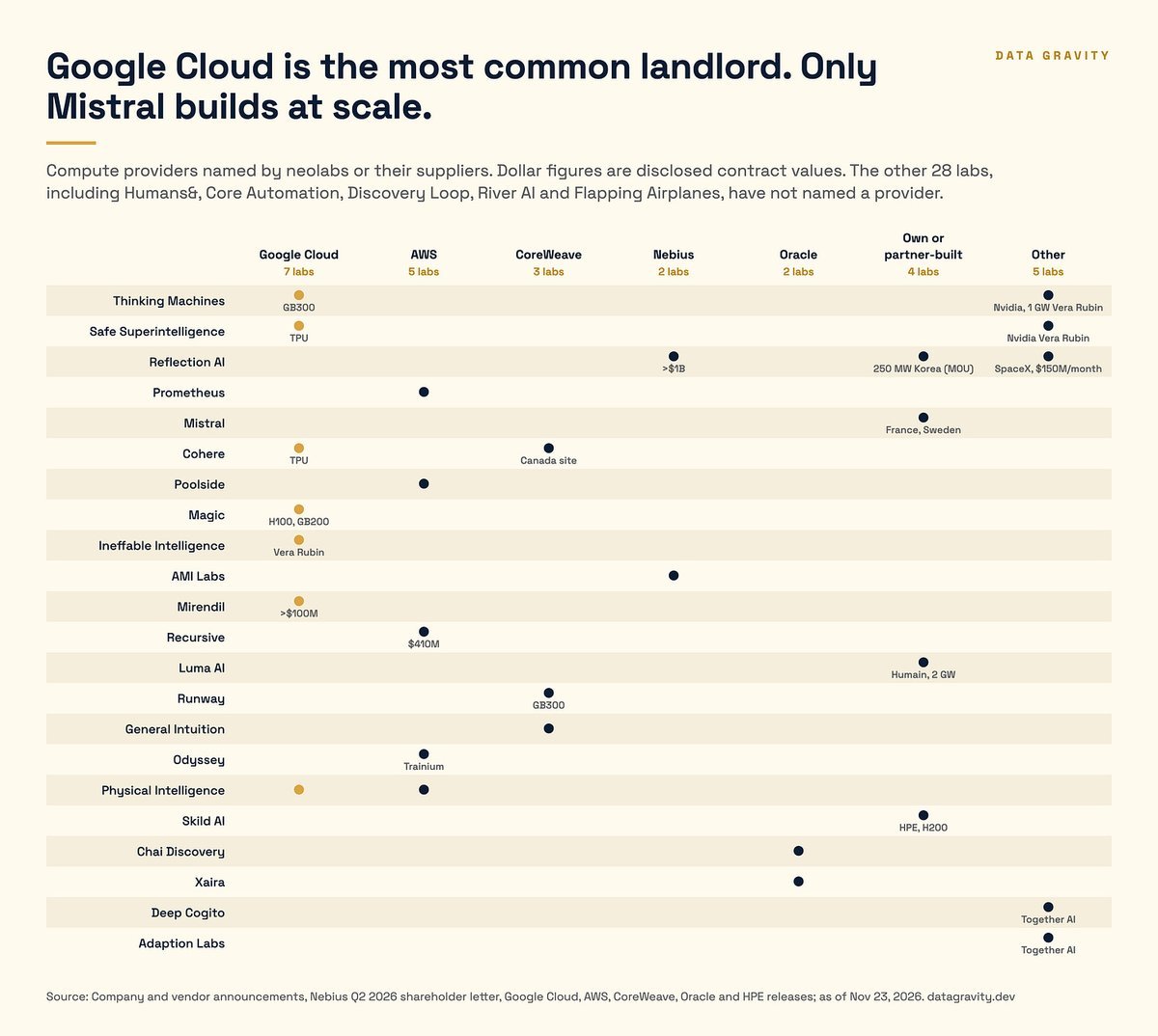
Only 22 labs have said who supplies their compute. Google Cloud tops the list with seven: TPUs for SSI and Cohere, and Nvidia GPUs for Thinking Machines, Magic and Ineffable. AWS counts five customers and CoreWeave three. Humans&, Core Automation, River AI and the rest of the 28 silent labs haven’t named anyone.
Mistral stands apart as the one lab building at scale. An $830 million bank loan pays for 13,800 Nvidia GB300s at a site south of Paris, €1.2 billion is committed to a Swedish data center, and in July it agreed to lease some capacity to Microsoft.
Gigawatt deals and who pays
Renting GB300-class capacity at $5 per GPU-hour runs about $69 million per megawatt over three years. At that rate, the compute slice of Thinking Machines’ confirmed $2 billion buys roughly 23 MW, or about 80 MW if the $5 billion round closes. Its Nvidia agreement is for at least 1 GW of Vera Rubin systems from 2027.
Luma anchors Project Halo, a 2 GW cluster being built by Saudi Arabia’s Humain. Luma’s own money covers about 10 MW, and Humain also led its $900 million round, so one company is investor, landlord and builder. Nvidia backs more than half of the 50 labs and supplies chips in most disclosed deals, which means a lot of its investment comes back as hardware sales.
The gap with the big labs is huge. Anthropic’s S-1 lists $69.8 billion of compute commitments due in the next year and $895 billion overall, against an estimated $37 billion that all 50 neolabs can spend on compute across their entire funding.
What to watch next
Outspending the giants isn’t an option, so each neolab is wagering that its own method squeezes more out of less compute. If the wager pays off, a few dozen megawatts is enough. If it fails, the lab needs a much larger raise or an acquirer.
The acquirers so far are chip and cloud sellers. AMD finished its $8.2 billion World Labs purchase this month, and Amazon agreed on Nov. 23 to take Decart’s optimization technology and team. Watch three things: whether Thinking Machines closes the $5 billion round, how big Cohere’s Series E is (its first close came without a figure), and who covers Reflection’s compute bills, which already top its confirmed funding.
Source: datagravity.dev