
Linear has passed $100 million in annual recurring revenue, and its COO says agents now create more than half of the work in the product. Linear ARR crossed that line this year, backed by over 40,000 customers who pay for the product and net revenue retention of 177%, says Cristina Cordova, who runs go-to-market at the company.
The growth came with a sharp change of direction. Linear began as an issue tracker. After raising $134 million over seven years, CEO Karri Saarinen wrote a March post declaring the category finished, under the headline “Issue tracking is dead.”
From 40 people to $100 million
Cordova arrived in 2023 with a long Stripe career behind her, plus a stint running partnerships and platform at Notion and a partner role at First Round. Linear then had roughly 40 staff and a single salesperson. It now has around 170.
The founders created the product after years of frustration with older tools at companies such as Coinbase, Airbnb and Uber. Startups such as Vercel and Ramp picked it up self-serve and helped it spread. An August share sale let employees cash out $99 million, priced at a $2.5 billion valuation.
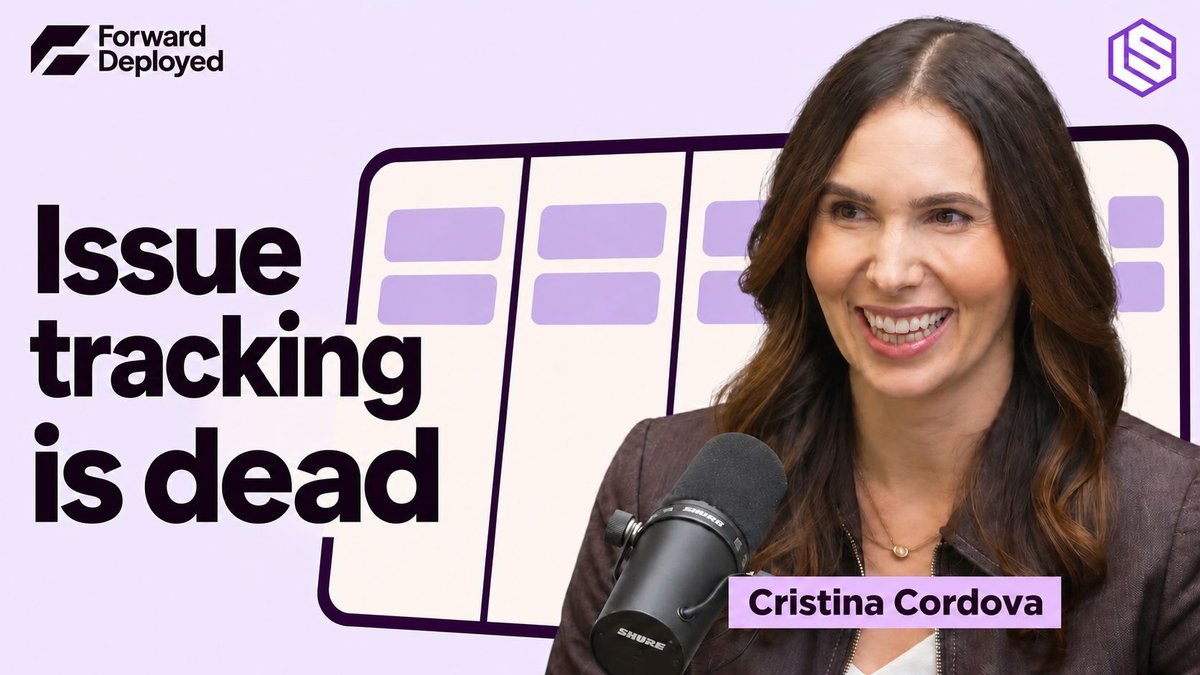
Agents now create most of the work
In May 2025 the company launched an MCP server, which Cordova describes as practically the first of its kind. It has since added a platform for building agents, connections to Codex, Cursor and GitHub Copilot, and an agent of its own. A year ago agents accounted for 3% of the work created in Linear. Today the share is over half.
Cordova rejects the idea of Linear as a plain data store fronted by an MCP server. SaaS firms that accept that role, she says, are badly misjudging the market, because users have no reason to open an app whose agent workflows are no better than those outside it. She watches agent usage against app usage. If agents grow while the app stalls, the product is a commodity. Both are growing at Linear.
Why enterprise plans were dropped
The route to Linear ARR of $100 million wasn’t the one the company mapped out.
Within three weeks of starting, Cordova removed the enterprise goal from the company’s list. Her team was one salesperson, so she courted growth-stage firms and left rivals’ customers alone, much as Stripe signed up new businesses before it won anyone away.
Linear did announce an enterprise push for 2025, with a list of features for big organizations. Agents then took over the schedule. The MCP server, the agents platform with its new APIs and the coding-tool integrations were unplanned, and much of the enterprise list never got built. Cordova says she pressed ahead while competitors hesitated, and large companies began adding Linear to their shortlists.
A sales team without SDRs
Linear has never employed a sales development rep. Cordova thinks qualification calls waste a buyer’s time, since people want to see the product, not answer questions about budget. Account executives run their own outbound, helped by tools that keep it personal.
The company also skips forward deployed engineers. Solutions engineers join enterprise account executives on deals and sometimes build a ServiceNow integration in a night to prove the idea works.
Support is handled internally. AI writes draft replies and a person decides what gets sent; no LLM answers tickets alone. In her 3.5 years at Linear, Cordova says, no customer has escalated over poor support.
Pricing and headcount
Until June, Linear’s pricing was entirely seat-based. Coding sessions, which run Claude Code and Codex and draw on AI credits, ended that. Loops, the company’s recurring agent jobs, use AI credits too. Chat with Linear Agent stays free despite running on frontier models.
Cordova says she’d like outcome-based pricing, as Intercom does with Fin at $0.99 per resolved conversation. It’s harder for Linear. Routing a bug to the right team is worth different amounts to different companies.
Linear operates with roughly half the staff of similar companies at this revenue. From Stripe, Cordova brought a 40% rule: engineering, product, design and data should make up at least 40% of the company. Hiring is deliberately slow, and candidates are tested on a real problem. Her test was drafting Linear’s plan for reaching customers, and she then took the job of carrying it out. Besides the founders, she’s the only C-suite executive.
What other AI startups should read into it
Cordova says AI budget is what speeds up buying right now. Companies reserved money for categories that were new, and products that fit skip the usual competition for funds. She expects that to shift. Buyers are choosing one-year contracts and paid pilots over three-year terms.
She also cautions that some startups reach $100M very fast on a few contracts worth $30 million to $40 million each, signed with defense firms or large law practices. Linear’s base is different: 40,000 paying customers behind its Linear ARR figure. Renewals of the one-year deals will show whose revenue was durable, she says.
Source: Latent Space