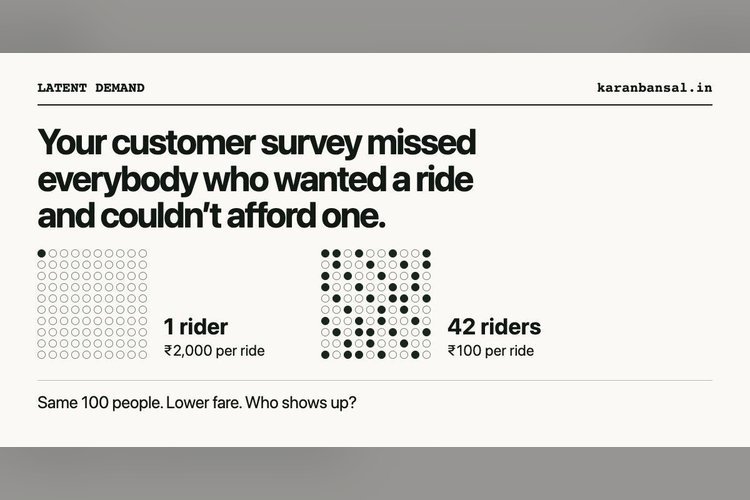
Latent demand is the use that never shows up in a survey because the cost, the effort or a missing button keeps people away. A Kenyan clinic found out by accident. It sent appointment reminders as one-way texts, but replies stayed enabled. Pregnant women began answering, and within a short time staff faced over 1,000 messages daily. AI was added afterwards to sort which ones needed a person first.
Counting the people who weren’t there
Poll those women a day earlier about texting the clinic for help and the tally would have been zero. They hadn’t asked because they had no way to. The need was already there.
The same blind spot makes old sales charts look like bad forecasts. Questioning current ride-hailing customers would never reveal the people who sign up once a ride becomes easy enough.
Light: 3,000x cheaper, 13,000x more use
Over the two centuries from 1800, inflation-adjusted light in Britain became about 3,000 times cheaper. Per-person consumption, counted in lumen-hours, rose roughly 13,000-fold: a second lit room, a lamp left burning for reading, then streets lit through the night. Add population growth and national consumption grew around 40,000x.
Incomes grew about tenfold in that time, so price isn’t the only driver, but income alone can’t account for 13,000x. William Stanley Jevons noticed the same effect with coal in 1865, when more efficient engines led Britain to burn more of it.
Postage, cameras and cars
Britain posted around 76 million letters in 1839, with fees set by distance and often paid by the recipient. A single prepaid penny rate replaced that in 1840. Volume more than doubled within a year and reached 347 million by 1850. The Post Office bore the cost, with net revenue down about 73% in 1840. Simplicity can release as much demand as a low price, though more volume doesn’t guarantee more profit.
Kodak’s first camera sold for $25 in 1888. The $1 Brownie followed in 1900. Until then Kodak’s top year was 55,000 cameras; the Brownie shipped over 150,000 in its first. The price dropped 25-fold, and since nobody needed training to use it, the skill hurdle disappeared too.
Ford’s Model T started at $850. Once the moving assembly line began in 1913, the price kept sliding until it reached $260, and by 1927 over 15 million cars existed. A 3.3x reduction in nominal dollars sounds modest, but it put the car within a working family’s budget. What counts is whether a price cut reaches first-time buyers, not how big it is.
Containers, airfares and shampoo
Moving loose cargo onto a ship cost roughly $5.83 a ton in 1956. In April of that year Malcom McLean’s Ideal-X left Newark for Houston carrying 58 containers. His own company put the new cost near 15.8 cents a ton, about 37x lower. When the price of a step all freight must pass through collapses, unplanned uses appear, and global supply chains grew out of it.
Fares roughly halved on routes Southwest Airlines entered, and passenger numbers more than tripled, per Southwest’s account of a 1993 US Department of Transportation study. Halving a price can triple use when the new buyers were never in the market.
Shampoo in 1983 meant a large lump-sum purchase for a rural Indian household. Chik offered single-use sachets at a rupee or less, and by 1990 it controlled over half of southern rural markets, ahead of the former leader. Per-millilitre cost wasn’t the obstacle. The size of the purchase was.
Where demand pushes back
Cheaper doesn’t always mean good news for incumbents. Duranton and Turner found that driving grows in step with interstate lane kilometres. Widen a city’s highways by 10% to ease congestion and congestion returns, since quicker roads make previously skipped trips worthwhile. Heavier use doesn’t mean the problem is fixed.
ATMs took over a teller’s main task of dispensing cash. Urban branches went from about 20 tellers to 13, yet banks opened roughly 43% more branches because each cost less to run. Mobile banking then arrived, and teller jobs have fallen almost 30% since 2010.
What this suggests for AI demand
A useful test for AI: count who can now attempt a task at all, then look at what lands on the receiving side. Vermont’s federal court logged 45 self-represented cases in fiscal 2021 and 1,121 in fiscal 2024, per Shah and Levy. Immigration applicants with stalled cases were passing around filing tips because that court acted fast. One filer wrote up how Copilot drafted a complaint and a Fiverr lawyer reviewed it for $150. Court data can’t say how many filers used AI, but the story shows a newly workable path: arrive with a draft and pay only for a check.
People are still needed on the receiving side. Courts must read each complaint and clinics need someone for urgent calls. If AI behaves like light, letters and cars, the early sign won’t be a sharper forecast from current users. It will be a surge of new work from people who weren’t users before.
Source: karanbansal.in