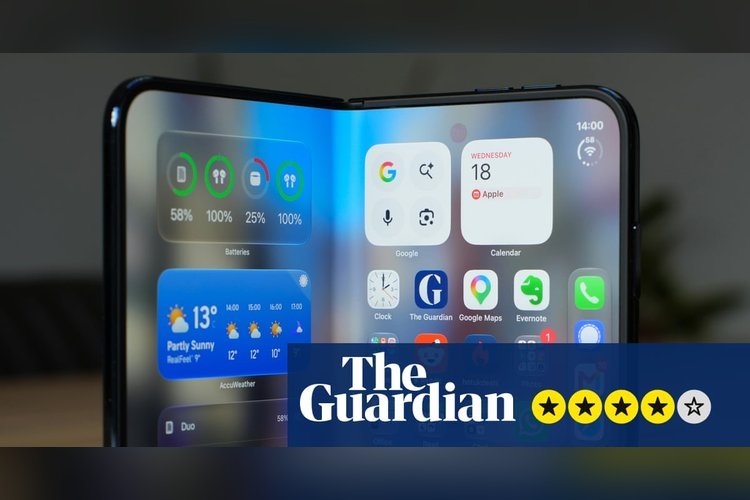
The iPhone Duo is Apple’s first folding phone, and it starts at $1,999 (£1,999, €2,299, A$3,499). That makes it the most expensive iPhone ever sold. Early hands-on testing suggests it is the most original iPhone in almost ten years, though it asks for real trade-offs in return.
A short, wide body
Most folding Android phones are tall and narrow. The iPhone Duo goes the other way. Closed, it measures 117.8 x 84.1 x 11.3mm and weighs 254g, which makes it 6.1mm wider than the iPhone 18 Pro Max.
Apple gave both screens the same 1.4:1 shape. The outer panel is 5.4 inches and the inner OLED is 7.6 inches, both at 120Hz. The result is a phone that is hard to use with one hand. Typing and reaching across the display usually takes two.
The inner screen has a matt finish like Apple’s high-end iPads and MacBooks. It cuts glare and hides the crease. It is also softer than normal phone glass, so a hard press with a fingernail can leave a permanent mark. Some owners have already reported units with broken screens.
iOS changes for the first time in a decade
The short outer screen leaves little room above a keyboard, so Apple rebuilt parts of iOS around it. The dock now sits on the right edge. The status bar shrinks to a small circle under the selfie camera, and controls such as back buttons and tab bars move to the right too.
That pushes the main part of an app toward the left, which is awkward for right-handed thumbs. Touch ID sits on the right side of the frame, so left-handed users will find it harder still. There is no Face ID.
Apps fall into three groups. Apps that haven’t been updated appear as a standard iPhone window in the middle of the screen, which looks silly on the big display. Apps updated for iOS 27.1 stretch to fill the screen but leave the right panel empty. The best ones are redesigned for the Duo and use both panels. Apple’s own apps lead, and Google Maps now spreads the map across the whole display. Instagram head Adam Mosseri has said it is “a bit of a tricky form factor” for developers.
Not every Apple change works. Moving the equals key in Calculator is a particular irritation.
Hinge modes and multitasking
The hinge holds at different angles. Stand the phone like a tent and it shows the standby clock and widgets. Half open, it works like a small laptop with the keyboard on the bottom half, or it splits video above and controls below. Netflix even spills colors from the picture onto the lower half.
Split screen is limited. Two apps can run side by side, only when the phone is turned sideways, and they can’t be resized. You can pin a pair to launch together. Held upright, you can pin a video to the top with one app underneath, and nothing more.
Battery, repairs and cameras
The Duo runs Apple’s A20 Pro chip with 12GB of RAM, the same processor as the iPhone 18 Pro. Battery life is a pleasant surprise. With about 3.5 hours of use on each screen, it lasted close to two days. Most people will charge it every other night. A full charge takes about 82 minutes with a 60W adapter, which isn’t included.
Apple says the battery keeps at least 80% capacity after 1,000 full cycles. A replacement costs £209. Out-of-warranty screen repairs cost £389 for the outer display and £999 for the inner one. iFixit scored the phone 5 out of 10 for repairability, the best for a foldable but well behind regular slab phones.
The camera setup is the clearest compromise. There are two 48MP rear cameras, a main and an ultra-wide, and no telephoto. Low-light shots trail the iPhone 18 Pro. The upside is that you can use the rear cameras for selfies while the outer screen acts as a viewfinder. The 4MP camera under the inner screen is only good for video calls in bright light.
How the price compares
In the UK, the iPhone 18 Pro costs £1,199 and the iPhone 18 Pro Max £1,299. Rival foldables are cheaper: the Samsung Galaxy Z Fold 8 is £1,699, the Galaxy Z Fold 8 Ultra £1,899, the Google Pixel 11 Pro Fold £1,799 and the Honor Magic V6 £1,300.
Who should buy it
The Duo suits people who are tied to Apple’s ecosystem and want something different. Watching TV on a commute is a highlight, and old 4:3 shows fill the inner screen almost exactly. Messaging on the closed phone takes getting used to, and multitasking feels cramped.
Developers are shipping updates daily, so the app picture should keep improving. Reviewers say better and cheaper foldables exist on Android. For everyone else, a regular iPhone is the safer buy.
Source: the Guardian