
Durable AI agents are the difference between a crashed overnight run that costs you twice and one that picks up where it stopped. A hands-on comparison of Inngest and LangChain (LangGraph plus LangSmith) built the same long-running coding agent on both. Inngest came out ahead 4 to 2 across six categories, with LangChain winning on observability and deployment.
The test agent, CodeClimb, loops through experiments and evaluations for hours. Its best night ran 26 rounds in 11.8 hours and cost $74.63. A crash at hour six with no checkpoints means paying for those six hours again, while a leftover sandbox keeps burning credits.
What the test agent needs
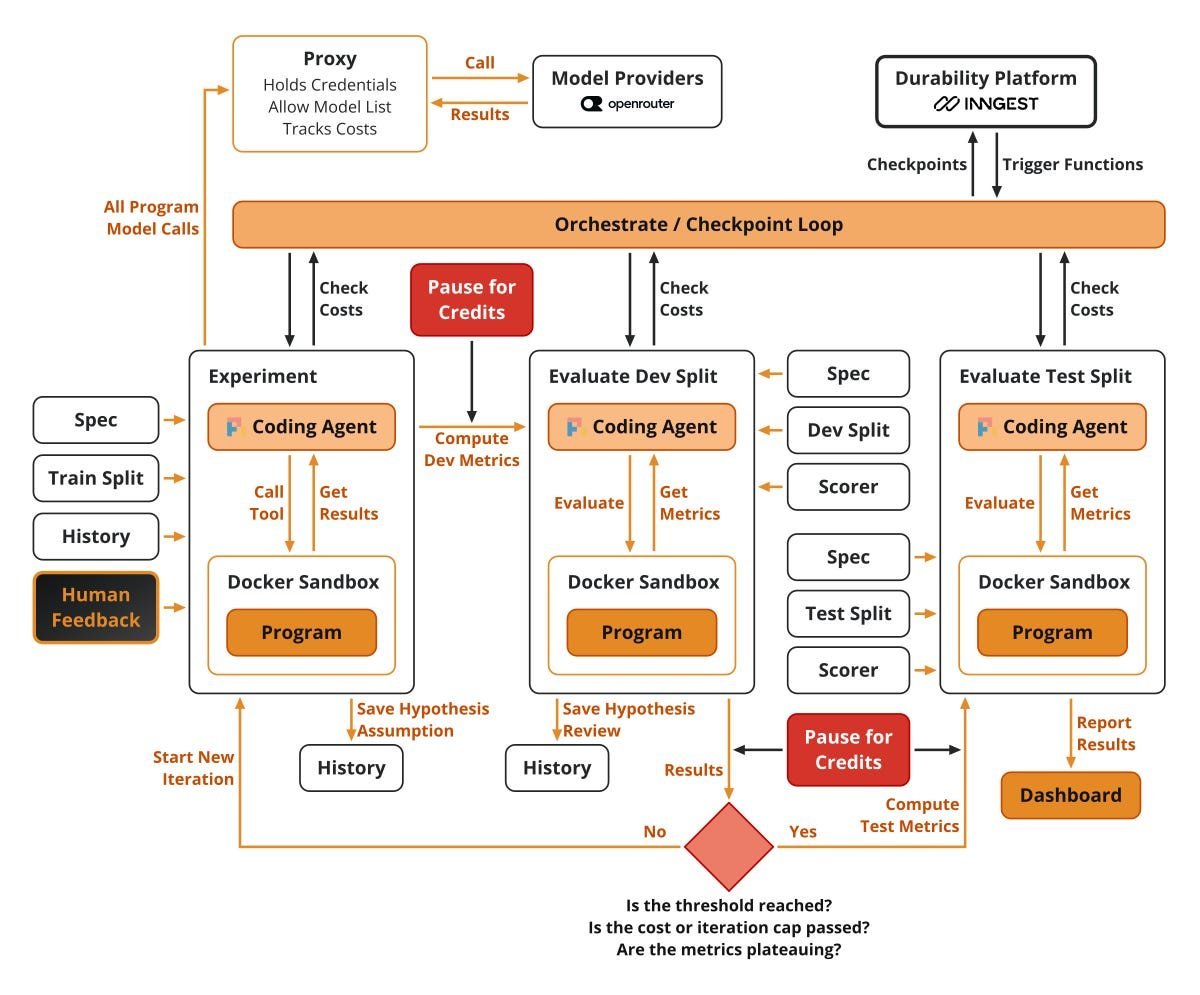
CodeClimb has a coding agent write a solution, then scores it on a dev split with metrics such as F1 and mean reciprocal rank. The results feed back into the next round. The loop stops at a metric threshold, a cost cap, a round limit or a plateau, then scores a held-out test split to check for overfitting. The dataset has 22 articles, split 6 train, 8 dev and 8 test.
The guardrails are strict. Each experiment is capped at $2.50 and 30 minutes, and each night at $120. Those checks run before every model call. A durability layer has to survive crashes, retry failed steps, free sandboxes and let a human pause or resume the run.

How Inngest handles it
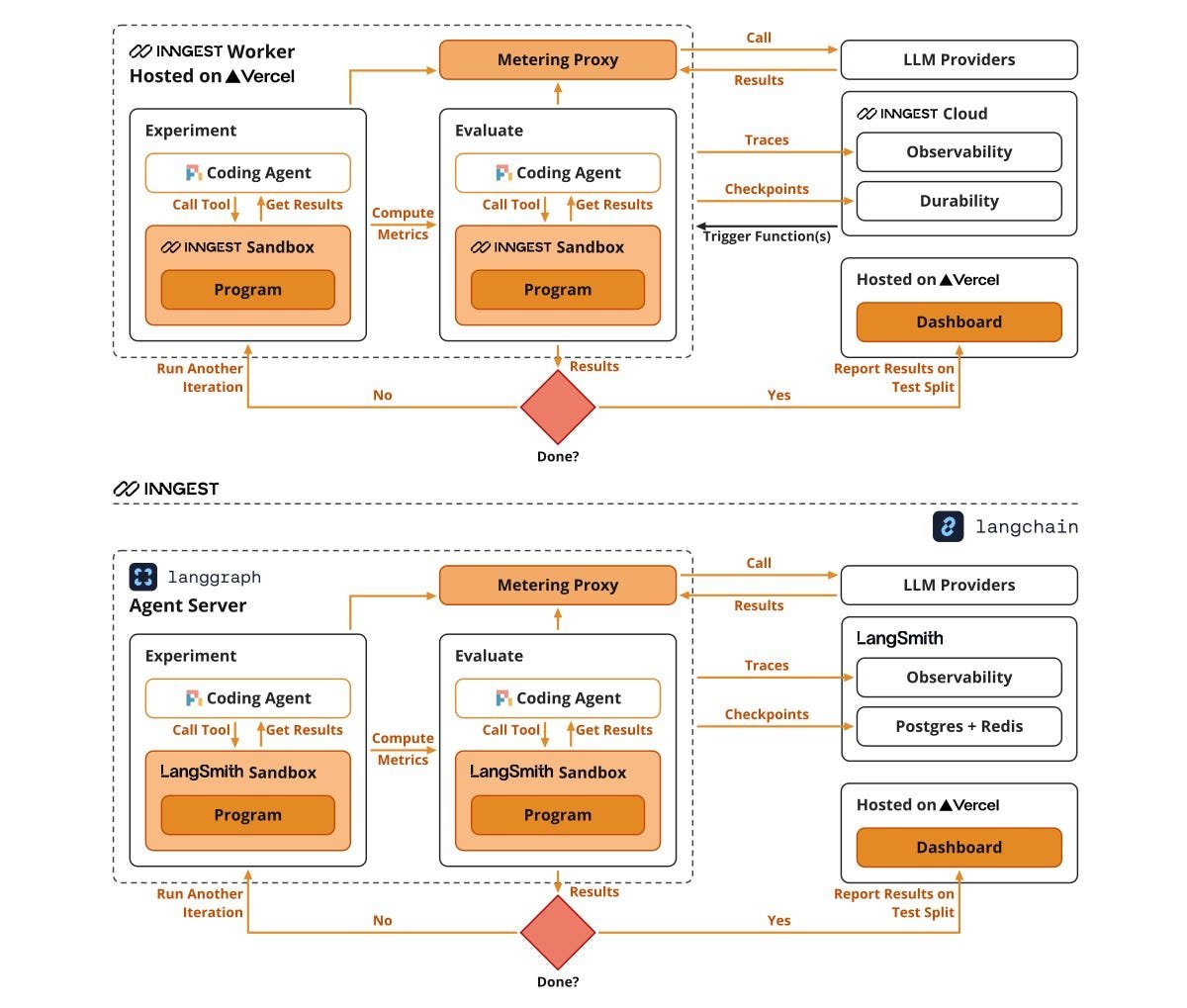
Inngest splits the system in two: a long-lived worker that runs your code and a server that holds run state, schedules steps and triggers the worker. The server can run on Inngest Cloud or be self-hosted, since it is open source.
CodeClimb ended up with 6 functions and 4 events. A parent function, run-night, invokes run-experiment and run-evaluator each round. Every experiment-plus-evaluation is one step, because step inputs and outputs travel between server and worker and should stay small. A step can run up to an hour, so experiments were capped at 50 minutes.
Because the server sits outside the worker, it notices a dead worker in about two minutes and can retry the work or send it to another worker. When credits run out, a waitForEvent call pauses the night for up to 3 days without holding a worker.
The downsides: event-driven designs can turn into a tangle that is hard to follow, and traces last only 7 days on the Pro plan.
How LangChain handles it
LangGraph runs everything on one node. The Agent Server holds the scheduler and the agent code, with Postgres storing threads, runs and checkpoints and Redis queuing jobs. The Functional API, with entrypoints and tasks, matched Inngest’s step model better than the Graph API.
Each task is checkpointed and retried up to three times. Human approval uses interrupt(), which ends the run and frees resources until the thread is resumed.
Durability is weaker. Even with the “sync” setting, the server batches writes every second, so a step not yet saved is lost. Task retries live inside the server process, so a crash wipes them out. After a restart, a sweeper reruns the whole run up to three times, then the thread fails while its sandboxes keep running. The team had to add a watchdog to clean those up.
Scorecard
- Durability: Inngest, which cleans up after crashes more reliably.
- Developer experience: Inngest. Porting existing code is easy and the docs are clearer. LangChain suits you only if you fit its patterns.
- Observability: LangChain. LangSmith has agent-native views of LLM and tool calls, which Inngest lacks.
- Deployment: LangChain, where hosting and scaling are close to turnkey.
- Cost: Inngest, since LangChain’s prices climb with scale.
- SDKs: Inngest. Both support TypeScript and Python, but Inngest also supports Go and cross-language workers.
What it costs
Pricing was estimated from list prices dated 2026-11-21 for 12-hour nights at 10, 100 and 1,000 a month, excluding model spend. At the small tier, fixed fees dominate: $99 for Inngest Pro plus $20 for Vercel Pro, against a $39 seat and a $62 serverless deployment on LangSmith. Beyond that, sandboxes drive the gap, at about $1.15 a night on Inngest versus about $2.17 on LangSmith, whose smallest sandbox has 2 vCPUs and 4 GiB. Around 1,000 runs, the Agent Server would need to move from serverless to dedicated. These are rough estimates, not measured bills, and storage and network are excluded.
Which to pick
Inngest fits teams porting an existing codebase or needing custom, high-precision durability. LangChain fits small teams starting from scratch with standard agent patterns who would rather pay for a hosted runtime than run infrastructure.
Temporal, Restate and DBOS are other options the comparison did not test. Inngest sponsored the comparison, though the opinions were independent. A follow-up will benchmark how well each platform works with coding agents, skills and MCP setups.
Source: decodingai.com