
How companies adopt AI is shaping up as an organizational problem more than a technical one. Anthropic’s economics researchers Nathan Wilmers, Maxim Massenkoff and Peter McCrory interviewed people at 58 of its enterprise customers, in 66 conversations, and found the biggest gains came from firms that reorganized work around the tools.
The sample spans AI-native startups and century-old businesses, plus law firms, dentists, accountants, hedge funds and a trucking company. It isn’t random or representative, interviews were anonymous, and the value estimates are the interviewees’ own, so the findings are a framework for later quantitative work.
Output beats cost cutting
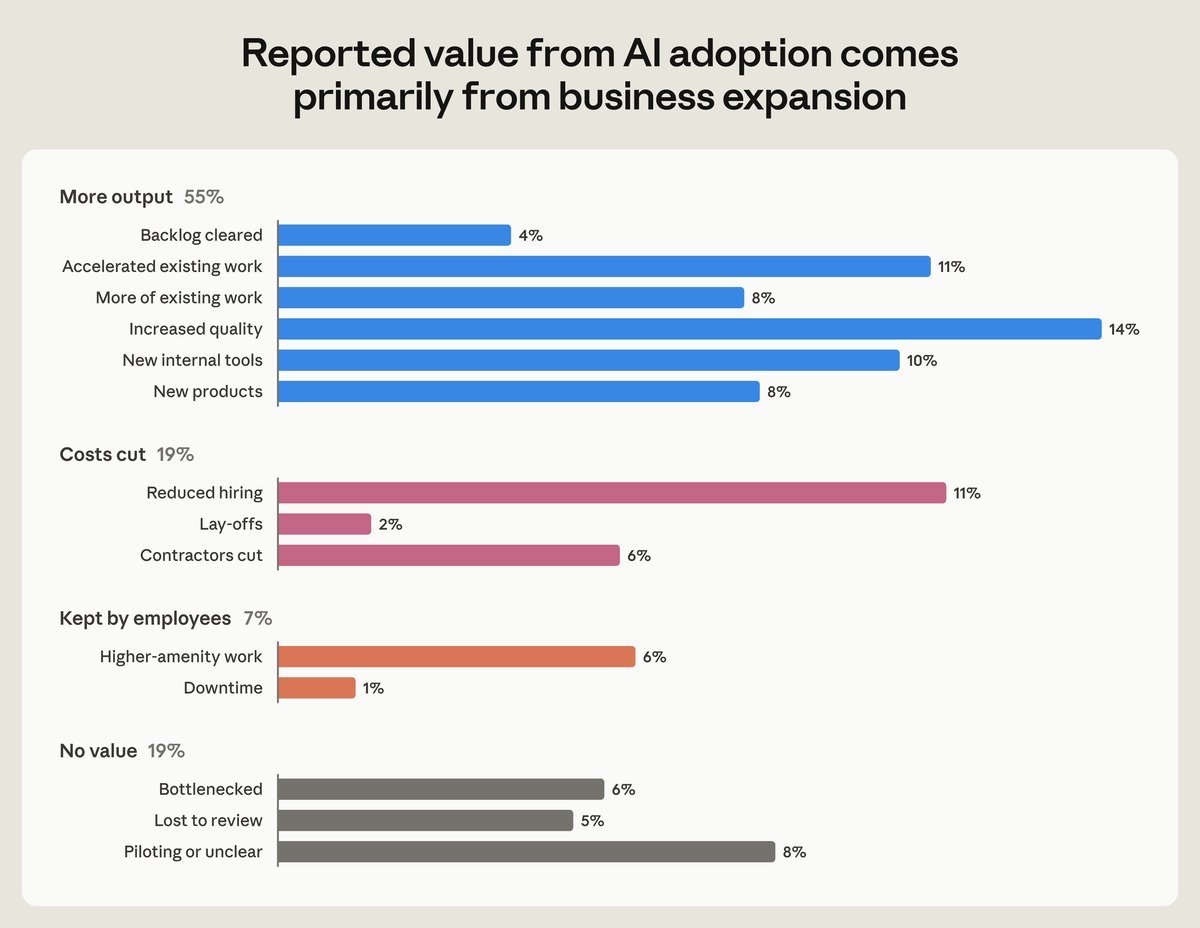
Interviewees said most AI uses added value by raising output rather than lowering costs. About half of those gains came from speeding up or expanding existing work. The rest came from better products and services or new ones, such as a medical group giving patients an up-front estimate of after-insurance costs, or a dental company answering midnight calls instead of sending them to voicemail.
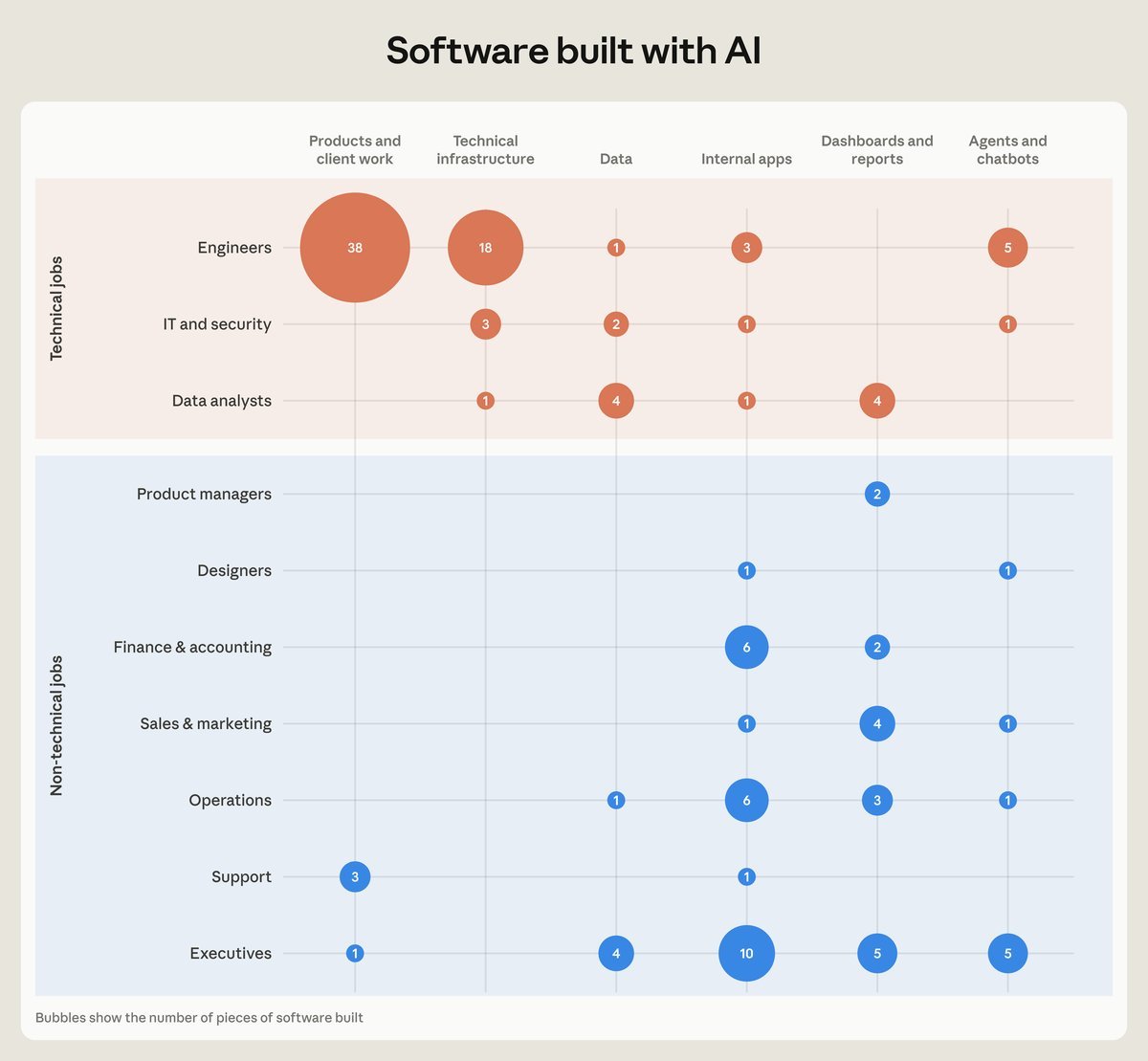
Mostly, agents write code. Of 100 pieces of software the interviewees described in detail, 80% automated manual work like spreadsheet updates, and 20% replaced software bought from vendors. Nontechnical staff are building apps, such as an accountant’s audit tool that matches 401(k) payments across dozens of systems, a job that used to take 80 hours.
Fewer layoffs, less hiring
Domestic layoffs driven by AI were rare. Five companies had pushed out employees who wouldn’t adopt it, and only two had seen automation fully eliminate a position. Ten companies reported hiring more because of AI, mainly into implementation and IT support roles.
Hiring tells a different story. People at two-thirds of the companies said AI had reduced their hiring. One engineering leader put it this way: “We may not be firing, but we’re not hiring.” Nine companies cut contractors, including developers, customer service staff and legal counsel, often already offshored. One finance company shed well over 100 offshore contractors. The researchers read that as a possible early warning for international business services.
Three adoption routes, three snags
Top-down automation can change hiring fast. One company’s document-review agent cut its planned reviewer hiring by more than 90%. But experts balked at building systems that might replace them, and some workflows were shelved. Others went stale as models improved, with one employee saying a vendor tool would be “obsolete in three months.” Some firms also use AI to monitor staff, which raised surveillance worries.
Bottom-up experimentation, where tools are simply handed out, produced pockets of success. A real estate investment manager built a deal tracker replacing a $10,000-a-year product. Yet maintenance costs ate into savings, adoption was uneven, and power users flooded colleagues with AI-written material. The most-cited bottlenecks came from inside the organization. Reviewing AI output swamped human attention, and faster coding left code review, sales and strategic decisions behind. Customer skepticism and regulation were rarely mentioned.
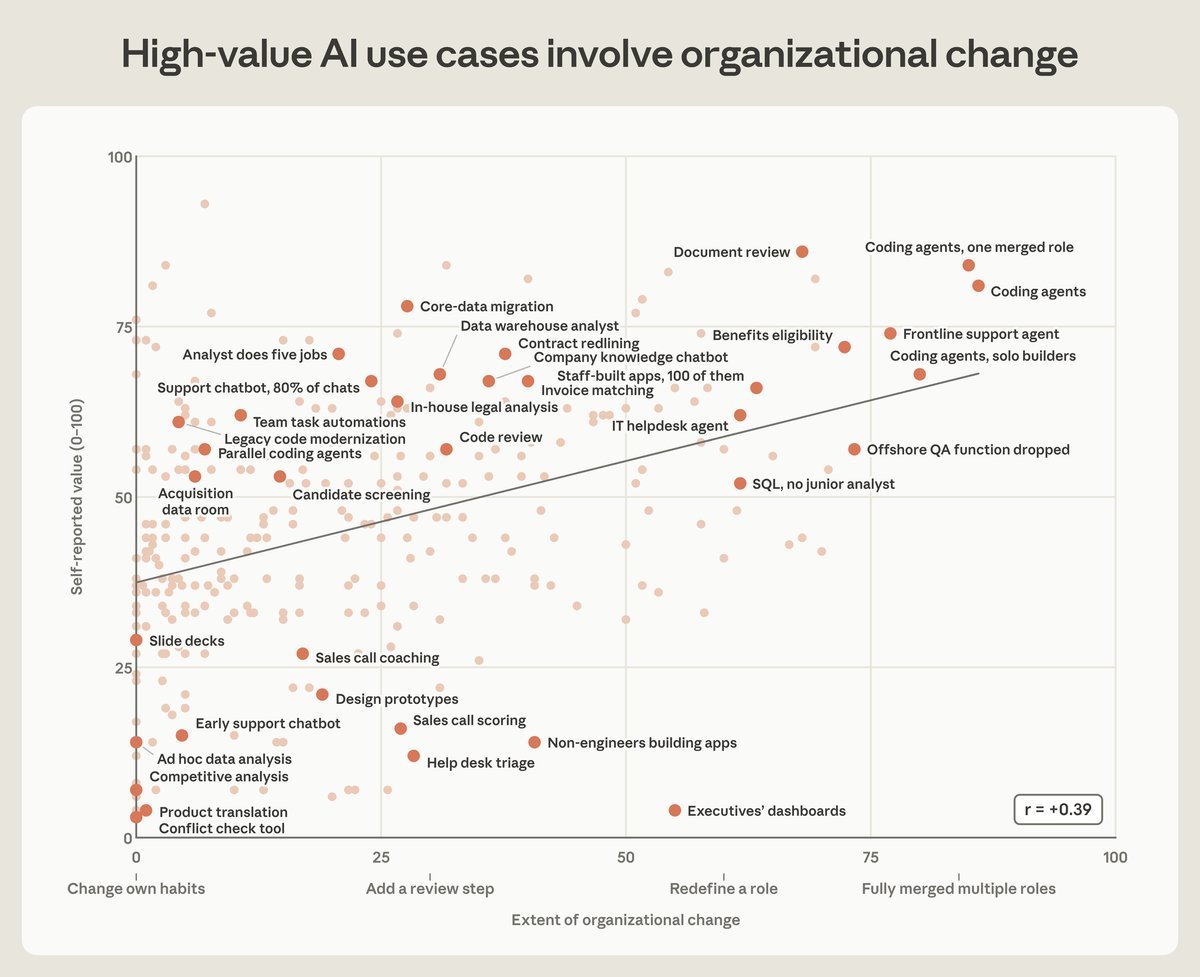
The third route is reorganizing. Interviewees tied their highest-value uses to meaningful structural change, and the researchers describe three moves.
- Broaden roles so one person or small team owns a whole workflow. One manager said the company had collapsed designer, product manager, engineer and QA into a single role.
- Redeploy people to the tasks AI can’t do. A construction firm’s project managers now spend mornings with customers while an agent collects site updates and drafts daily reports.
- Build shared infrastructure, including company data access and guardrails, so nontechnical builders don’t create security gaps.
Three law firms, one technology
The report opens with three firms. One automated its mailroom with two API calls, saving clerks five minutes a letter but risking their jobs. A second struggled with uneven use, from hallucinated app menus to seven-page prompts sent to IT. A third had junior lawyers mark up AI first drafts with senior attorneys, so they could still judge draft quality, and cut no jobs.
What to watch
The authors expect follow-up quantitative research to test these ideas. Meanwhile, the pattern in the interviews is that companies reorganizing for ongoing model improvement, rather than locking in a fixed approach, report the strongest results. The hiring slowdown is the figure to track.
Source: anthropic.com