OpenAI says its GPT-6 models can design new proteins using only reasoning and general-purpose code, with no specialized biology model producing the designs. The company calls this GPT-6 protein design capability intrinsic, and backed it with computational tests and lab experiments with research partner Onava.
Why proteins are hard to design
Proteins are chains of amino acids whose sequence helps set how they fold into three-dimensional shapes, and shape drives function. Researchers usually know what they want a protein to do, such as block a signal cancer cells use to dodge the immune system. The hard part is working out the structure that does it and the sequence that produces that structure. Specialized models for structures and sequences have made this more practical, but coordinating them takes expertise, and each accepts only certain inputs.
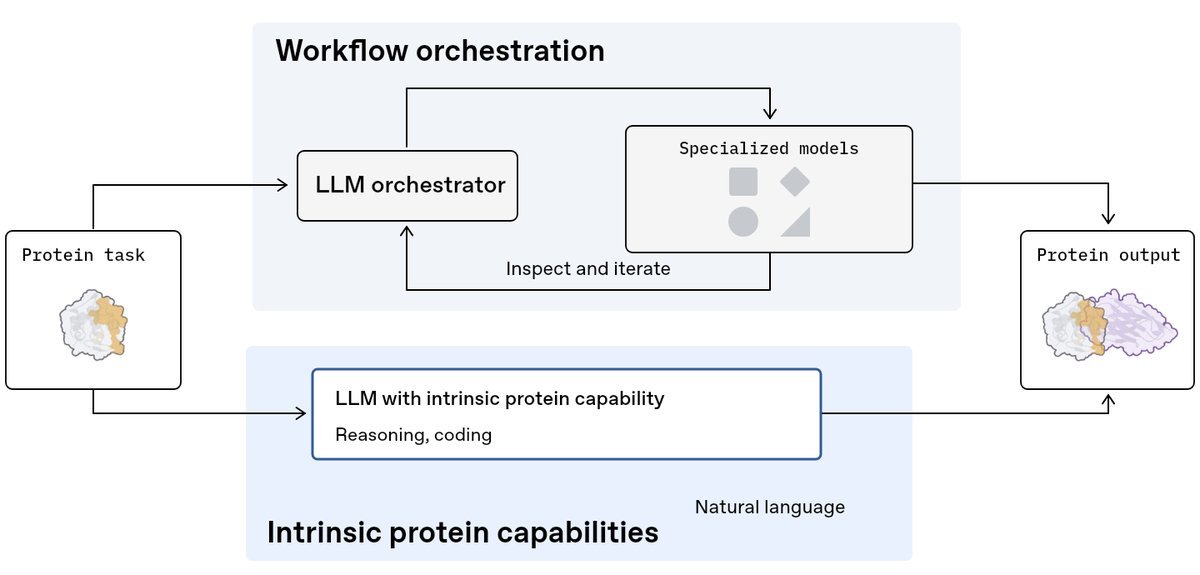
A general-purpose model that can do the work of several specialized ones could adapt to new instructions more easily. OpenAI says it could guide its models from the level of a single bond between two atoms to the overall shape of a protein, switching tasks just by changing the prompt.
GPT-6 protein design in computational tests
OpenAI tested whether the models could design small binding proteins called minibinders, build proteins around specified structural features, predict molecular interactions and rank how sequence changes affect stability and binding. Its latest models performed comparably to or better than specialized models on most tasks. Predicting a complete protein structure stayed a clear weakness.
- On motif scaffolding, 43.7 percent of designs from the latest internal model passed on 30 MotifBench challenges, against 27.8 percent for RFdiffusion.
- On fold-guided design, 18.9 percent passed across 200 challenges, against 17.1 percent for Proteina.
- On minibinders, GPT-6.2’s structures scored slightly below RFdiffusion, while the latest internal models scored higher.
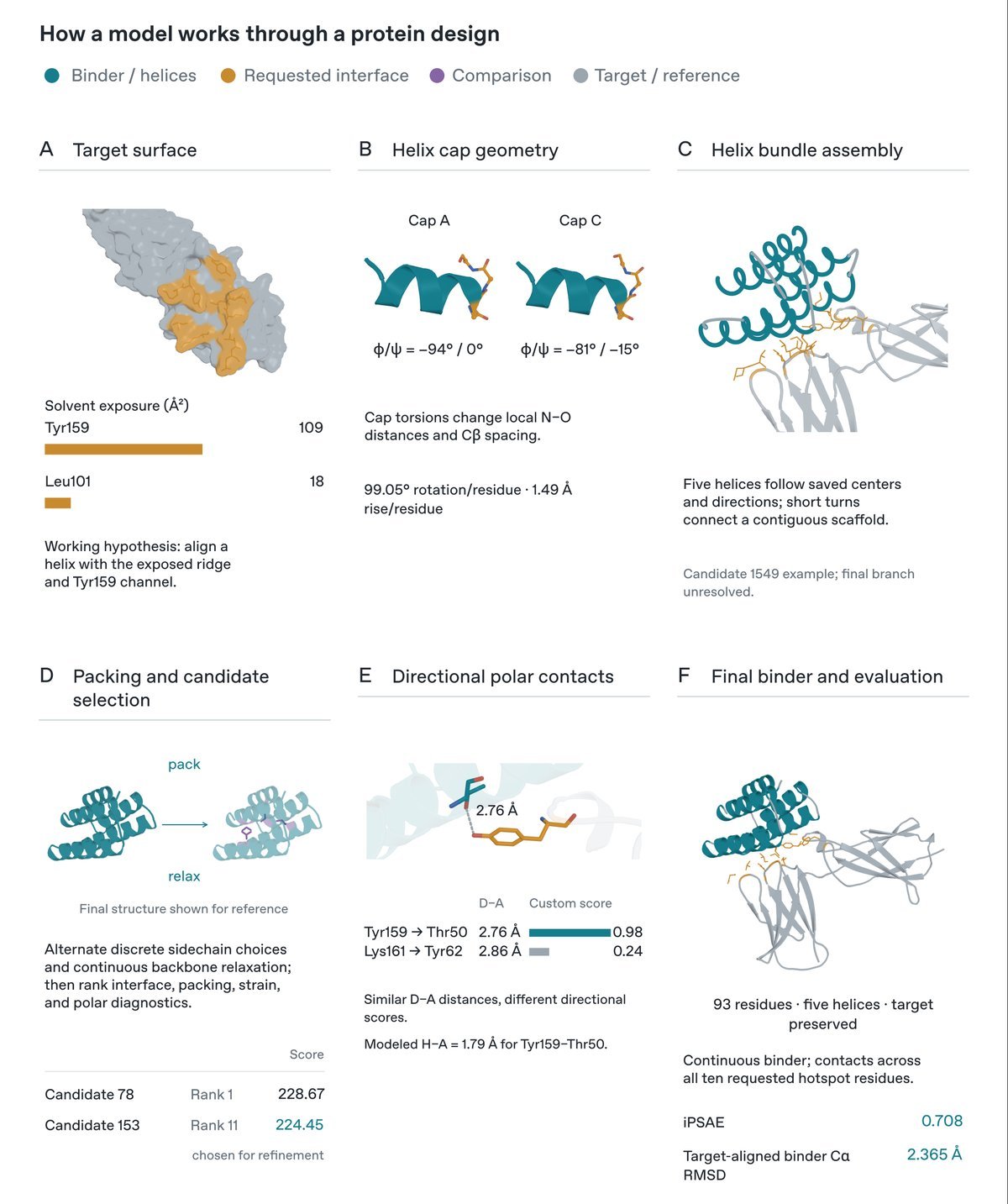
An internal model also followed instructions about where a minibinder should attach and how many coils or strands to include with near-perfect fidelity.
Lab results with Onava
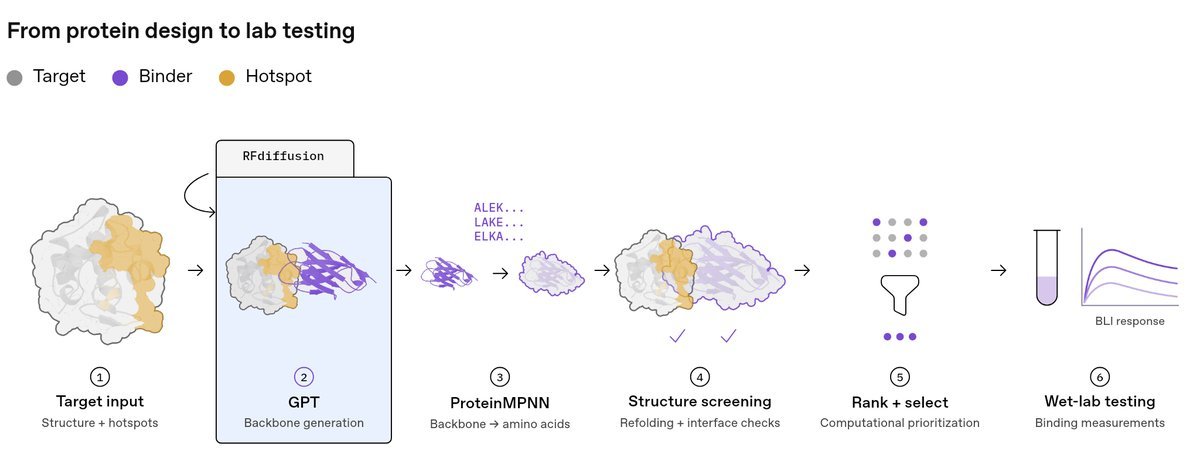
For the first experiment, GPT-6.2 was given structures of five target proteins and wrote code to create minibinder designs. Specialized models, including SolubleMPNN, supplied amino acid sequences and helped pick candidates. Of 322 minibinders tested against the five targets, 35 (10.9 percent) bound their intended target. Hits included 5 for PD-L1, 3 for IL-7Rα, 1 for TrkA, 8 for VEGF-A and 18 for IL-17A. OpenAI notes the original RFdiffusion study reported higher hit rates, but rates depend heavily on filtering and the definition of binding.
In a second test, GPT-6.2 proposed new sequences for existing minibinders after the originals were withheld. Binding showed up in 75 of 88 designs for MDM2 (85 percent), 26 of 42 for VEGF-A (62 percent) and 8 of 59 for PD-1 (14 percent). Sequences often differed from the originals, with median differences of 50 percent for VEGF-A, 43 percent for MDM2 and 15 percent for PD-1.
For three unpublished minibinder shapes, 14 of 107 proteins made from GPT-6.2’s sequences (13.1 percent) bound. For one PD-L1 shape it designed two sequences that differed from the original in 52 and 58 of 90 amino acids and from each other at 44 positions, and both showed signs of binding. OpenAI says that suggests the results go beyond memorization.
Antibodies
Researchers often redesign an antibody’s binding loops to grip a target more tightly or more selectively. OpenAI gave GPT-6.2 six small antibodies that bind IL-4Rα, with the three binding loops removed, and asked for new loop sequences. Of 182 designs, 128 (70 percent) showed binding. In a separate test on five therapeutic antibodies, the model changed about half the amino acids in three loops, and 179 of 272 fragments (66 percent) bound the original target, PD-1 or PD-L1.
What it still can’t do
Specialized models still helped select candidates in every lab experiment, and the computational results don’t show that designed enzymes would work. OpenAI says it envisions GPT-6 protein design letting researchers eventually guide protein structure generation by describing features, much as people guide image generation today. Further lab validation of designs, and whether full structure prediction improves, are the next things to watch.
Source: OpenAI