A new chart from OpenAI suggests the public GPT-6.2 Astra release comes from the same lineage as the model behind September’s Navier-Stokes proof. OpenAI never said which system did that work. This chart gives the strongest clue yet.
It sits in an essay by chief scientist Jakub Pachocki, posted on a Sunday, four days after the model reached the public. His pitch: the industry should track perplexity as a common measure of progress and as a trigger for safety limits.
Reading the perplexity chart
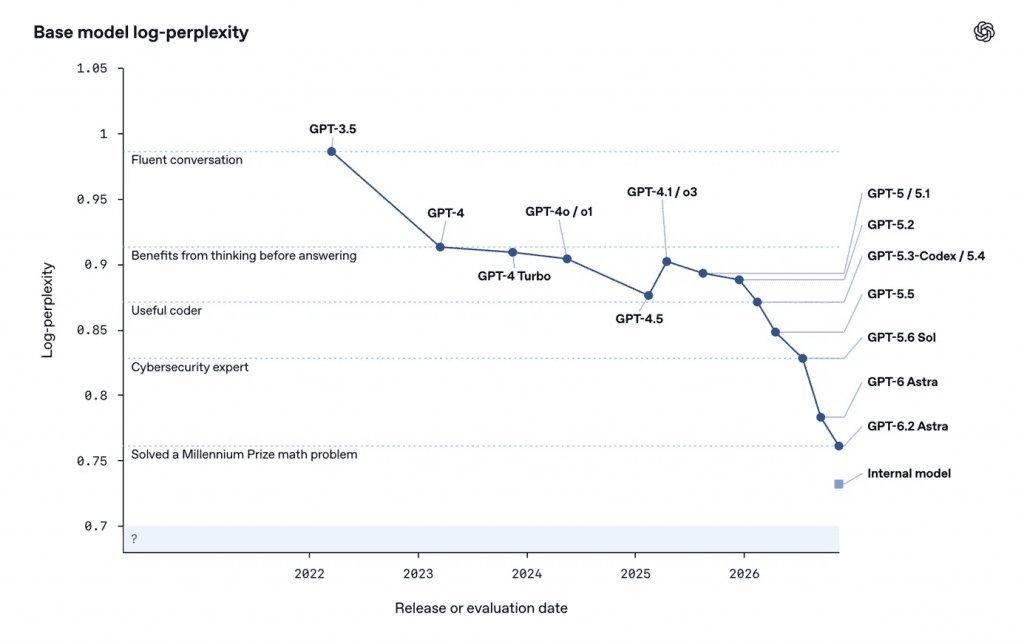
Perplexity, along with the closely related cross-entropy loss, scores how accurately a base model guesses the next token in text it hasn’t seen. Lower is better. OpenAI has logged this figure since GPT-3.5 but never released it before. It uses text from the company’s own codebase.
Each major OpenAI base model gets a point on the chart, and horizontal lines mark what models could do once they crossed each level:
- About 0.99: holds a fluent conversation (GPT-3.5)
- About 0.91: gains from reasoning before replying (GPT-4)
- About 0.87: codes usefully (GPT-5.3-Codex, GPT-5.4)
- About 0.83: acts as a security expert (GPT-5.6 Sol)
- About 0.76: cracks a Millennium Prize problem
GPT-6 Astra scores about 0.78. GPT-6.2 Astra scores about 0.76, right at the last line.
The Navier-Stokes connection
OpenAI announced on September 8 that it had resolved the Navier-Stokes existence and smoothness question, showing a smooth 3D fluid can form a singularity in finite time. Around 10,000 agents working in parallel needed about 88 hours. The company described the underlying model only as far stronger than GPT-6 Astra, with training starting August 28.
No other Millennium Prize claim has come from OpenAI, so the line on the chart almost certainly stands for this proof. A model sitting exactly there probably shares a base with the proof system, or matches its pretraining quality.
Pachocki won’t name the model, but he writes that internal results on open math questions started once a model got below roughly 0.76. Solutions piled up in one Slack thread. OpenAI has since said that model settled over 100 long-standing open problems and produced more than 300 mathematical results.
Strong at science, uneven elsewhere
That lineage fits how the product has behaved. OpenAI sells GPT-6.2 Astra, which shipped next to GPT-6.2 Sol, as the best choice for scientists. It leads the Vals Science Index and Terminal-Bench Science.
Across general tests it’s weaker. Its Artificial Analysis Intelligence Index score of 62 puts it second to Claude Fable 5.2, and it ranks seventh on the full Vals Index. Early users describe it as erratic and tough to steer. It also followed GPT-6.1 Astra, which OpenAI pulled in October when testing revealed an alignment regression. A strong base with unfinished post-training would look just like this.
Limits of the claim
ChatGPT’s version didn’t prove anything by itself. The September proof relied on thousands of coordinated agents over several days, with reported compute costs in the millions of dollars, and GPT-6 Astra did the Lean formalization. Perplexity describes the base model, not the shipped product, and Pachocki concedes it ignores post-training and chain-of-thought gains.
Scrutiny of the proof continues. NYU’s Tristan Buckmaster says OpenAI claimed credit for related work he did with Anthropic’s Levent Alpöge, a charge OpenAI’s Sebastien Bubeck rejects. A Lean formalization is public, but formal peer review hasn’t happened. Mathematician Cédric Villani nonetheless called the result a cataclysm for mathematics.
What lies below the line
The chart also carries two points beneath the Millennium Prize mark. An “Internal model” square sits near 0.73, and a shaded band between about 0.68 and 0.70 holds only a question mark. Pachocki expects new abilities to emerge in that range, though he doesn’t know which ones and says OpenAI may not yet be testing for them.
The curve has steepened this year. Between GPT-5.5 and GPT-6.2 Astra, log-perplexity dropped about as far as it did between GPT-3.5 and GPT-4. Pachocki credits mostly sustained research and compute spending, with a smaller share from AI helping to do AI research.
His proposal follows: frontier labs should jointly set perplexity ceilings and hold off crossing them until oversight tools improve. With an internal model already past the proof threshold, OpenAI seems to think that conversation can’t wait long. Other labs haven’t publicly answered.
Source: OfficeChai