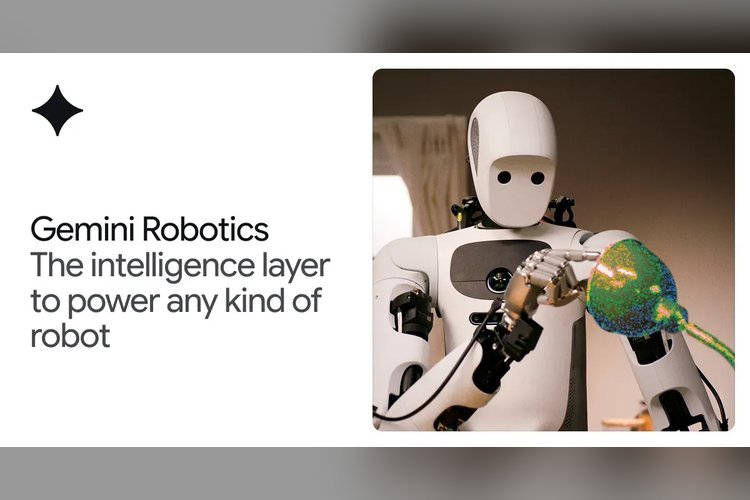
Google DeepMind is offering Gemini Robotics 2.5, a set of AI models that turn camera input and spoken or written instructions into motor control. The Gemini Robotics models are meant to run any kind of robot, from two-armed workstations to full humanoids, and developers can join a waitlist to test them.
The family has three parts that work together, each with its own job. One reasons about the physical world, one drives the hardware, and a lighter version runs on the robot itself.
Three models, three roles
The flagship is a vision-language-action model, or VLA. It takes what a robot sees and what a person says, and converts both into movements. Google DeepMind calls it its most advanced VLA and says it can control robots ranging from bi-arm setups to humanoid bodies.
The second is an embodied reasoning model. It understands physical spaces and plans multi-step tasks, and it can coordinate with people and with other robots. The reasoning model and the VLA are built to operate as one system, with the planner deciding what to do and the VLA carrying it out.
The third is the most efficient VLA in the family. It’s a lightweight version tuned to run locally on robotic hardware, so a robot doesn’t depend on a distant server for every decision.
Tasks the robot has never seen
Most industrial robots repeat one task. Gemini Robotics is designed to handle a range of tasks, including ones it wasn’t trained on, and to adapt to unfamiliar situations as they come up.
Google DeepMind lists several capabilities:
- Adapting to any bi-arm robot in just a few hours.
- Fine dexterity for delicate jobs, such as screwing in a light bulb and tying knots.
- Whole-body control of humanoids, from feet to fingertips, including bending, reaching and balancing.
- Control of complex humanoid hands and parallel grippers.
The bi-arm figure stands out. Retraining a robot for a new body usually takes far longer than a few hours, so a quick adaptation step would lower the cost of trying the system on different hardware.
Planning and teamwork between robots
The reasoning model pairs spatial understanding with long-horizon planning. That lets a robot map out a sequence of steps and finish a complicated job in a setting it hasn’t met before.
It also supports multi-robot collaboration. Two robots can split the labor and complete one task together, including robots of different types. Workflows that a single machine can’t manage alone become possible in that setup.
Talking to a robot in plain language
The models respond to everyday commands. A Gemini Robotics robot can explain what it’s doing while it acts, and a user can redirect it without technical vocabulary. Google DeepMind says this makes the models a good fit for instructing robots in volatile or hazardous environments, where a person wants to steer a machine from a distance.
Hardware partners and safety
Google DeepMind works with robotics hardware developers on what it calls physical AI. Through those research partnerships it says it’s building the next generation of humanoid and general-purpose robots. Apptronik, which makes the Apollo humanoid, is one example of a company pairing its machines with the Gemini Robotics models.
On safety, the company describes a layered approach. It combines practical safeguards with collaboration among experts and policymakers, and it points to its Responsibility and Safety Council. It did not detail specific test results.
How to get access to Gemini Robotics
Access to Gemini Robotics 2.5 is limited for now. Interested developers and companies share a few details to join a waitlist, so there’s no open release yet. Pricing and a general availability date haven’t been announced.
Two things are worth watching with Gemini Robotics 2.5 next. One is whether outside teams confirm the quick adaptation to new robot bodies. The other is how well the on-device model performs compared with the larger VLA, since robots that work offline can go into places a cloud-dependent robot can’t. Early waitlist results should show how far the Gemini Robotics models carry beyond demonstrations.
Source: Google DeepMind