Gemini 4 Neon, the mid-size model in Google’s Gemini 4 family, got every coding test right in hands-on trials against Claude Opus 5.5. It also cost much less on long inputs. Google released it on November 18, 2026, and the early results show a model that is strong but easy to overspend on.
The family has three tiers. Carbon is the large model for long, hard projects, Hydrogen is the fast and cheap one, and Neon sits in the middle.
What Google shipped
Google aims the model at engineers, analysts and scientists. A 1 million token context window comes standard, along with four reasoning settings. Out of the box it runs on high, and xhigh is the ceiling.
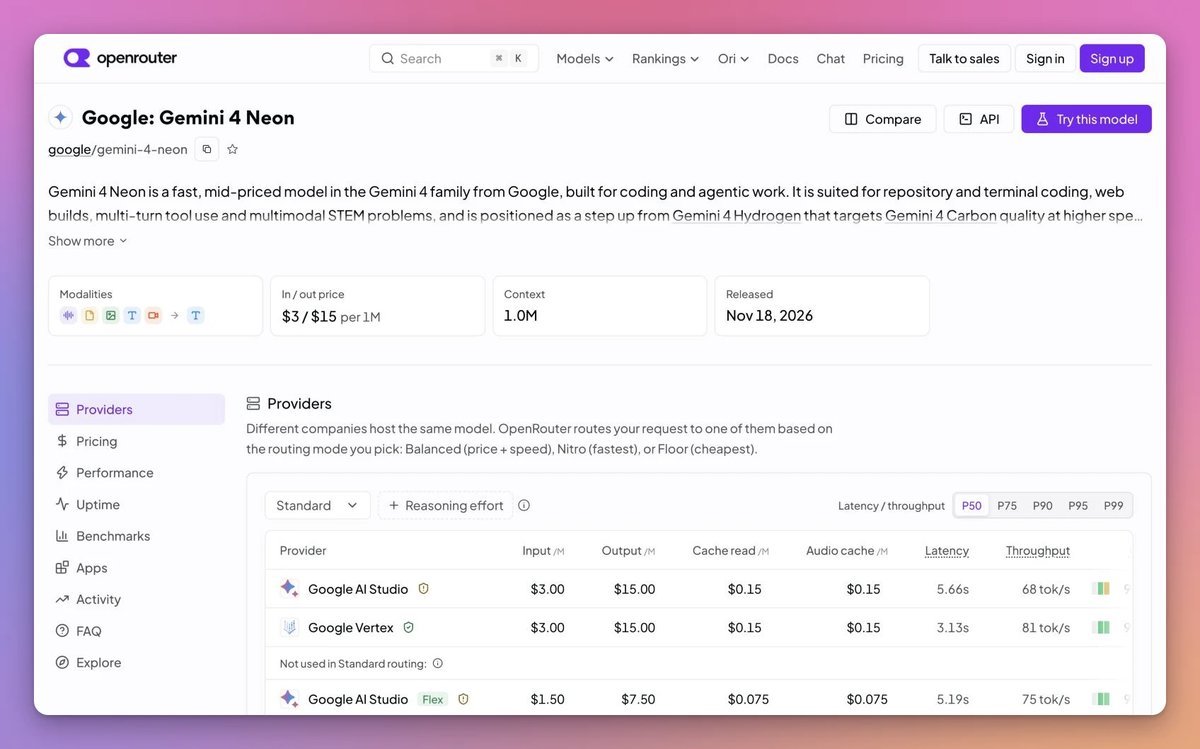
Subscribers to the Pro and Ultra plans get Gemini 4 Neon in the Gemini app. Developers can call it as gemini-4-neon through Google AI Studio and the Gemini API, and it also appears in Antigravity and Gemini Enterprise. Third-party routing on OpenRouter lists it too. Cached input is priced at $0.15 per million tokens, 95% below the normal rate.
Google’s own benchmark claims are strong: top spot on the Artificial Analysis Coding Agent Index (58.6), 65.2% on Terminal-Bench 4.1, second on the Vals Index (70.9%) and third on the Artificial Analysis Intelligence Index. Vendor-supplied numbers deserve independent checks, which is why the hands-on results below matter.
Two coding tasks, three correct answers
Neon, Carbon and Opus 5.5 all ran at high effort. Each coding answer was graded by a test suite written beforehand, so a pass meant every case held up.
One task was a duration parser that converts strings like ‘1h30m’ into seconds and rejects malformed input, checked against 30 inputs. The other was a CSV parser with the usual awkward edge cases, checked against 27.
All three models passed both, and on the duration parser they landed on the same regex.
Where Gemini 4 Neon costs more
The difference was how long each model deliberated. Before writing about 70 lines for the CSV parser, Neon burned 5,495 reasoning tokens. Opus used 694. Despite the cheaper per-token rate, Neon’s bill for that job was roughly triple.
Carbon was slower again, needing five minutes and nearly 20,000 tokens. Neon’s output speed was a bright spot: 6,032 tokens in 49 seconds, around 122 per second, where Carbon managed about 64. For routine coding work, Neon is the more practical of the two.
Dialing the reasoning down fixes much of this. On low, the model still solved the CSV task and cost under half of the high run. Small, clearly specified functions suit that setting. Keep high for agents, where extra thinking has real work to do.
Writing and long-context results
The models also rewrote a rambling commit message about a bug that sent a newsletter form’s emails twice. Neon gave a conventional “fix:” title and a compact paragraph. Opus 5.5 kept the detail that three page navigations meant three emails, which makes the bug easy to grasp. Carbon answered with two short bullets. Neon and Opus both did well.
The long-context test favored Neon most. Twenty-three posts from one site, about 385 KB of Markdown, went into a single prompt, and each model had to name the posts that mention OpenRouter. Only two did. Gemini’s tokenizer counted 26% fewer tokens than Claude’s for the same text. With the lower per-token price, Neon cost 42% less for the same correct answer.
What developers are saying
Developer reaction has been active. A discussion thread drew 728 points and more than 600 comments within a day. Many place Neon near Opus 5.5 in ability, with a lot of people still choosing Opus for code. Praise for the prose quality came up repeatedly, and one user clocked Neon at about 127 tokens per second against 46 for Carbon.
Tool use is the sore spot: earlier Gemini releases burned some users, and trust hasn’t fully returned.
What to test next with Gemini 4 Neon
The takeaway is to match the model to the job. Neon looks best for reading a lot and answering a little: a codebase, a stack of PDFs, a long log. For short coding tasks it’s as correct as Opus but slower and pricier at default effort, so drop it to low.
Agent performance on a real project is still untested in these trials. That’s where Google claims its biggest gains, with lower cost per task than rival models on long agentic benchmarks.
Source: flaviocopes.com