AI coding tools now produce so much software that “slop,” low-quality model output, has become a daily worry for engineers. One answer gaining ground is formal verification, which uses mathematical proofs to show that code does what its specification says. A new startup, &Truth, is the latest company betting that formal verification for AI code can scale.
It joins Harmonic, Theorem and Axiom Math, all of which sell verification tools that lean on AI’s growing skill at math.
Testing is not proof
When AI coding companies say an agent “verified” its work, they usually mean it ran tests, critiqued its own output or had another model judge it. Clark Barrett, &Truth’s co-founder and co-CEO, says the difference is knowing when you’re done. Testing, patching and scanning find plenty of bugs, he says, but you never know whether one more is lurking that your tools can’t see.
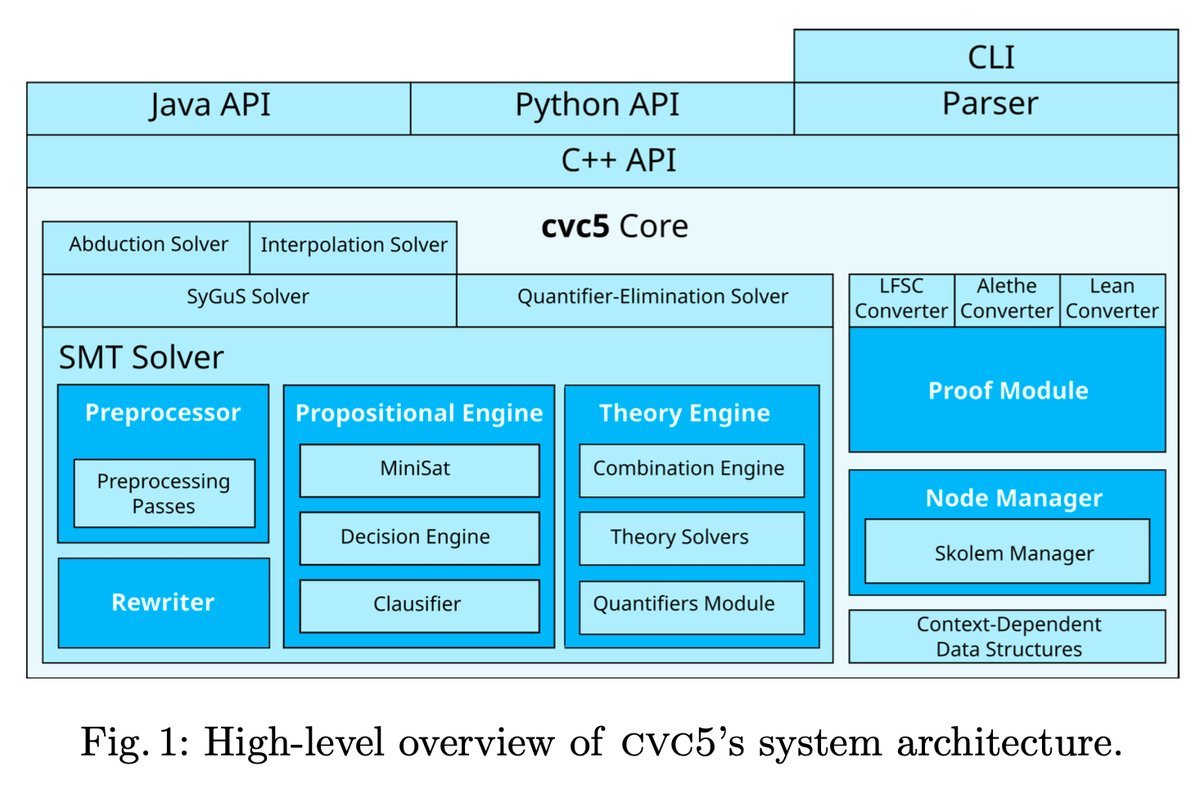
Barrett is also a Stanford computer science professor and co-creator of cvc5, a solver for satisfiability modulo theories (SMT) that Amazon uses widely. Inside Kiro, Amazon’s agentic development environment, cvc5 handles specification analysis and test generation. Barrett says production pipelines at Amazon now call it billions of times a day.
Lean at the center
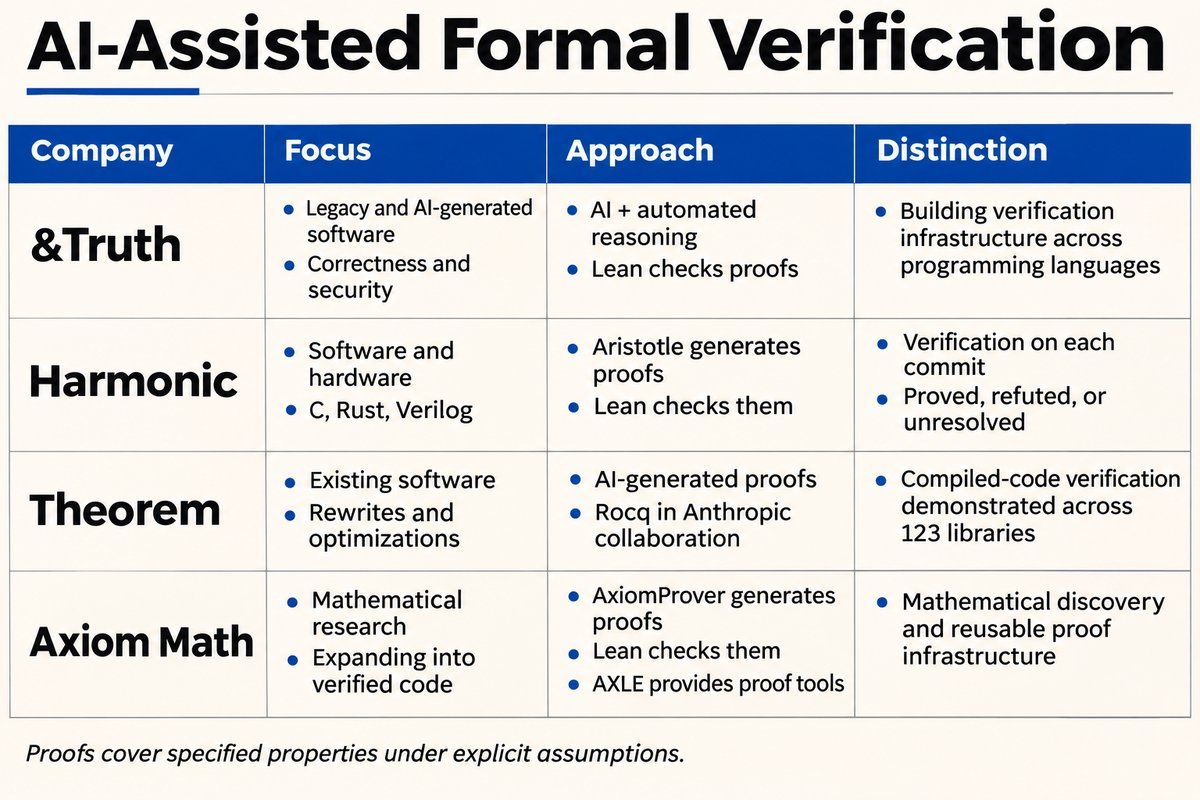
&Truth is built around Lean, a proof assistant and programming language released as open source. The company pairs AI with automated reasoning to construct proofs that Lean can check. In Barrett’s words, Lean checks that you didn’t make a mistake, like a very sophisticated checker for mathematics.
Frontier models already use Lean for hard math. GPT-6.2 Astra produced a proof of Smoktunowicz’s Gap Theorem this week that Vals considers the first one written in Lean. Vals also noted that Anthropic formalized Fermat’s Last Theorem in Lean, a 13-million-line effort. Separately, Anthropic mathematician Levent Alpöge is said to have used Claude on the 167-year-old Riemann hypothesis, with the proof posted in Lean.
On top of Lean, &Truth is assembling a system it describes as a “verification machine.” The aim is to read code in any language, prove whether it meets precisely stated requirements, and let people trust it without reading every line.
How the rivals approach it
Axiom Math uses formal verification to give its math-reasoning models correctness feedback during training, and its AxiomProver generates Lean proofs. A companion toolkit, AXLE, explores, validates and manipulates them. CEO Carina Hong has said verification is about scaling brilliance, not only catching hallucinations.
Harmonic’s Aristotle is an automated theorem prover that relies heavily on Lean. The company says the AI drafts proofs while Lean checks each step, so no result depends on the AI being correct.
Security is the first target
Barrett says cybersecurity is a main focus for &Truth. One use he describes is going through the world’s C code, open or closed source, to check that it’s memory safe, and pointing to the exact problem when it isn’t. Theorem also focuses on security. It has worked with Anthropic on a post arguing that language models are making formal software verification feasible at much larger scale.
Cost has been the obstacle, since verification burns many tokens. But that’s improving. Across 36 small verification tasks, Anthropic found that Opus 5.5 solved half of them using about 40% fewer tokens than Opus 5, and the trend is expected to continue as models train on long verification tasks.
From vibe coding to “veri-coding”
&Truth predicts a shift from vibe coding to what it calls “veri-coding,” in which verification is built into the workflow. Barrett expects the experience to look much like today’s. You still tell the agent what to build, perhaps after some work pinning down the specification, and the agent works with the verification tool behind the scenes. The difference is that the code should work the first time.
That shifts developer time toward writing specs and reviewing results, and away from writing or reviewing code. Nader Dabit of Cognition has used the term “outcome engineering” for a similar idea: when agents build what you ask for, you need a way to check what they deliver.
What to watch
None of these tools has yet proved itself on everyday software at scale. The test is whether token costs keep falling and whether writing a precise specification turns out to be easier than reviewing code. If both hold, formal verification could become a routine check on agent output.
Source: Latent Space