ERNIE 5.5 Flash now decodes at 1074 tokens per second on SGLang, according to the team that added low-latency support for the model. The setup was four SM100 GPUs, a single request at a time, a 55K-token prompt and 1K tokens generated. With a larger DSpark block size of 7, speed reaches about 1310 tokens per second.
Both figures assume simulated DSpark acceptance lengths: 5.5 for the 1074 result and 7.2 for the 1310 result. They depend on that assumption rather than on a measured acceptance rate.
What was changed
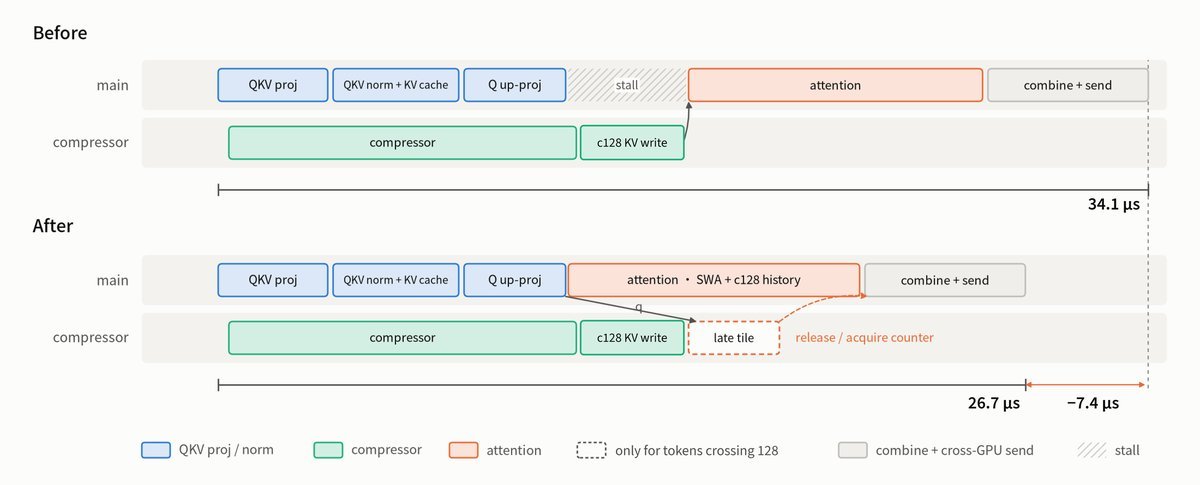
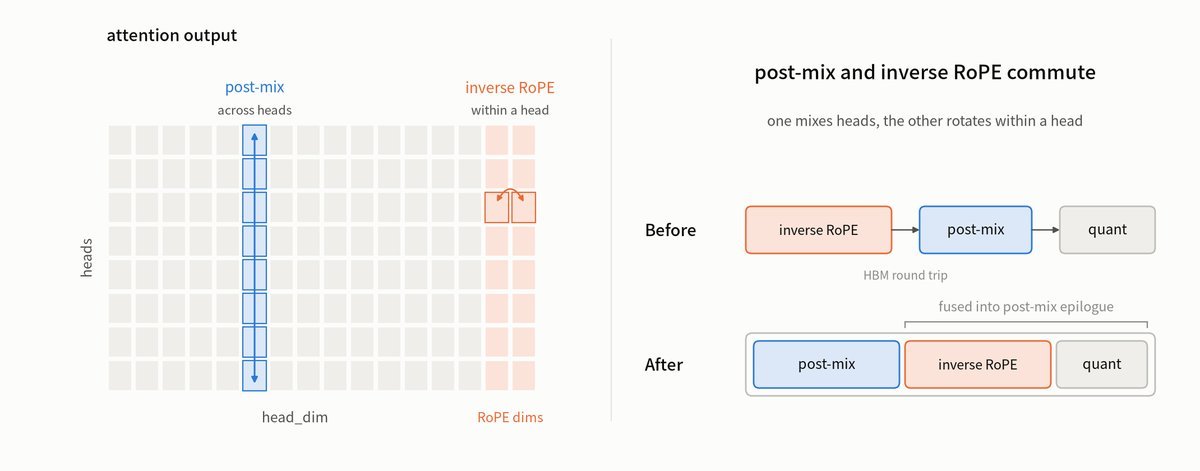
The engineers worked end to end. The changes include low-latency GEMM, tensor parallelism and DSpark speculative decoding, plus repeated tuning of compute-communication fusion, multi-stream execution and PDL. Three more pieces landed late: MegaLLMoE, a reworked attention dataflow and One-Pass mHC. The final configuration uses attention TP4 and MoE TP4.
The first measurement point is a naive data-parallel and expert-parallel implementation. From the second point on, tensor parallelism is used, and every measurement after DSpark is enabled uses the 5.5 acceptance length.

Why low-latency decoding is hard
Decoding is autoregressive, so each step depends on the previous one. With a single request, each step handles very few tokens, one in ordinary decoding and only a handful with speculation. By the roofline model the arithmetic intensity is far too low, which makes the workload memory bound.
The model is a big sparse mixture-of-experts design, and its mHC mechanism carries several residual streams from layer to layer. Every small architectural detail adds memory traffic, syncing and communication cost. Decoding is therefore limited by latency, not by compute. The per-step time follows a serial critical path with three overheads: weight reads limited by HBM bandwidth, scheduling and synchronization costs unrelated to computation, and communication latency between GPUs. The smaller the computation, the bigger the share of the last two.
Two ways to go faster
Speed equals tokens produced per step divided by per-step latency, so the work splits in two. The first is to cut the number of steps. Speculative decoding verifies several candidate tokens in one forward pass, producing more tokens for a small extra cost and raising arithmetic intensity. The second shortens each step: read weights close to the bandwidth limit, fuse operators to trim fixed costs, and run communication alongside computation.
Leaving data parallelism behind
The first change was dropping DP/EP. If attention runs with data parallelism, memory access and computation land on a subset of ranks while the others wait. Tensor parallelism spreads computation and weight reads evenly across ranks for a small communication cost, which uses every GPU’s compute and shortens the serial time of the busiest rank.
The same logic applies to the experts. Expert parallelism requires GPUs to swap data both before and after the expert math, and a step holds too little work to mask that delay. Tensor parallelism only needs to reduce expert outputs, which lowers communication volume and the number of synchronizations. It also splits every expert evenly across GPUs, so uneven routing no longer skews the load.
Smaller GEMM tiles for Blackwell
Blackwell’s FP8 UMMA instructions are built for large matrices, with each instruction covering a big block and coarse tiles when combined with TMA. At batch size 1 under tensor partitioning, matrices are tiny, so tiles cut at that size can’t fill all streaming multiprocessors and leave compute and memory bandwidth idle. To get around it, the team emulated the m16n8k32 MMA instruction and sliced tiles finer.
What it means for inference teams
For teams serving ERNIE 5.5 Flash with long prompts and strict latency targets, the result shows that parallelism choice and kernel design matter more than raw GPU count at low concurrency. The 1074 tokens per second figure should be treated as a best case, because it relies on simulated acceptance length and a single batch-size-1 setup. The next test is how closely real DSpark acceptance lengths match the simulated 5.5, since that number carries most of the speedup.
Source: lmsys.org