
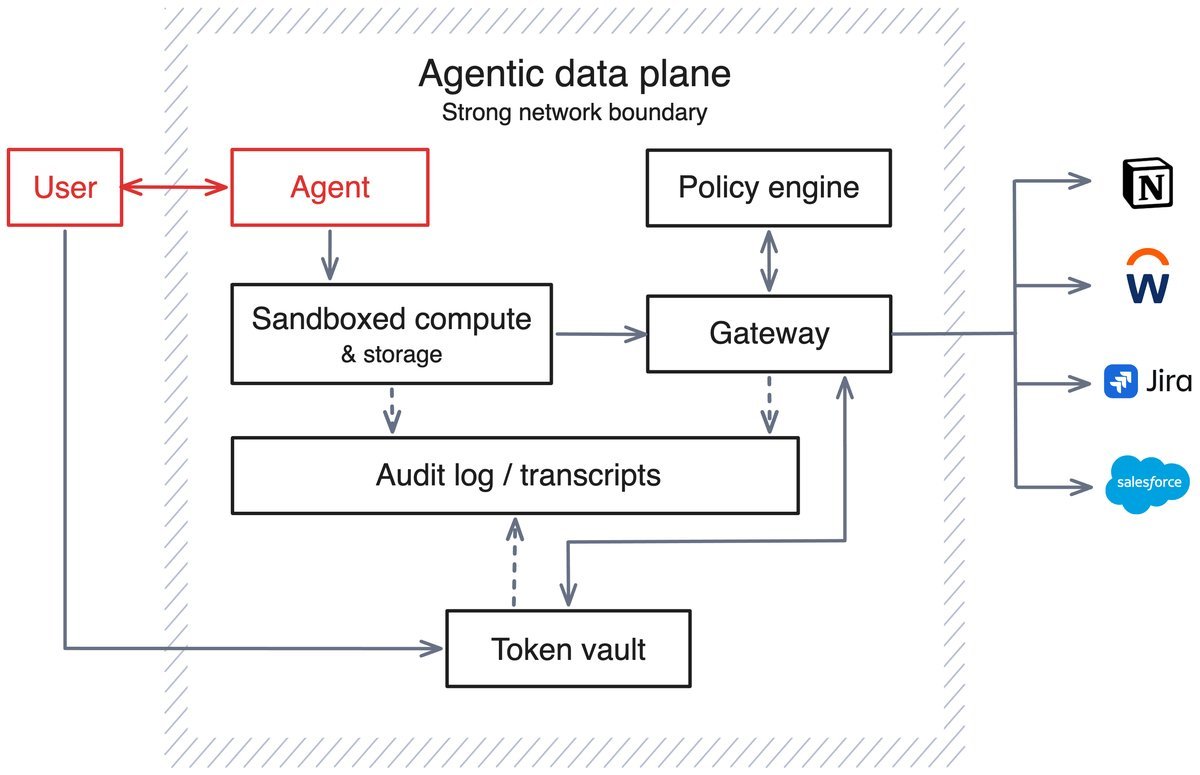
Enterprise AI agent security takes more than a sandbox. OpenClaw works well on one developer’s laptop, but a company deploying agents widely needs four things: a gateway, complete transcripts, a token vault and isolated compute that can talk only to the gateway.
The debate began with a Hacker News commenter who mocked the sandbox-first approach. Locking an agent in a box, they argued, does little when the agent also has to reach your calendar, your mail and other services to be useful. Those connections come with credentials, and a misbehaving agent can abuse them.
A single gateway for outside access
The proposed design routes every request from an agent to an external system through one gateway. It logs each tool call and model invocation, so an auditor can later trace why a loan was approved or who authored the prompt behind a production code push. Rate limits and guardrails get applied in the same spot.
The gateway also holds the emergency stop. Say an agent begins exposing Salesforce customer records. Instead of tracking API access across 27 services, an admin disables the agent in one place and covers every agent the company runs. Redpanda’s Agentic Data Plane splits the job in two: an AI Gateway for models and an MCP Gateway for tools.
Transcripts show reasoning
A log of actions says what happened. A transcript says how the agent got there. It records inputs, outputs, tool calls, token usage and the reasoning behind each step.
A guardrail judges one request or reply at a time. Transcripts let a team compare behavior across several cooperating agents and catch regressions as versions change. They also support reviews of agent quality: two similar agents get different tools for the same task, and the team compares outcomes.
Why credentials stay in a vault
An agent connected to a calendar or Salesforce usually stores credentials in a config file, often with wider permissions than the task needs. Putting that agent in a sandbox changes little, since the secrets travel with it.
A vault moves them elsewhere. The agent never sees the Salesforce token. When an action is due, the gateway requests a short-lived token limited to that single operation.
This matters for enterprise software that offers no service accounts. Salesforce and ServiceNow, for instance, accept only user-based sign-in. With on-behalf-of flows, an agent can act as a specific person, using that person’s real permissions, without holding their login. Multi-tenant agents can’t work properly without it.
Compute with one door
Sandboxes still earn their place. Employees get computers, and agents gain from them as well. Compute is a big reason Claude Code spread so fast in software teams: models reason better about tool results when they can run ordinary Unix commands on them, and a sandbox keeps that safe.
The catch is network access. The sandbox should reach nothing except the gateway, which mediates every outside interaction. Credentials arrive as out-of-band metadata linked to the agent’s identity, so the agent can do exactly what its session requires.
Redpanda built a command-line tool called agi, short for “agentic gateway interface,” for this purpose. From inside the sandbox, an agent calls the AI gateway through it. The tool describes its own commands, so an agent can find outside services and use them like any Unix program, while the gateway governs each call. Managed Agents use this pattern by default.
Where the laptop model stops working
A developer running OpenClaw on a dedicated machine with narrow access faces a manageable risk. Both the data and the agent are theirs.
Problems begin at scale. An IT team might spin up a VM per department, or a manager might decide the sandbox counts as production governance. Neither holds up. Access keys have to arrive out of band, because an agent can’t leak what it never sees.
The production baseline
That makes four required parts: gateway, transcripts, token vault and sandboxed compute. With them, developers, security teams and CIOs can actually control their agents. A sandbox limits where the agent runs, but any credential placed inside it still goes wherever the agent goes.
Source: redpanda.com