A new class of AI called decision models is getting attention from developers who are tired of waiting for chatbots to write essays. The first was Jev, released by TypeSafe AI on September 15. It doesn’t write text. It answers with a yes or no, a pick from a fixed list, or a score, and it does so in a few hundred milliseconds.
What Jev actually outputs
Jev gives back one of three things. A Noul is a yes or no. A choice picks from a set of options. A score rates something on a scale such as 1 to 5 or small, medium and large. Every answer comes with a probability, and choices and scores also get a confidence value. Jev doesn’t produce that confidence itself. It is calculated from how spread out the probabilities are.
TypeSafe AI describes the approach as fast “System One” thinking, the psychologist Daniel Kahneman’s term for quick thought that needs no effort. Slow, deliberate “System Two” reasoning is what recent language models have been getting better at.
The company hasn’t published Jev’s architecture, and its CEO says the details are being kept close. Outside observers have three guesses. It probably still uses a transformer. It isn’t autoregressive, so it returns every decision in one parallel pass instead of one token at a time. And it is trained with RLCD, short for Reinforcement Learning for Calibrated Decisions, which aims at trustworthy probabilities rather than answers people like.
Why developers care
Many applications only need a “smart if statement.” Sending a whole agent after that job means long outputs and long waits. Jev takes natural language input, and images since October 14, and returns an answer in a format you define. Output costs nothing per token because there are no tokens to generate.
Classifiers have existed for years, but each needed its own dataset and training run. Jev works out of the box through an API call. One request can sort an email into billing, technical, sales, spam or other and score the sender’s sentiment at once. Teams that used to run two models can run one.
The catch: working out of the box doesn’t mean working well for every task. A handful of evaluations on your own data is still needed.
The rivals that followed
Jev’s release set off a wave of copies:
- SemIf, formerly OpenJev, is an early open-source version built on an open-weights language model. Its probabilities aren’t equivalent to Jev’s calibrated ones.
- Laya, open source, has the same three primitives and benchmarks well against Jev. It must be fine-tuned for a domain, though, and does no better than random zero-shot.
- OpenAI’s Decisions API, announced September 29 at DevDay, runs on a GPT Luna model with a predefined set of options. Sam Altman called it an “exciting speed update.”
- Cloudflare’s Clef and Clef-flash, based on Qwen3.8-27B and Qwen3.5-9B, arrived October 1 and can be downloaded free from Hugging Face.
- Microsoft-Decision-1 is a post-train of Qwen3.5-9B.
- Liquid AI’s d1 family started with d1-3B and d1-omni-600M on October 7, then added d1-2B and d1-Omni-2B on October 27.
On benchmarks, several of these beat Jev in specific areas.
Routing agents with a single call
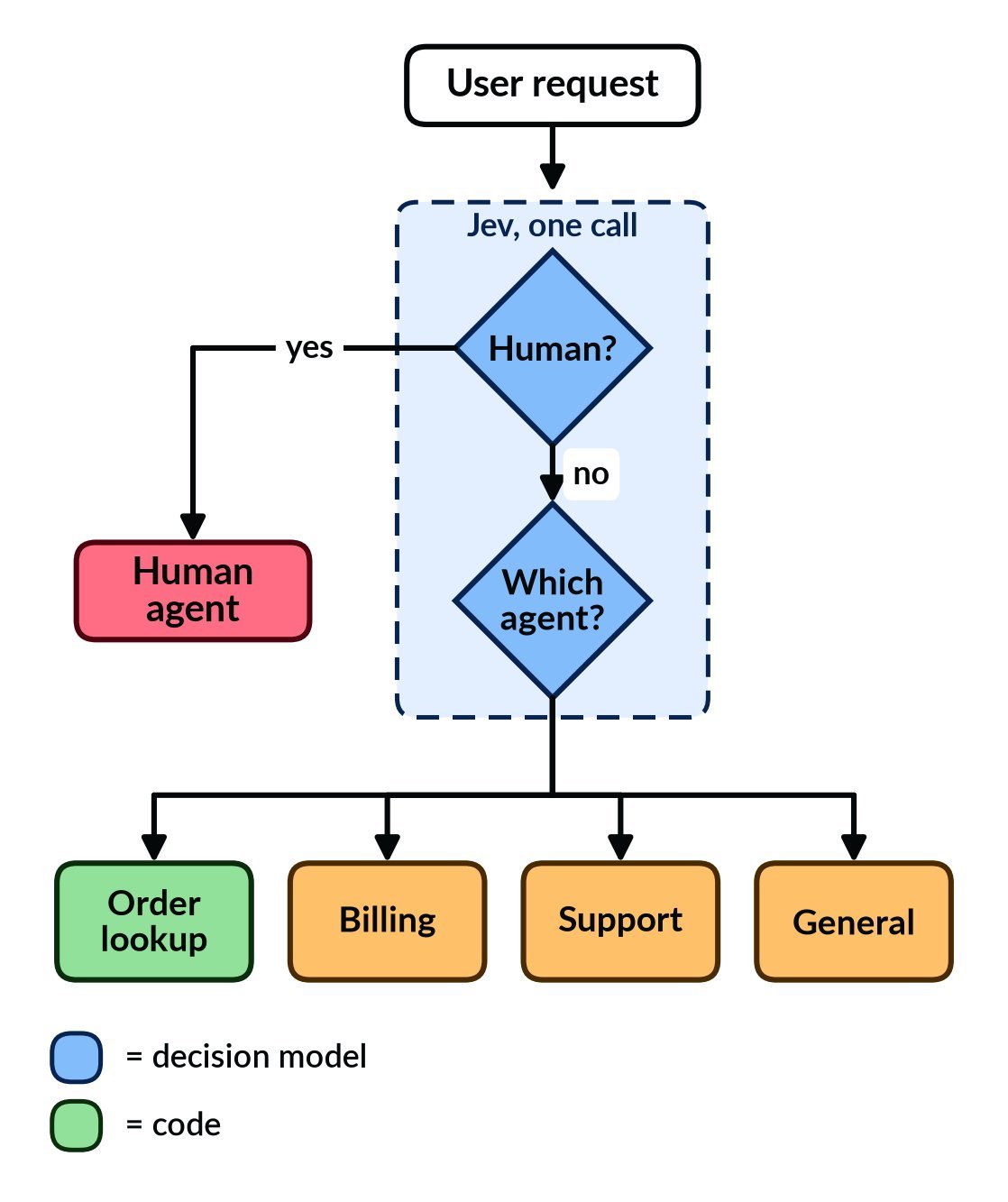
One practical use is agent routing. Today a language model often decides which agent should handle a task, which can take seconds. A decision model can answer in one call whether a human needs to step in and which agent should take over.
Four models, one Doom deathmatch
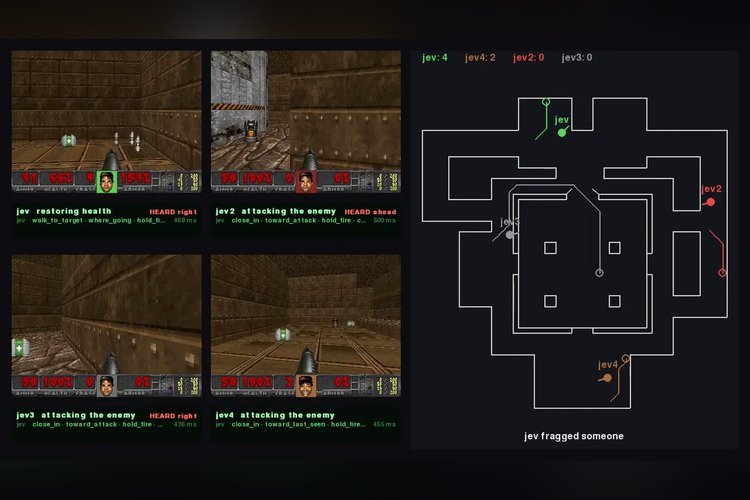
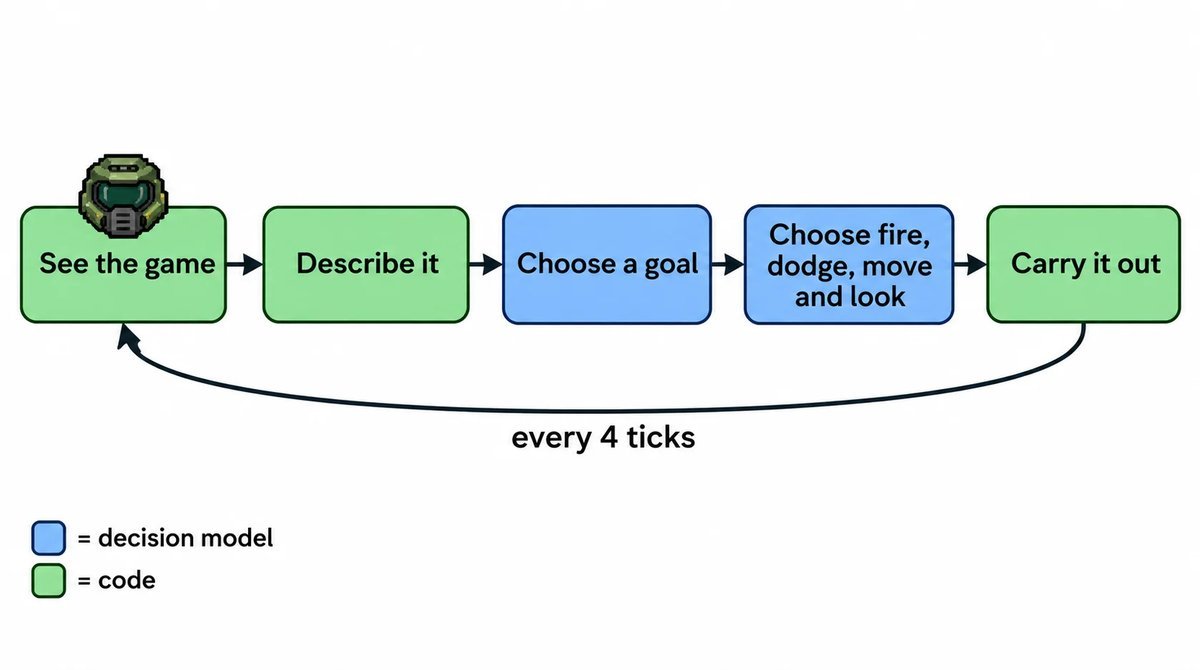
To test them, a developer wired four decision models into a Doom free-for-all using ViZDoom and Freedoom, with calls through OpenRouter. Each model got the same text description of its surroundings: health, armor, ammo, nearby enemies and items, and a short memory of what it had seen. The first version played about as badly as random. Offering higher-level options such as scout, and actions such as walk_to_target instead of move_forward, made the behavior sensible, though not championship level.
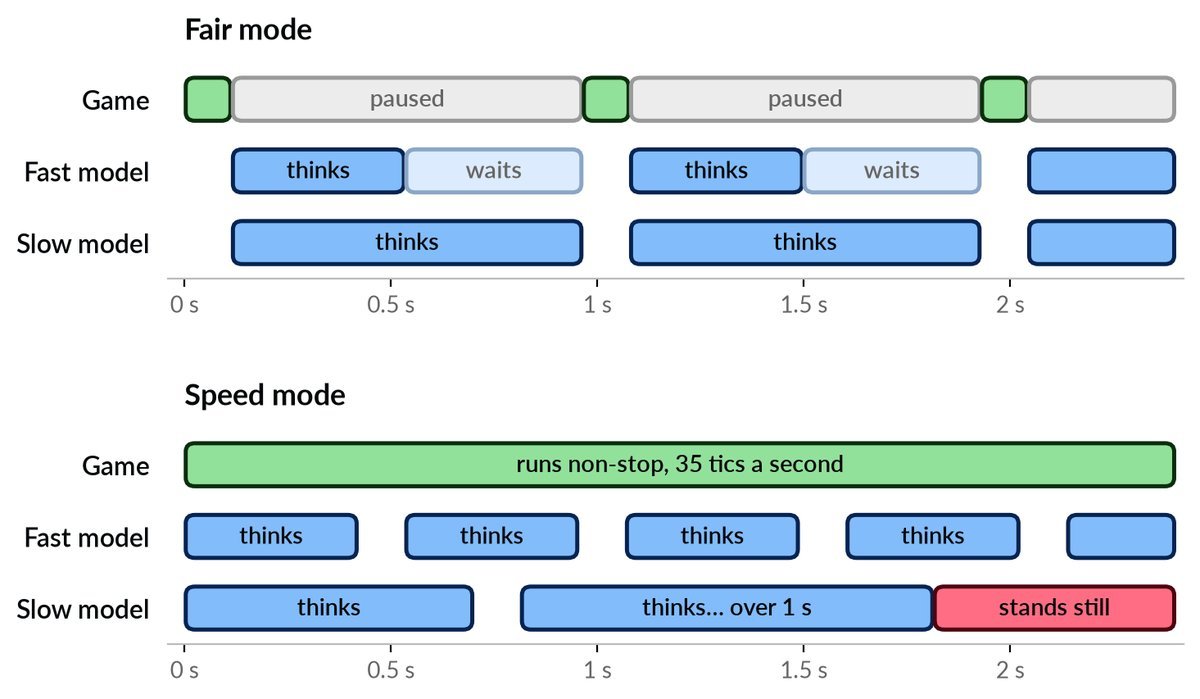
The players were Jev, OpenAI’s GPT-6 Luna, Microsoft-Decision-1 and Clef-flash. The game ran in two modes. In speed mode, play continues in real time, and a model that takes more than a second leaves its character idle. In fair mode, the game pauses every four tics (a tic is 1/35 of a second) until every model answers.
GPT-6 Luna won both. In the two-minute speed match it scored eight frags, five of them in the first half, and it was the most aggressive, closing in on enemies half the time. Jev had the lowest, steadiest latency and was the only model that never timed out. Microsoft-Decision-1 was the most cautious, with just over a third of its movement choices being a retreat. Clef-flash timed out 17 times and finished with zero frags and a match-high eight deaths.
Fair mode told a similar story. Only Luna had a kill-to-death ratio above 1. Jev only scored in the second half, and Microsoft-Decision-1, with the highest latency, scored the fewest frags. Steady latency didn’t translate into better play. The fair match took over 15 minutes of real time because the game waited on each model.
What to watch next
Doom is a stress test, not a use case. Even at a few hundred milliseconds, these models aren’t quite fast enough for constant, twitch decisions. The more likely home for decision models is the boring middle of software: triage, routing, moderation and classification. Expect more vendors to ship their own versions, and expect developers to run their own evaluations before trusting any of them.
Source: Scott Logic