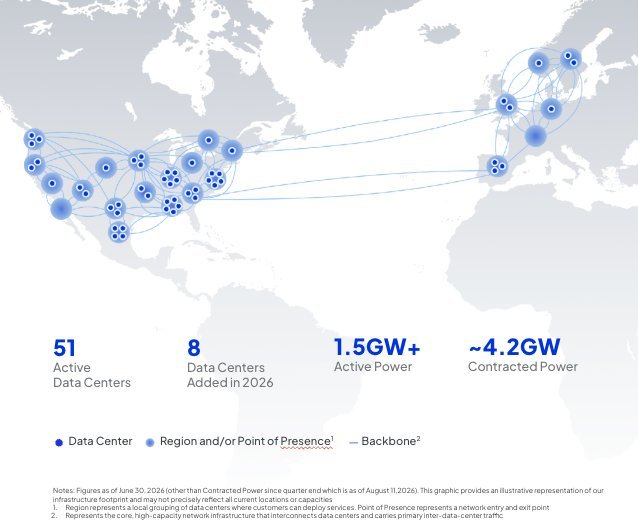
CoreWeave is building a global backbone for AI workloads, and the CoreWeave global network now links 51 live data centers in North America and Europe, eight of them added in 2026. They provide over 1.5 gigawatts of working power, plus roughly 4.2 gigawatts under contract.
New regions from Q4 2026
Expansion is the point of the announcement: the CoreWeave global network is meant to behave as one system rather than a set of separate regional clouds.
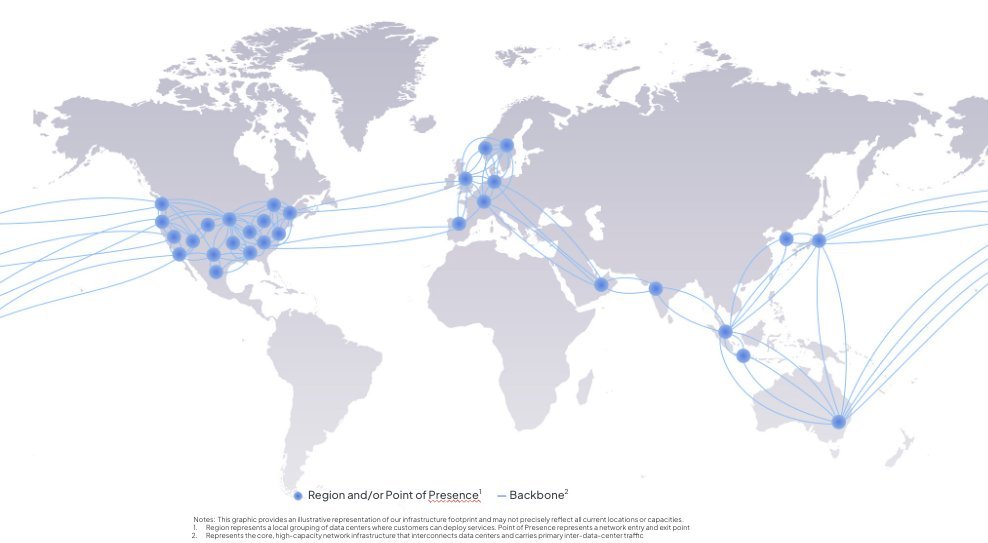
CoreWeave also unveiled a 22.5MW Copenhagen facility running on renewable energy. From the fourth quarter of 2026, new points of presence (PoPs) will open in Japan, South Korea, Australia, Singapore, Indonesia, India and the UAE, joined by land and undersea fiber.
The Indonesian PoP will connect the three sites CoreWeave revealed in August. In India, it will extend the company’s AI cloud with 240MW of capacity in Navi Mumbai. The North America and Europe portions are running today.
CoreWeave describes the result as a petabit-scale AI backbone with worldwide reach. For scale, it says that capacity could serve 4K video to 66 million viewers simultaneously. Most specialized rivals, it says, serve only a few regions.
Why AI traffic needs its own design
The company’s argument is that AI workloads move data differently from the web applications most cloud networks were designed to carry. A training job may pull petabytes from storage to GPUs in another region, and a stall anywhere along that path leaves expensive accelerators idle.
Ordinary cloud networks carry huge numbers of small, regular flows from web apps and databases. Training and inference pipelines create “elephant flows” instead, which can occupy a link for days while shifting petabytes. Data is staged near available GPUs, model artifacts are sent to deployment sites, and inference runs closer to users.
CoreWeave built around three priorities.
Speed
Many clouds still run 10 or 100 Gbps links and reserve 400 Gbps for a few edge sites. Every CoreWeave PoP instead gets several 400 Gbps connections on a single optical IP network.
Encryption
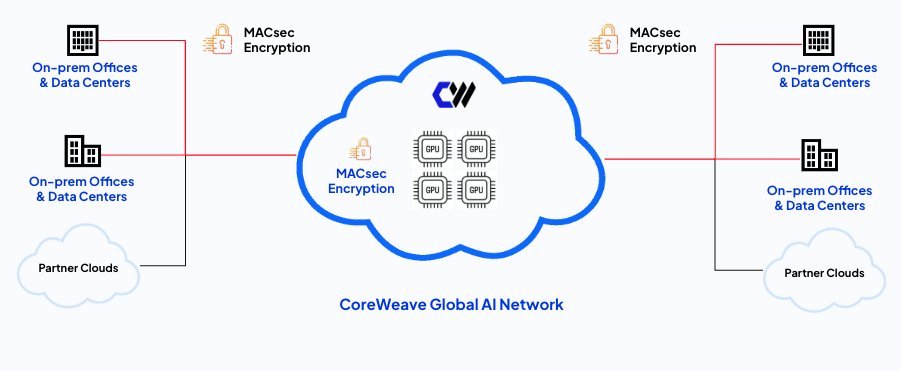
CoreWeave applies MACsec (IEEE 802.1AE) encryption in hardware on the network interface, so traffic is protected at full line rate with no software slowdown. Coverage includes backbone links between regions, Direct Connect traffic from a customer’s own network, and traffic inside its data centers. The company says other providers may support MACsec on direct connect links but not always end to end across the backbone.
Resilience
Every PoP links to a minimum of two others across four physically separate paths, and regions attach to two PoPs each. No pair of regions depends on a single route, and that covers the new Asia Pacific and Middle East links back to the Atlantic regions. When a cable or fiber route drops, traffic shifts to another path in the mesh without customers doing anything.
Linking the backbone to the GPU fabric
CoreWeave says the backbone and the in-data-center fabric work as one network. Inside a facility, the fabric is multi-plane and non-blocking, with leaf switches sized so their nodes can all run at full speed. A two-tier layout reaches as many as 128,000 GPUs in fewer hops, trimming congestion, latency and jitter.
The company points to earlier figures from this design: Model FLOPs Utilization 20% higher and 96% goodput. It adds bare-metal servers with no hypervisor cost, and LOTA in AI Object Storage, which it says speeds reads up to eightfold.
CoreWeave is candid about physics. No network beats the speed of light, it says, but it can remove avoidable delays such as jammed transfers, hand-run data staging and copy jobs that have to complete before work can begin.
What customers can do now
Current customers can watch their own traffic in the Internet Transit dashboard inside Managed Grafana. Teams limited by storage instead of transport can look at the new cross-region write acceleration in CoreWeave AI Object Storage.
The test of the CoreWeave global network comes in Q4 2026, when the Middle East and Asia Pacific PoPs are due to go live. Those routes will show whether customers can move datasets and checkpoints between continents at the speeds the company describes.
Source: storagenewsletter.com